

What Really Decides the Size of a Pool Demolition Job
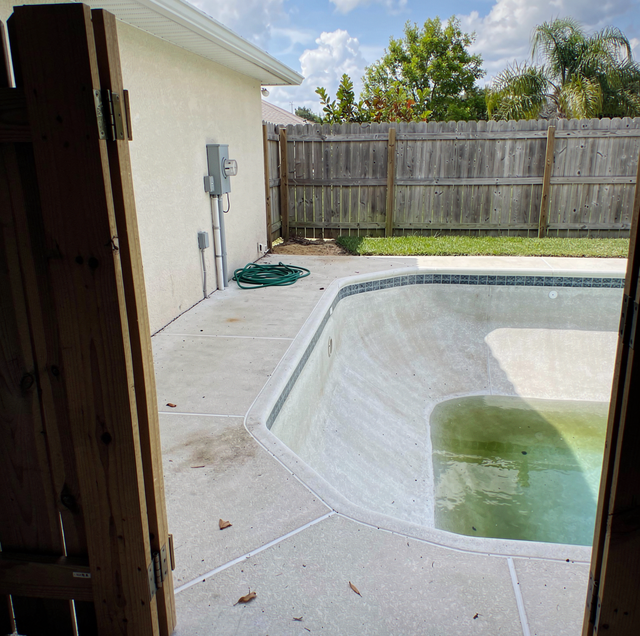
A crew can pull up to two jobs in the same week and find that two pools measuring about the same on the tape are nothing alike in the amount of work. On the first, a mini skid steer goes through the side gate and never leaves the yard. On the second, that gate is too narrow for the same machine, the heater runs on gas, and the screen cage is staying up. None of that was visible from the driveway. What determines how much work a pool demolition actually is comes down to a handful of variables a homeowner has never had reason to measure, and they interact in ways that only resolve themselves on the property itself.
Pool Size and Depth Set the Starting Scope
Length and width matter, but depth changes the job more than either. A shallow, uniform-depth pool has a shell and a cavity that behave predictably from one end to the other. A pool with a deep hopper bottom, a diving envelope, or a steep transition slope has more shell to break, more variation in how the breaker has to work the bottom, and a cavity that holds more volume once the shell comes out. Two pools with the same footprint on a site plan can differ meaningfully here, and it's one of the first things a walk-through establishes on your property before anything else gets scoped.
The Deck Is Often the Larger Half of the Job
The concrete deck surrounding your pool is often a larger surface area than the pool itself, and it's part of the same job, not an add-on. Deck concrete and coping have to be broken and removed along with the shell, and if your deck is finished in pavers, those come out too, either salvaged or hauled depending on their condition. A pool with a narrow apron of deck is a different job than one ringed by a full patio slab that extends to the fence line, even if the pools themselves are identical.
Shell Material Changes What the Breaker Has to Do
A gunite or shotcrete shell is a formed concrete structure reinforced with rebar. Getting it out means jackhammering drainage holes through the shell bottom so water can't pool underneath once fill goes in, then breaking the walls down enough to push the material into the cavity as fill. Vinyl-liner pools are usually built on steel or polymer wall panels set on a footing collar, over a vermiculite or sand floor rather than a formed shell, so there is far less concrete to break, and the walls come apart rather than fracture. Fiberglass shells are handled case-by-case, because the shell itself doesn't fracture the way gunite does and the right approach depends on your specific pool.
A broken gunite shell leaves cut rebar and jagged edges exposed before fill goes in, and a screen cage left standing overhead adds a low-clearance hazard the equipment operator has to work around for the whole job.
Access Decides Which Machine Can Reach the Yard
Every property has a narrowest point between the street and the pool, and that point decides the equipment, not the other way around. A full-size tracked machine moves material faster, but it needs a gate and side yard wide enough to pass through. Where your path is tighter, a mini skid steer is what actually fits, and it reaches yards a larger machine can't get into at all. A job on a wide corner lot and a job on a narrow interior lot can involve the identical pool and still run on two different machines with two different rhythms.
Measure at the tightest point along the entire path to the pool, not just at the gate. A side yard that narrows at an AC unit, a fence post, or a utility meter can rule out a machine the gate width would have allowed.
Utilities Have to Come Off Before the Breaker Starts
Pool equipment pads are wired and plumbed, with more running to them than most people expect: water lines, electrical circuits for the pump and any lighting, and, in some cases, a gas line feeding a heater. Each of those has to be located, disconnected, and coordinated before demolition starts, not during it. Permits, where they apply, are a scheduling item that must be cleared before the machine arrives, so they sit alongside the utility disconnects rather than after them. A pool with a simple pump and no heater clears this step quickly. One with a heater, lighting, and a salt system takes longer to get ready.
Everything Attached to the Pool Adds Its Own Step
Beyond the shell and the deck, your pool likely has a pump, filter, and possibly a heater, plumbing runs, skimmers and return jets, a salt chlorinator cell, a ladder or handrail set, and maybe a diving board on its own footing. Some properties add a screen enclosure or pool cage around the whole area. Each of those is a discrete task in the sequence, not a detail folded into the removal of the pool. A bare pool with a ladder and a single pump is a shorter list than one with a heater, a salt cell, a diving board, and a full cage.
What the Site Becomes Afterward Shapes the Finish Work
Once the shell and deck are down and the debris is pushed into the cavity, the fill gets compacted, and your site is graded so runoff drains away from the house. What that finished surface needs to support afterward changes the finish work: a future lawn, a patio or paver hardscape, and a future structure like a shed or an addition each call for a different compaction outcome. That decision gets made before fill goes in, because it's much harder to correct once your yard is graded and green again.
Debris That Becomes Fill Doesn't Leave the Property
A meaningful share of the broken shell and deck concrete remains on site as fill material rather than being trucked away, which changes what actually has to be moved off your property compared with a job where more of that material has to be hauled out. That's a real scope difference, not a minor one: it changes how much of the sequence is breaking and placing rather than loading and hauling, which is a different rhythm of work on the ground.
Why This Is a Walk-Through, Not a Photo
None of the variables above sit in isolation. A narrow side yard doesn't just rule out the bigger machine; it also changes how long your deck will take when only a mini skid steer is available. A screen cage that stays up doesn't just add a step; it also limits where any machine can be positioned inside it. A heater and a salt cell aren't just extra parts; they're additional utility connections that must be coordinated with the same disconnect window as everything else. A listing photo or a satellite image shows your pool's outline. It doesn't show the gate width, wiring, what's attached, or what your yard will look like afterward, which is precisely the set of things that actually define the scope. That's the reason this always starts with someone standing in your yard.
Frequently Asked Questions
No. Above-ground removal is a separate, simpler job with no shell demolition and no cavity fill involved, since there's no in-ground structure to break up, just the pool structure, its supports, and any surrounding deck to take down.
Yes, deck-only demolition that leaves the shell in place is its own distinct scope, separate from full pool demolition, and it's requested on its own when a deck needs to come out, but the shell is staying.
That narrows where material can be staged and where a machine can turn, which constrains the job more than the extra square footage of slab does. A deck meeting the house wall also means breaking concrete against a foundation rather than in open ground, so that edge gets worked back with a smaller attachment or by hand while the machine handles the middle.
Not automatically. A diving board footing is typically a separate, deeper concrete pour set below the surrounding deck slab, so removing it is its own step distinct from breaking up the deck around it.
Yes, and the deck is where it shows. A cage's perimeter footers sit inside the same slab band that would otherwise be broken out, so keeping the cage means the deck gets cut back to a line short of those footers rather than removed out to the fence. That leaves a border of old concrete around the footprint, which is worth settling before the saw comes out rather than after.
The service lines at the equipment pad are shut off and capped before anything starts. Buried runs uncovered during excavation are capped where they are cut. Electrical circuits feeding the pad and any gas line running to a heater are disconnected by the licensed trade beforehand, which is why those disconnects are scheduled ahead of the machine rather than handled on the day.
The variables that set the scope are mostly ones a homeowner has no particular reason to have measured: the pinch point where the side yard narrows at the AC unit, what fuel the heater runs on, whether the cage footers sit inside the slab band. None of that is unreasonable not to know. It is just not knowable from the house.
Schedule a walk-through — get an accurate scope for your pool demolition before any work starts. Polk Services LLC serves Lakeland, Highland City, and Mulberry. Call (863) 344-5806.
