

What Happens During a Pool Demolition, From Gate to Grade
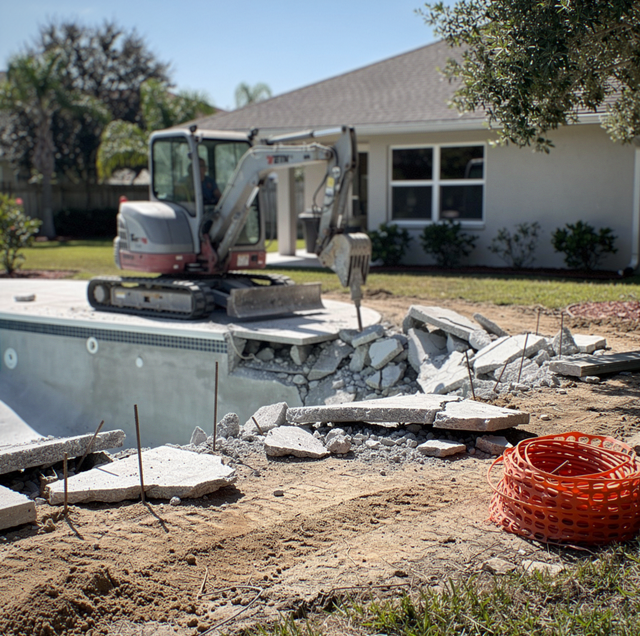
The gate swings open and the first machine rolls through, tracks chewing a shallow line into grass that was unmarked an hour ago. It idles near the old pool deck while the operator sizes up the angle, then eases forward and picks a spot to park that isn't where you would have guessed. From the kitchen window, the whole thing suddenly feels less like a project on a calendar and more like something happening to your actual yard, in real time, with a machine that, up close, is bigger than it looked as it pulled into the driveway.
The Machine Comes Through the Gate
Before anything gets torn up, the crew handles its own access and setup. A section of fence or a gate panel comes off if the machine cannot clear it as it stands, and that panel is returned to place before the crew leaves each day so the yard is not left open overnight. The crew picks a staging spot, usually the flattest open ground closest to the pool, for tools, cut material and anything waiting to be loaded out, and the machine itself typically parks along the same strip once it is done for the day instead of being driven back out through the gate each afternoon.
The path the machine takes from the gate to the pool matters more than it looks. That is the route it will drive, back up, and turn on for as long as the job runs, and it is also the exact strip of lawn that gets regraded at the end along with the pool's footprint. A wide, direct route with one turn does less damage to the surrounding grass than a route with several tight corrections, which is part of why the crew studies the approach before the first pass rather than just driving toward the pool.
Ask the crew to walk you through the planned machine route before work starts. Knowing which strip of lawn is the working path, not the whole yard, makes the mud and tire tracks on day one far less alarming.
The Loud Days: Equipment, Deck and Shell
Pool equipment comes out first and separately from the structure itself: the pump, filter, heater, salt cell if the pool has one, skimmers, returns, ladders, handrails, and a diving board if present, all cleared and hauled off before the machine touches the shell, with the board's footing coming out later as a separate deeper pour alongside the deck, with the power and any gas feed to the pad disconnected by the licensed trade beforehand. Only after that do the deck and coping come up, and this is where the job turns loud. A hydraulic breaker or jackhammer attachment works the concrete in sections, and that percussive hammering is the part that carries. From inside the house with the windows shut, it reads less like construction noise and more like something rhythmic and mechanical happening just past the wall, on and off through the working day, never continuous.
Cutting and breaking are kept wet; water runs over the blade or breaker tip as it works, knocking down dust that would otherwise drift with every pass. Once the deck is clear, the machine works the walls down section by section. A standard in-ground pool with a moderate deck runs roughly 48 to 72 hours of active work start to finish; a larger pool, difficult access, or a deck with a lot of hardscape attached stretches that further, since more material simply takes more passes to clear. Those are the days worth planning around if you work from home or have a light sleeper on a nap schedule, since the noise is concentrated rather than spread evenly across the whole job.
Where the Debris Goes
Broken concrete and old material do not leave the property immediately upon generation. They get staged in a cleared area, usually near the machine's route and not scattered across the yard, and sorted as the pile grows: rebar and metal pulled aside, clean concrete kept separate from mixed debris, anything reusable set apart from what is headed out. Pavers and natural stone coping are handled on a case-by-case basis, and if there is material worth keeping, saying so before the crew starts means it gets set aside rather than loaded out with everything else.
A screen enclosure, if the pool has one, comes down around this same stretch of the job and gets sorted the same way, framing separated from mesh rather than hauled off as one mixed load. Debris that leaves the site does so in batches, not in a single trip, and the more that gets loaded and hauled out rather than staged for reuse in the fill, the more movement in and out of the driveway you will notice over the course of the job. Material that is reused in the cavity never has to leave the property at all, which is one reason two demolitions of similar size can involve noticeably different numbers of trips through the gate.
Filling, Compacting and Grading the Footprint
Once the shell is broken down, the cavity gets filled in layers rather than all at once, each layer compacted before the next goes on top. After the footprint is built back up to grade, the machine's entire route is reworked, not just the hole itself. The staging area, the turning spots, the tracks by the gate: all of it gets graded along with the pool's footprint so the yard reads as a single, continuous, even surface rather than a smooth patch ringed by disturbed ground. This is usually the point where the property stops looking like an active job site and starts looking like a yard again, even before grass is established on the reworked ground.
Rake-Clean and What's Walkable When
Rake-clean is the final step after grading, not a cosmetic pass tacked on early. The crew goes over the graded area removing loose stone, small concrete fragments, and construction debris that grading alone does not catch, because that is what a first walk across bare soil turns up otherwise.
Different parts of the yard become usable at different points, not all at once. Areas outside the machine's route and the footprint are typically walkable through the job, since they were never disturbed to begin with. The footprint itself and the strip the machine drove are a different story: graded and raked clean, that ground is still loose worked soil and will not take weight the way established lawn does.
The machine's route and the staging strip are where ruts reappear first. Both were compressed by tracks and then loosened again by the finish grade, so they move under weight long after the footprint itself has settled.
Frequently Asked Questions
No, it goes out on a different path. Pump housings, filter tanks, heater cabinets, and salt cells are mixed materials, so they are separated for scrap routing instead of going out with the rubble. Pump housings and heater cabinets are also the bulkiest single items to come out of a backyard, which is why they leave on the first pass rather than waiting for the debris runs.
Pavers set in sand lift cleanly and stack, so those are worth asking about. Coping is different: it is bonded to the beam it sits on and breaks as that beam comes out, so it does not survive salvage. Tell the crew where a paver stack should go before the deck comes up, because a pallet left in the machine's route has to be moved twice.
It comes down early, before any machine can position itself within the cage footprint, because there is no working room under a standing cage. Mesh and framing are separated on site as it comes apart. The sequencing is the part worth knowing: the cage goes before the deck, so the first day of visible progress is often the enclosure disappearing rather than any concrete moving.
The crew typically connects a hose to an exterior spigot near the work area, so you do not need to supply anything beyond access to one. If there is no spigot near the pool, mention it when scheduling the job so the crew can plan around it.
Water suppression knocks down most of it at the source, but wind can still carry fine dust onto a nearby patio, walkway, or parked car during the loudest days. A hose-down once that phase is done clears it.
Work stops at that point rather than continuing around it. An unmarked irrigation lateral or a low-voltage run is cut cleanly, and the ends are left visible above the fill rather than buried, so whoever reinstates it can find them without reopening the footprint. Anything that looks like a service rather than a yard line is left alone until it has been identified.
The morning after the crew is gone, the driveway is empty, the fence panel is back in its track, and the tracks along the machine's route have been graded into the rest of the lawn. Where the pool used to sit is a level, raked-clean stretch of bare soil, flush with the yard around it down to the edge of the route the machine drove. Standing at the same kitchen window, it takes a second to place exactly where the water line used to be.
Book a pool demolition walk-through — see how the job would run on your property before anything is scheduled, including pool demolition in Auburndale. Polk Services LLC serves Lakeland, Highland City, and Mulberry. Call (863) 344-5806.
