

DIY Yard Leveling: Why "Flat" Can Backfire on Drainage
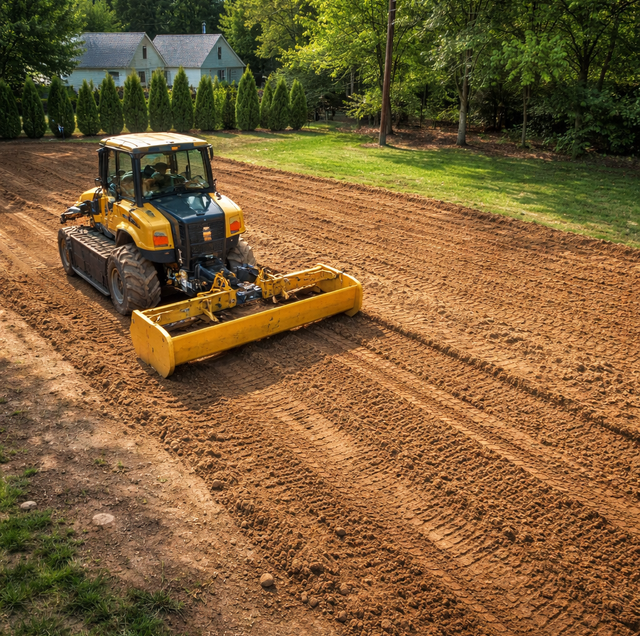
Quick Answer: A rented box blade or laser level can cut a yard mathematically flat, and flat isn't graded. Without a fixed reference point and a planned elevation, a DIY pass can remove the fall water needs or tip ground back toward the house.
You rent a box blade, hook it to a compact tractor's three-point hitch (or tow a lighter ATV-rated drag harrow if the yard's small enough that a full box blade is overkill), and drag it across the yard until the humps are gone and the low spots are filled. It looks good from the porch. Then it rains, and water sits in places it never used to, or worse, it creeps toward the foundation instead of away from it. The equipment worked exactly as designed. The problem is what "level" was set up to do, versus what the yard actually needed.
Flat and graded are not the same goal. A yard that's dead-level has zero slope in every direction, which means gravity has nothing to pull water toward. A yard that's properly graded has a planned, gentle fall that moves water off the property on purpose, in a chosen direction, toward a spot that can actually handle it. Renting equipment and running it until the ground "looks even" gets you the first outcome. It rarely gets you the second, because nobody set a target elevation before the first pass.
What a Rented Box Blade or Rake Attachment Does
A box blade is a scraper: two side plates, a set of teeth or a straight blade across the bottom, pulled behind a tractor. It cuts high spots, carries loose soil in the box, and dumps it into low spots as you drive. A rake attachment does something similar with a spring-tine or bar-tooth head, better for pulling debris and breaking up clumps than for precision cuts. Both attachments follow the ground they're riding on. The blade rides on skids or the tractor's own tires, so it responds to whatever contour is already there, not cutting toward a number you decided on ahead of time.
That's fine for smoothing a rough patch. It's not fine for setting drainage, because the blade has no idea where the house is, where the property line sits, or which direction water is supposed to travel. It only knows "higher than the box" and "lower than the box." Left to run without a reference, it tends to average the ground out, planing the humps down and the dips up until everything reads close to flat on a level or a laser receiver. That's the trap: the tool's default output is flatness, and flatness is the opposite of what a drainage-conscious cut needs.
A box blade or rake cuts several inches into topsoil, deep enough to catch shallow sprinkler lines, invisible-fence wire, or a buried utility lateral. Call 811 before any grading pass, even one you'd call minor, and wait for lines to be marked.
Why Cutting to Dead-Level Removes the Fall Water Needs
Think about what a puddle actually is: water sitting on ground that has nowhere lower to go within reach. If the surrounding grade has some consistent pitch, water sheets toward the low side and keeps moving until it reaches a swale, a drain, or the street. If the grade reads zero on a level, water has no direction. It spreads out, soaks in where the soil allows, and stands everywhere else, because gravity isn't wrong; there's no downhill for it to follow.
A homeowner running a box blade to "get it flat" is often chasing the wrong instrument. A four-foot level or a phone's bubble app confirms that one short section reads even. It says nothing about whether the yard, over its full 60- or 100-foot run, is trending consistently toward a low point that can carry water away. You can make every four-foot section read flat and still end up with a yard that has no working slope at all, which is functionally worse than the bumpy, unleveled ground you started with, because the humps and dips at least broke up standing water into smaller puddles that could evaporate or soak in independently.
The Backward-Pitch Trap: When Leveling Tips the Yard Toward the House
The riskier version of this mistake isn't neutral flatness; it's a grade that ends up tilted the wrong way without anyone noticing. It happens for a mundane reason: a box blade towed behind a small tractor doesn't cut evenly on every pass. The operator angles the blade slightly differently near the house, where there's less room to maneuver, than out in the open, in the middle of the yard. A few passes closer to the foundation end up shaving a bit more off, or a bit less fill gets dropped there because it's harder to back the tractor in tight. The result is a few feet of ground next to the slab that sits lower, relative to the yard behind it, than it did before the "leveling" started.
That kind of dip is easy to miss by eye. It doesn't have to be dramatic. A relative drop of even a half inch over a ten-foot run next to the foundation is enough to hold water against the slab during a heavy rain instead of shedding it away, especially in soil that's slow to drain. The homeowner who just spent a weekend and a rental fee getting the yard "flat" has made the drainage worse than before they started, in the one location it matters most.
The Missing Step: Setting a Benchmark Before Any Dirt Moves
The difference between a leveling job that helps and one that hurts almost always comes down to one step that happens before the equipment ever touches the ground: establishing a benchmark. A benchmark is a single fixed, known point that every other elevation on the site gets measured against, something permanent that won't shift, like a mark on a foundation stem wall, a manhole rim, or a driven stake set below where any grading will reach. From that one point, a rotary laser level and a grade rod (or, on a smaller job, a story pole and a line level strung between stakes) let you read the actual elevation at the foundation, at the middle of the yard, and at the property line or drainage outlet, before you cut a single pass.
Once those readings exist, the plan writes itself: pick a target elevation at the house that sits above the surrounding ground, pick a lower target at the point you want water to exit, and now every pass of the box blade is cutting toward a number instead of toward "looks even." That's the entire difference between grading and leveling. Grading starts with a plan for where water ends up. Leveling, done the way most rental jobs are done, starts and ends with the tool's own bubble reading zero.
A rotary laser level rented for a weekend, paired with a grade rod, can read elevation differences across a full yard to within about a quarter inch, tight enough for residential drainage work without hiring a survey crew.
The Second Trap: A Single Pass Doesn't Compact the Soil
Even a homeowner who correctly references a benchmark runs into a second problem that has nothing to do with slope: a box blade or rake attachment loosens and redistributes soil; it doesn't compact it. Dragging fill into a low spot leaves the fill fluffed up, full of air pockets, at maybe 70 to 80 percent of the standard maximum dry density (the lab benchmark compaction specs are measured against), instead of the 90-plus percent a properly compacted subgrade needs. It looks flat and firm on the day you finish, because dry, loose soil holds its shape until something disturbs it.
Then it rains. Water works into those air pockets, the loose material settles under its own weight and the weight of the water sitting in it, and it settles unevenly, because no two spots got the same amount of fill or the same soil texture. A section that was flush with the surrounding grade in October can be an inch or two lower by the following spring, not from erosion, but from the fill simply finding its true density for the first time. That new low spot becomes the yard's newest puddle, in a place that never held water before the "improvement" job.
The fix a lot of DIY leveling skips isn't complicated; it just takes another rental and another pass. After grading and lightly watering the fill to help settle it, running a vibratory plate compactor over it in thin layers, an inch or two at a time rather than one thick lift, gets the soil close to its final density before grass or sod ever goes down. Keep the compactor moving in a straight, controlled line rather than working a slope or a soft edge where it can get away from you, and never reach under or beside it while the plate is running. Skipping the compaction step entirely is what turns a good afternoon's work into a yard that needs redoing by summer.
It's a bit like painting over a wall that still has a soft patch of drywall mud underneath. The paint looks perfect on day one. Press on it a few weeks later, once everything has had time to cure and settle, and the flaw underneath shows through exactly where it always was.
How a Grading Crew Plans the Cut Before Moving Any Dirt
A crew doing this professionally treats the site survey as the actual job, not a formality before the real work starts. That means walking the property to note where downspouts discharge, where a neighboring lot's runoff already crosses the line, and where the soil itself changes, because a sandy stretch that drains fast and a compacted clay pocket that doesn't will behave completely differently even after they're cut to the same elevation. Only after that does the plan settle on a target finished elevation at the foundation, a slope direction, and an exit point, expressed as a cut-and-fill plan the equipment operator can actually follow pass by pass.
The equipment itself isn't the difference-maker. A skid steer with a laser-guided grading attachment can hold elevation far more precisely than a towed box blade, because the hydraulics respond to the laser receiver in real time rather than riding whatever contour is already under the machine, but even that equipment can produce a bad result without a plan behind it. The plan is what turns "moving dirt" into "grading."
What to Do If You've Already Rented the Equipment
If the yard has already been leveled and the puddling is worse, the ground doesn't need to be torn up again from scratch. Start by checking whether the grade near the foundation reads level or, worse, tips inward, using a string line and a line level stretched from a fixed point on the house outward. If it does, that section needs fill and a re-cut toward a real target elevation, not another all-over leveling pass. If the low spots are scattered through the middle of the yard instead, that's more likely the loose-fill settling problem than a slope problem, and it usually responds to targeted fill and compaction in just those areas rather than regrading the whole lot again.
Either way, treat that walk-and-check as the real diagnostic step, the one regrading always starts with, rather than reaching straight for another all-over leveling pass.
Frequently Asked Questions
Yes: drive two stakes at opposite ends of the run you're worried about, tie a mason's string tight between them at the same height on each stake, and hang a line level on the string's middle. A taut string with a line level shows you the trend across the whole span at once, instead of the 48-inch snapshot a standard level gives you one placement at a time, so you can see a slow drift toward the house that a short level would miss entirely between readings.
Give it at least two or three real rain events, not a single garden hose test, and ideally four to six weeks of normal weather. Freshly loosened fill from a box blade or rake can look and drain well while it's still dry and fluffed up, but it will pond only after it's had enough moisture cycles to settle into its true, denser shape.
Generally, yes, and on newer machines the gap is wider than just operator control: some grading attachments now pair with GPS or laser machine-control systems that automatically adjust blade depth to hold a programmed slope, rather than requiring the operator to chase a laser receiver by eye, pass after pass. A towed box blade has none of that; it rides on skids that follow whatever ground is already under it, which is exactly what lets it average high and low spots toward flat instead of cutting toward a chosen slope.
A benchmark is a fixed, permanent point, like a mark on a foundation stem wall or a driven stake set below the grading depth, that all other elevation measurements on the site reference. Because equipment traffic can easily knock over or bury a single stake, crews commonly set a second "witness stake" a few feet off to the side with an offset distance and direction written on it in permanent marker, so the original benchmark can be re-found and re-checked even if it gets covered or clipped partway through the job.
Scattered small dips through the middle of a leveled area, rather than one clear low side, usually point to uneven fill settlement rather than a slope error. A quick field check: dig a shallow 6-inch test hole in two or three low spots. Soil that comes out loose and crumbly, with no real resistance to a shovel, confirms unsettled fill; ground that's firm and hard to dig into points instead toward a genuine slope problem that a leveling pass never actually corrected.
A vibratory plate compactor, run in thin layers of an inch or two at a time rather than compacting one thick lift all at once, gets loosened fill much closer to its final density before it's covered with sod or seed. Get the moisture right before you start: grab a handful of the fill and squeeze it; soil that holds together in a ball but crumbles when you poke it is at roughly the right moisture for compaction, while soil that stays dusty and won't hold a shape at all is too dry and will resist the compactor instead of settling under it.
Getting the tool right is only half of it. The other half is knowing where the water is supposed to end up before the first pass ever cuts into the ground, and that's the step a weekend rental almost never includes on its own.
Have your yard's finished grade planned and cut correctly the first time — a target elevation and slope direction set before any dirt moves, not just a flat-looking pass. Polk Services LLC serves Lakeland, Highland City, and Mulberry. Call (863) 344-5806.
