

Dry Well or Sump? The Real Test Before You Dig
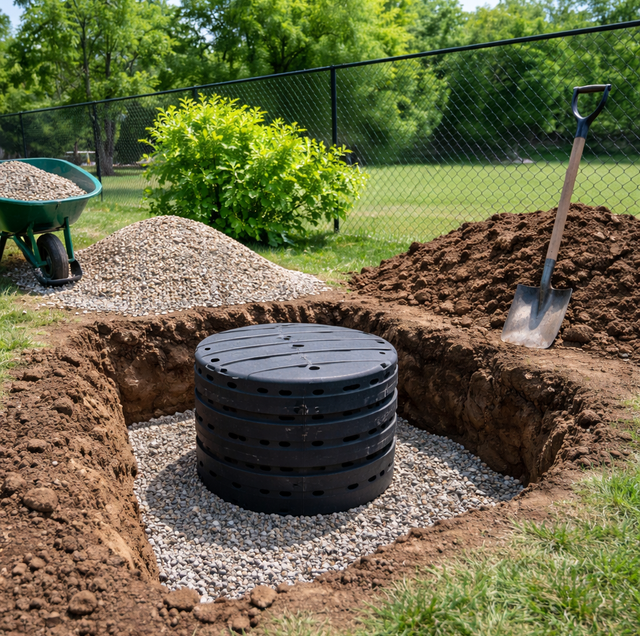
Quick Answer: A dry well only stores and releases water into surrounding soil; it doesn't add drainage capacity the soil lacks. It works for one isolated low spot with decent-draining soil. Sheeting water across a lawn is a slope problem no single hole fixes.
A lot of yard-drainage advice online boils down to "dig a hole, fill it with gravel, done." Sometimes that's exactly the right call. Sometimes it's a few hours of digging that buys you two dry weeks and then the same puddle shows back up, usually right after the next real storm. The difference isn't luck. It comes down to whether the hole was ever built to handle the amount of water actually arriving at that spot, and whether the problem was ever a single spot to begin with.
What a Dry Well or Sump Does
A dry well (some people call it a gravel sump, others a rock pit) is a hole dug below a low spot and backfilled with clean, washed gravel, sometimes with a perforated plastic barrel, a milk-crate-style structure, or a manufactured drainage chamber set inside it instead of solid rock. Water runs into the hole, fills the space between the gravel (or inside the chamber), and then percolates outward through the surrounding soil over the following hours or days.
That's the entire mechanism: temporary storage plus slow release. It's the same idea as a bucket set under a slow drip: the bucket doesn't make the drip stop, and it doesn't change how fast the water is falling; it just holds it somewhere else until it has time to go away on its own. A dry well does the same job for runoff, buying the soil time to absorb water it would otherwise have to accept all at once on the surface.
That distinction explains both when a dry well earns its keep and when it can't possibly work. A dry well never increases how much water your soil can absorb per hour; it only delays when that water reaches the soil, spreading a heavy pulse of runoff over a longer window so the ground can keep up. If the soil around the pit is already slow to drain, storing water there for a few extra hours doesn't change the math; the water still has nowhere to go once the gravel voids fill up.
Why a Backyard-Dug Pit Usually Undersizes the Problem
This is where most DIY dry wells fail, and it's rarely about digging in the wrong place. It's a volume problem. A typical hand-dug sump, roughly 3 feet across and 3 feet deep (about 21 cubic feet), backfilled with gravel that's maybe 35-40% space (voids between the rock), holds somewhere in the neighborhood of 55-65 gallons before it's full. That sounds like a lot until you do the runoff math: a single downspout draining a modest roof section during a heavy storm can shed hundreds of gallons in under an hour. A paved patio or a sloped section of driveway sheeting toward that same low spot adds more on top of that.
Before digging any pit deeper than a few inches, call 811 to have gas, power, water, and communication lines marked. A hand-dug hole can hit a shallow line just as easily as a machine can, and marking is free.
Once the gravel voids fill, the pit stops accepting water the same way a full bucket stops taking more drips; it overflows at the surface. From the outside, that looks exactly like the original puddle, just delayed. Worse, a pit that stays saturated between storms because it's undersized becomes a standing-water reservoir a few inches under the lawn, which invites mosquitoes and softens the ground around it rather than fixing anything.
Sizing a dry well correctly means working backward from the contributing area: how many square feet of roof, pavement, or sloped lawn actually drains to that point, and how quickly the surrounding soil can absorb water once it arrives. Undersizing is the single most common reason a DIY pit "stops working" after a season. It rarely stopped working. It was never built to hold that much water in the first place.
When a Point-Catch Fix Is the Right Call
A dry well or sump is a solid tool in a specific, narrower situation than most people assume: one isolated low spot, fed by a limited, identifiable source of water (a single downspout, a short run of paved walkway, a small depression in an otherwise level yard), sitting in soil that drains reasonably well once it gets the water. If the rest of the yard sheds water well and this one dip is the outlier, catching that water where it collects and giving it somewhere to go makes sense. You're not fighting the whole lot's slope; you're patching one weak point in an otherwise functional grade.
The soil test that matters here isn't complicated: if a hole dug a couple feet down in that spot drains within a few hours after a hard rain, the ground around it can accept water once it's given the chance. A dry well sized to the actual volume feeding it, set in soil like that, does exactly what it's designed to do.
When the Real Problem Is the Whole Lot's Slope
The dry well approach falls apart the moment the "low spot" isn't really a spot at all; it's the low end of a slope that runs the wrong direction across a much bigger stretch of yard. If water sheets across ten, twenty, or fifty feet of lawn every time it rains, arriving from multiple directions rather than one identifiable source, no reasonably sized pit is going to keep up with it. You can dig it as deep and wide as you want, and it will still be overwhelmed the first time a real storm hits, because the volume of water crossing that much ground during a downpour is an order of magnitude more than any single backyard pit was ever built to store.
The tell is usually pattern, not just puddle size. One dry well candidate: a single wet patch near a corner of the house, downspout draining right into it, rest of the lawn dry. A regrading candidate: water tracking across most of the backyard toward a fence line, or pooling in two or three separate low areas that all seem to be part of the same overall low side of the property. When the water's arriving from everywhere rather than one place, the fix has to change the shape of the ground itself, cutting and filling to re-establish a consistent fall away from the house and toward wherever the water is actually supposed to exit the property, not catch the water after the fact at one point.
Regrading also solves a problem a dry well structurally can't: it stops water from crossing areas you don't want it crossing, rather than giving it somewhere to collect once it's already there. That's usually the more durable fix on a lot-wide slope issue, even though it's more work up front.
Soil Type Decides Whether a Dry Well Can Work at All
Even a correctly sized dry well depends entirely on what's around it. In sandy, fast-draining soil, water percolates outward from the pit walls at a decent clip, and the storage-plus-slow-release mechanism functions as intended. In dense clay or heavily compacted soil, that same pit holds water fine, but the surrounding soil barely lets it back out, so the pit stays full between storms and adds no real capacity. A dry well dug into clay isn't wrong in concept; it's just working against soil that was never going to cooperate.
A high water table creates a similar dead end from a different direction: if groundwater sits close enough to the surface that the pit bottom is already wet before it rains, there's no dry soil left below it to accept anything. In either case, the fix stops being "dig deeper" and becomes changing the surface grade so water is carried to a spot that can actually accept it, or off the property entirely.
Reading Your Yard Before You Decide
Walk the property during or right after a hard rain and pay attention to two things: how many separate places are holding water, and where each one is getting its water from. One wet spot with an obvious, limited source (a downspout, a short paved run) fed by soil that drains once given time is a dry well candidate. Multiple wet spots, or water visibly moving across a long stretch of lawn from several directions before it pools, points to a grade problem that a point-catch fix won't touch — that pattern is the signal to stop digging test holes and get the whole lot's slope looked at instead.
Frequently Asked Questions
Yes, and it's common on properties with a mix of problems: a French drain intercepts and carries water along a line, then daylights or discharges into a dry well or a lower area rather than dumping it at the surface. The two work in sequence rather than competing; the drain moves the water, and the well gives it somewhere to go once it arrives.
There's no fixed number; it depends on how deep you have to dig before the soil starts draining well. What matters more than depth alone is getting below any compacted fill or clay lens near the surface and into soil that will actually accept water; sometimes 2 feet is plenty, sometimes going deeper is pointless because the soil doesn't improve with depth.
No pipe is required for a basic gravel-only pit, but swapping some of the gravel for a perforated barrel or a manufactured plastic drainage chamber (sometimes sold as an "infiltrator" or rain-garden chamber) buys more storage in the same hole: those chambers run close to 90-95% open void space, against roughly 35-40% for loose gravel, so the same 3-foot pit can hold two to three times the water before it fills.
If it's undersized or the soil around it won't accept water fast enough, yes, water can surface and travel downhill exactly like it would from any other overwhelmed low spot, and an overflowing pit near a property line sends that water straight onto whatever sits downhill of it. Sizing and placement matter for that reason as much as for fixing your own puddle.
Sediment carried in with runoff, especially from a downspout without a gutter guard, settles into the gravel voids over years and reduces storage volume year after year, part of why a well that worked fine initially can perform worse a few years in. A layer of filter fabric between the topsoil and the gravel, replaced every several years, keeps fines from washing into the rock and extends the structure's working life.
Run a rough number instead of guessing: a hard rain drops roughly 60 gallons for every 100 square feet of roof or pavement that sheds to one point per inch of rainfall, so a 300-square-foot section of roof or driveway draining to your low spot can deliver close to 180 gallons in a single one-inch storm. Pace off the roof and the paved area that visibly slopes toward the spot, multiply, and compare that number with the pit size in the sizing section above before deciding whether a small dry well can keep up.
Digging a hole and filling it with gravel isn't a wrong instinct; it's a specific tool for a specific job. When the water source and the soil around the pit line up, it earns its place. When either one is off, the same shovel work that should have solved the problem moves the puddle a few feet and delays it by a day.
Get a free grading assessment — find out whether your low spot is a grading problem or a point-drainage problem before you start digging. Polk Services LLC serves Lakeland, Highland City, and Mulberry. Call (863) 344-5806.
