

A Pool Close to the House Changes How the Work Is Done
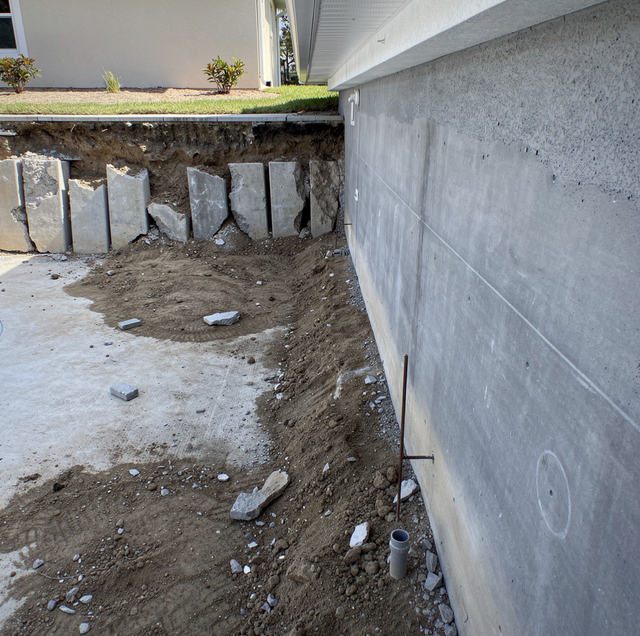
A pool wall and a house footing are two structures bearing on the same ground. The shell has been holding back the soil on its side of the yard for as long as the pool has existed. The footing sits in soil that extends uninterrupted to the outside face of the shell. Take the shell out and the ground on that side loses something it had been resting against.
Where the two are close enough, that shared ground is the mechanism, and it is why a pool near a structure is a different piece of work from the same pool in the middle of an open lawn. How close is close enough is not a question this article can answer, which is why everything below is about method rather than measurement. The concrete is the same concrete, and the steel is the same steel. What changes is how much ground gets disturbed, from which direction, in what order, and with what tool.
Two Structures Bearing on the Same Ground
A gunite shell is a retaining structure whether or not anyone thinks of it that way: water on one side, soil on the other, and a wall in between keeping the two apart. When the wall goes, the soil that was resting against it has nothing on that side until fill takes its place. In an open yard, that transition passes without comment, because nothing nearby is affected by it.
Close to a house, the same transition happens in the ground the structure's own footing occupies. How much that matters at a given property is not knowable from a photograph or a phone call; it is assessed on site by looking at what is actually there. What is settled in advance is the response. On that face, the work gets organized around moving as little ground as possible and leaving it unsupported for as short a time as possible. Every method choice below follows from those two goals.
A pool that sits close on one face is usually open on the other three. Most of the job runs the same as any other removal, and only the tight face changes method, tooling, and order of work.
Opening Ground Outside the Wall Is What Gets Avoided
In an open yard, the machine has room on all four sides. It works the walls down from above and from outside them, taking bites where it can reach, and the broken concrete drops into the cavity where it will stay. Getting a good angle on a wall usually means opening a little ground outside it, and in a yard with room that takes nothing but a few passes.
On the house side, opening ground outside the wall is the one thing to avoid, because the only place to open it is against the structure. Planning runs backward from that: whatever cannot be reached without disturbing ground on the house side has to be reached from somewhere else, with something else, at a different point in the day. That single constraint shapes a tight-site pool demolition more than anything else does.
How the Method Changes as the Gap Narrows
Four things change, and they change progressively. A comfortable gap changes almost nothing about the work; a narrow one changes all four.
Where the machine sits: The tracked machine works from the open side and reaches across the cavity to the far face, rather than walking the perimeter and attacking each wall from the outside. Reach does the work that repositioning would otherwise do. Which machine can get to the open side at all is a question of access, which determines the size of a pool demolition job.
What touches the near face: The large hammer that makes short work of a wall in open ground gets swapped for a smaller attachment, and on the tightest sites for hand tools. Slower, quieter, and far more controlled about where the energy goes.
Which direction material moves: Concrete on that face is broken inward, into the cavity, and the pieces are pulled away from the structure instead of being pushed toward it.
When the near wall comes out: Frequently last. Leaving it standing while the rest of the shell and the deck come out keeps the ground on that side supported through most of the job, and it shortens the window between that wall coming out and fill going back against the same ground. The usual order of operations is set out in the step-by-step process of a pool demolition; on a tight site, that order gets rearranged around this one face.
Vibration Carries Through Ground and Structure
A hydraulic breaker does not act only on the concrete it is touching. Energy travels out through the ground and into anything founded in it, which is why a breaker running near a house wall registers indoors before it is heard clearly, a low knock coming up through the floor with a cabinet door ticking against its frame somewhere in the next room, and why the answer on that face is a smaller tool instead of a faster one.
No honest number attaches to this. What a given structure feels depends on the ground between it and the tool, the mass of the concrete being broken, and the size of the hammer, and none of that can be read off a description. What is controllable is the tool. A smaller attachment delivers less energy per blow, requires more blows to do the same work, and keeps the effect local to the piece of concrete in front of it. On the tightest faces, breaking by hand makes it as small as it gets.
Concrete That Runs Right up to a Wall
A pool deck often runs all the way to the house, either butting the wall at a joint or poured tight against it. Breaking a slab in open ground is simple work: hit it in the field, let it crack, pick up the pieces. Breaking a slab that ends at a wall is a different job, because the one direction unavailable to work from is the direction the wall is in.
So the slab gets broken from the field side and worked back toward the wall, with the final strip taken off in small pieces so nothing is being driven against the wall as it releases. Coping along that edge comes off by hand where it meets the deck. The pace is slow, and the slowness is the point: on the last strip of concrete against a structure, a bigger tool buys nothing.
Fill Goes Back Against That Side Early
Once the near wall is out, the ground behind it is open. Fill returns in layered, compacted lifts, as it does everywhere else in the cavity, but the house side is commonly the first area brought back up rather than the last.
That sequencing is deliberate. Backfilling the near side early shortens the time the ground next to the structure spends unsupported, and it gives the rest of the cavity a stable side to finish from. What actually goes into the hole is a separate subject, handled in what goes back into a pool cavity; the point here is timing, not material.
Ground next to a structure that has just lost the wall it was resting against is not ground to stand on, park on, or stack material on. Keep foot traffic and stored material off that strip until fill is back and compacted.
What a Walk-Through Establishes on a Tight Site
Three questions, in that order: which faces can be reached, from where, and with what. Everything else on a constrained site is downstream of those answers. Someone walks the perimeter and looks at what the machine can occupy, how the near face relates to the structure, whether the deck ties into the wall or stops short of it, what is buried in the strip between the two, and where broken material can be staged and loaded out.
Spoil piles and the loading point usually end up on the far side of the pool, even when that means a longer carry, so the strip between the pool and the structure stays clear of stored material for the whole job.
The demolition half of this belongs to the contractor, and a good one will state plainly what will and will not happen on that face, in what order, and with what tool. Where a structure is close enough, part of the answer is not the contractor's to give. A pool wall and a footing sharing ground is a question about the structure as much as about the pool, and the people responsible for that structure are the ones who speak to it.
Frequently Asked Questions
In stages, from the top down. The bond beam and the upper courses come off first while there is still wall below them holding ground back, and the lower section follows once the machine has an angle on it from the cavity side. Working top-down keeps the height of unsupported ground from shrinking all at once.
Considerably. A vinyl-liner pool is steel or polymer wall panels bolted together, so the near face may come apart at its fasteners with no hammer involved. A fiberglass pool is a single molded shell that is cut into sections and lifted. The ground question stays the same either way.
The job converts to the smallest equipment that can still do the work: a mini skid steer operating inside the cavity itself once there is floor to stand on, plus hand tools and smaller attachments. Concrete leaves in more, smaller loads, and the schedule stretches.
That strip is a common route for irrigation piping, a downspout drain, or an air conditioning condensate line. Anything belonging to the house gets identified before concrete is broken on that face, and anything unmarked is treated as live until someone confirms otherwise.
Yes. A raised bond beam or a partially above-grade wall has less ground behind it on that face, so less is being held back there. Above-grade concrete can also be removed before excavation begins, which shortens the stretch of work closest to the structure.
Three things, and none of them is the wall itself. Whether the deck slab ties into the house, because that final strip comes off in small pieces. How long the coping run is on that side. And whether the bond beam stands above grade there, since above-grade concrete can be removed before excavation starts, taking pressure off the rest.
If a pool at your property sits close to the house, the conversation worth having is with the contractor who will be standing in that yard, and it belongs before a date is set. Ask which face the machine works from, what tool goes on the house side, and when that side gets backfilled. Where the structure is close enough that the question reaches past the demolition itself, put the same question to whoever is responsible for that structure and let the two answers meet.
Book a walk-through for a tight-site pool removal — it establishes which face can be reached, from where, and with what. Polk Services LLC serves Lakeland, Highland City, and Mulberry. Call (863) 344-5806.
