

Grading the Driveway Corridor Before Gravel Goes Down
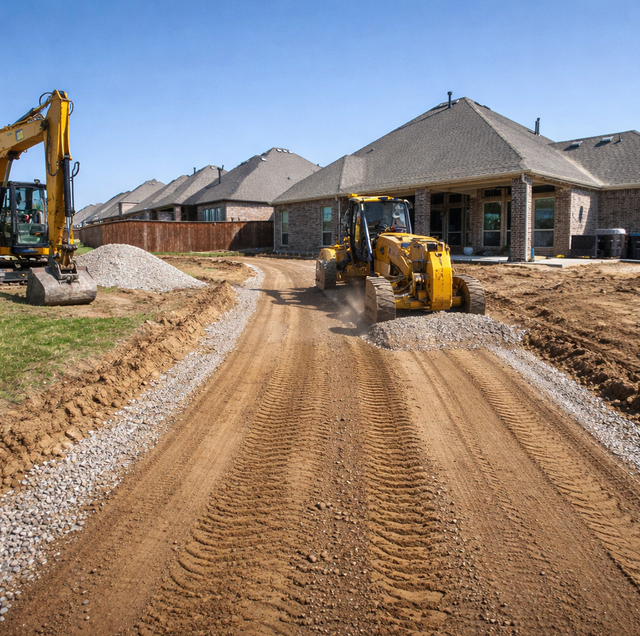
A property can be graded correctly for drainage and still hand a driveway builder a corridor that isn't ready to build on. Whole-yard grading solves a different problem: keeping water away from the house and off the lawn. A driveway corridor has its own separate requirements on top of that: longitudinal fall from the street to wherever the drive ends, a graded width wider than the finished lane, and a tie-in at the road that a general drainage pass doesn't automatically deliver. This is that corridor-specific work, the pass that happens before the driveway's own base course and finish layer go in.
Why the Corridor Needs a Grading Pass of Its Own
A driveway corridor meets two grade requirements that a backyard drainage fix doesn't have to solve. First, it needs a controlled fall along its whole length, from the road connection to the garage or parking area, steep enough to keep water moving but not so steep that a vehicle bottoms out or a car's underside scrapes at the road transition. Second, it needs enough width and a rough shape left in reserve for the driveway's own crown or cross-slope, the shaping that happens later as part of the base and finish layers, not during this pass. Get the corridor's rough grade wrong here and the driveway's own crown-building step, covered separately when the base goes in, ends up fighting a shape that was never right to begin with.
How Much Fall the Corridor Needs From Street to Endpoint
As a rough guide, a driveway corridor's longitudinal grade generally works best in the range of 2 to 8 percent along a typical residential run, easing to a gentler slope right at the road tie-in so a low-clearance vehicle doesn't scrape when transitioning from the street grade onto the driveway. A corridor steeper than that for any real stretch starts working against loose gravel specifically, since water moving fast down a steep grade can wash finer material out of a finish layer faster than a gentler slope would. On the other end, a corridor that reads as dead flat still needs a small amount of fall built into it on purpose rather than left flat, since flat ground with no built-in fall is exactly what turns into a mid-driveway low spot once traffic starts compacting it unevenly.
How Wide the Graded Envelope Needs to Be
The area that gets graded should extend wider than the finished driveway lane, typically a couple of feet past each edge where the gravel will actually sit. That extra margin gives equipment room to work the edges properly during the base and finish stages, and it avoids leaving an abrupt drop-off or berm where the graded corridor meets untouched yard on either side. A corridor graded exactly to the finished lane's width forces every later step- base compaction, edge restraint, drainage tie-in- to happen right at the edge of the disturbed ground, which is a harder place to work cleanly than a few feet back from it.
What Triggers Bringing in Fill Versus Just Cutting and Redistributing
The trigger isn't the corridor's total end-to-end fall, which is supposed to add up across its length at the target grade; it's how far any one spot deviates from that target line. A high spot or low spot that's off by a few inches is usually correctable by cutting it down or filling it with soil borrowed from elsewhere on the same corridor, keeping the job self-contained. A spot that's off by a foot or more from where the target grade line says it should sit is a different scale of problem: redistributing that much soil from elsewhere on a typical residential lot usually isn't realistic without robbing another part of the yard, so bringing in imported fill becomes the more practical route. Reading which situation you're in before committing to a plan is what separates a simple cut-and-fill day from a job that needs fill trucked in ahead of time.
Where the Corridor's Water Has to Go
Grading the corridor itself doesn't end the question of where water goes once it sheds off the graded lane. That runoff needs to land somewhere the property already handles water, not create a new wet spot along the driveway's edge. Where a corridor crosses an existing roadside ditch or swale at the street, a culvert pipe is often what carries that flow underneath the driveway rather than letting the ditch simply dead-end at the new gravel. An existing culvert at that crossing is worth checking for size and condition as part of this pass, since a driveway built over an undersized or collapsed culvert just moves the flooding problem from the ditch to the driveway itself. A single culvert at the road crossing isn't the only piece of that path on a corridor of any real length, either: shallow swales running parallel to the drive along one or both sides can pick up water shed off the graded lane in smaller amounts along the way, rather than sending the full volume all the way to one crossing point. Planning that parallel path alongside the culvert, not instead of it, is what keeps a long corridor from relying on a single pinch point to carry everything it sheds.
Clearing What's in the Way Before the Grade Gets Cut
Corridors that are overgrown, or that extend into ground that's never really been worked, brush, low limbs, old stumps, root systems still in the soil, hide the actual shape of the ground underneath them until they're cleared. Stumps and heavy roots within the planned corridor typically need to be removed with light tree removal and stump grinding before an accurate elevation reading is even possible, since a root mass beneath the surface can throw off a grade cut by several inches in a spot that looked flat from above.
Calling for a Utility Locate Before Any Cutting Starts
Before equipment cuts into the corridor at grade-changing depth, a utility locate (811 in most areas) marks buried lines running through the property. This matters most right at the road tie-in specifically, since that's where a corridor is most likely to cross utility runs that follow the road frontage rather than sit tucked away in the yard, a location a general property-wide grading job might not cut into at all.
Never let equipment start cutting the corridor before an 811 utility locate comes back, especially near the road tie-in, where buried lines are most likely to run parallel to the street frontage. Striking a gas, electric, water, or communications line during grading can cause serious injury, not just a repair bill.
Frequently Asked Questions
Not always. A culvert is especially important where the corridor crosses an active drainage path, such as a roadside ditch or swale that carries water along the street. If the road frontage doesn't have a ditch or defined drainage channel, the corridor may not need one at all, but that's worth confirming on site rather than assuming from the driveway or road's general appearance.
The 2- to 8-percent range covers a comfortable, low-maintenance corridor. Above that, up to roughly 12 to 15 percent for any sustained stretch, a gravel surface still works but needs more frequent regrading, since water moving faster down the grade carries finer stone with it sooner than routine maintenance would otherwise call for. Beyond that upper figure, a sustained stretch usually calls for a different surface approach entirely, not just more upkeep. A short, steep transition right where the corridor meets the road is more tolerable than the same grade maintained throughout the run.
A recorded drainage easement is generally set aside to preserve a flow path for water crossing multiple properties, and building or filling within it can run into restrictions. If a corridor's planned path crosses one, checking the easement's terms against the property's plat or local records before grading is worth doing so the corridor doesn't end up filling or narrowing a path that the easement exists to protect.
Yes, and for a corridor needing a significant cut, fill, or culvert work, that's often the more practical sequence. The corridor grade needs time to settle and be checked for soft or uneven spots before base material goes down, so scheduling grading as its own visit ahead of the base and finish steps isn't unusual.
Not automatically. An existing culvert in good condition and sized adequately for the ditch it crosses can often stay in place. One that's crushed, undersized, or badly silted in is the kind that gets flagged during this pass and typically needs replacing before the corridor grade is finalized over it.
A corridor that mixes cut sections and filled sections settles unevenly between the two, since undisturbed cut ground is already dense while freshly placed fill hasn't compacted to the same degree yet. Mechanically compacting the fill sections specifically, rather than treating the whole corridor as one uniform pass, is what closes that gap before base material goes down instead of leaving a soft strip exactly where cut meets fill.
Schedule a driveway corridor grading walkthrough — we'll check the fall, width, and drainage tie-in before any gravel goes down. Polk Services LLC serves Lakeland, Highland City, and Mulberry. Call (863) 344-5806.
