

What's Inside a Mattress and Why the Build Decides Its Route
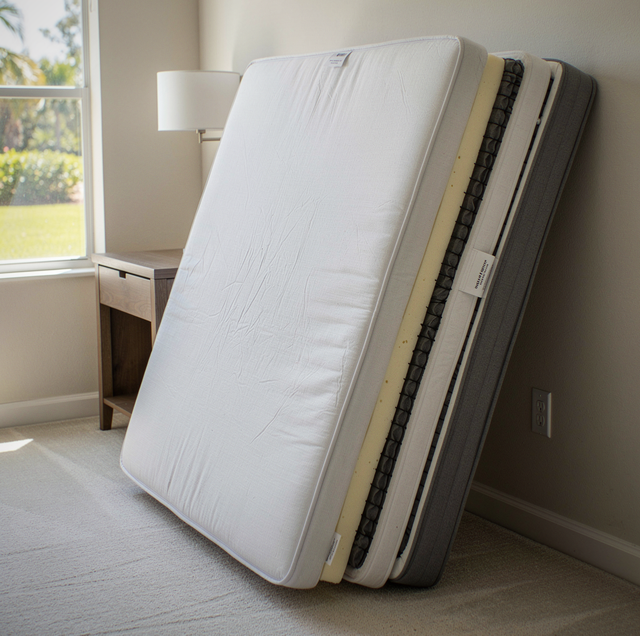
A vertical cut through a mattress shows the same order every time, from the sleeping surface down to the floor: quilted fabric ticking, one or more layers of foam or latex, a support core built from steel coils or dense foam, and, resting underneath on its own frame, a wood-and-cardboard foundation. Each layer was built to do one job. Once a mattress leaves the bedroom, that whole stack has to move as one bulky, awkward object, and the way those layers are put together determines how heavy it feels, how much room it takes up, and how it has to be carried.
The Ticking and Quilting Layer
The outer fabric you touch is the ticking, and it's typically quilted to a thin layer of foam or fiber sitting just beneath it, giving the surface some give before you ever reach the comfort layers underneath. Around the edge, that same fabric is usually finished with cording or a tape edge that ties the top panel to the side panels, so the covering wraps the whole shape rather than sitting as a flat sheet across the top only. This top assembly is mostly fabric and thin fill, light for its size, and its main job is surface feel rather than support. It's bonded to the rest of the mattress along the edges, so it stays part of the panel rather than lifting away as a separate piece, and by itself it tells you almost nothing about what's actually doing the supporting work underneath it. The thin fill under the quilting is a fiber batting rather than foam in a lot of builds, and that fiber can be cotton, wool, or a synthetic like polyester, chosen for softness against the top of the mattress rather than for any structural job.
Foam and Latex in the Comfort Layers
Below the quilting sit one or more comfort layers: polyurethane foam, memory foam, latex in natural or synthetic form, or fiber batting, sometimes several of these stacked together in bands of increasing firmness as you get closer to the support core. The foam is open-cell, and it takes up a lot of volume relative to how little it weighs. Latex behaves differently under a hand, denser and springier than foam, but it fills space in the same bulky, lightweight way. A softer layer near the top and a firmer transition layer just above the core are a common way to arrange these materials, each doing a slightly different job while still falling under the same broad category once it's out of the mattress. These layers do most of the work of making a mattress feel a certain way, and they're also the reason a mattress is bulky rather than heavy, since most of its size comes from materials that carry almost no weight of their own.
The Support Core: Coils or Solid Foam
Under the comfort layers is the support core, built one of two ways. An innerspring unit is a grid of steel coils, either interconnected coil to coil or individually pocketed, each sewn into its own small fabric sleeve and joined to its neighbors through the fabric rather than through wire. An interconnected grid behaves as one continuous piece of steel, since the coils are directly tied to each other; a pocketed unit behaves more like rows of small steel springs housed in cloth, each one able to move on its own before the fabric ties the row together. That difference is what makes a pocketed coil unit combine steel and fabric row by row, harder to separate cleanly than a bare interconnected grid where the wire can be handled as one connected mass. The other version of a support core skips coils entirely and uses a dense foam base instead, thick and firm compared to the layers above it, doing the same structural job without any steel in it at all.
A support core stays sprung steel or dense rebound foam no matter how a mattress is tilted or strapped for the move, and it can push back hard the moment pressure is released, so it gets carried the same way on every job.
Hybrid Builds Layer Coils and Foam Together
Not every support core is one material or the other. A hybrid build stacks a thinner coil unit under a noticeably thick layer of latex or high-density foam, rather than using either material as the entire core, as a straight innerspring or an all-foam mattress does. That puts steel and foam directly against each other inside the core itself, not just at the boundary between the core and the comfort layers sitting above it, which is where the plainer builds keep that same divide.
A hybrid core is also usually taller than either single-material version on its own, since it carries a coil section and a full foam section stacked together rather than swapping one material for the other. The two sections are still bonded at the seam between them the same way every other layer boundary in the mattress is, which means a hybrid build has one more internal joint holding dissimilar materials together than a straight coil or straight foam mattress does.
Adhesives and the Fire Barrier That Bind It Together
What turns a stack of unrelated materials into a single mattress is adhesive. The comfort layers, the support core, and the outer panel are glued together at various points, and that bonding is exactly what keeps a mattress from separating into loose pieces when it's picked up or moved. Without it, a mattress would behave more like a pile of stacked parts than a single object, foam sliding off the coil unit, ticking loose from the fill beneath it. Underneath the ticking, and separate from the comfort foam, sits a fire barrier layer, a distinct material whose only job is fire resistance rather than cushioning or support. It's bonded into the stack the same way everything else is, one more material layer added into the pile rather than something that comes free of it. A mattress is glued together the way plywood is, thin layers bonded into one panel, so no layer inside it is sitting there loose, waiting to be lifted free.
Frequently Asked Questions
The quilting is sewn through the ticking and the thin layer beneath it, so thread holds that top assembly together rather than adhesive. That stitching also serves a second purpose: it keeps the thin foam or fiber layer from shifting or bunching inside the fabric once the mattress is in use, which is why a quilted pattern holds its shape over years of sleeping, sitting, and stripping the cover for washing.
The fire barrier sits just under the ticking and is commonly a fiberglass-blend or treated fabric rather than foam or plain cotton. It's noticeably thinner and stiffer under a hand than the comfort foam sitting right next to it, which is one way to tell the two apart if a seam ever opens enough to feel the difference.
The wire in an innerspring unit is tempered spring steel, made to flex and return to shape rather than bend and stay bent. That's different from flat-sheet steel used elsewhere, and it's why a coil unit keeps pushing back against pressure instead of denting the way ordinary steel would under the same load.
Edge support is a firmer foam or wire rail built around the outer perimeter of the support core, added to prevent the mattress edge from collapsing under weight near the border. It's a distinct piece from the main coil grid or foam base, worked in along the perimeter rather than built into the interior structure.
No. The comfort stack can be a single foam sheet or three or four layers of different densities, depending on how firm or soft the mattress is built to feel. A softer mattress usually layers more material above the support core, while a firmer one keeps the comfort stack thin and lets the core itself do more of the work.
Generally no. The spray adhesive bonding the comfort layers to the support core cures into a bond that doesn't soften with age or ordinary handling. That's part of why a mattress keeps behaving as one solid object well after assembly, rather than coming apart at the seams the way a stitched item eventually might.
Move a mattress out the way it is actually built — one bonded object, too awkward to break down at the curb. Polk Services LLC serves Lakeland, Highland City, and Mulberry. Call (863) 344-5806.
