

What Disqualifies a Mattress from Donation
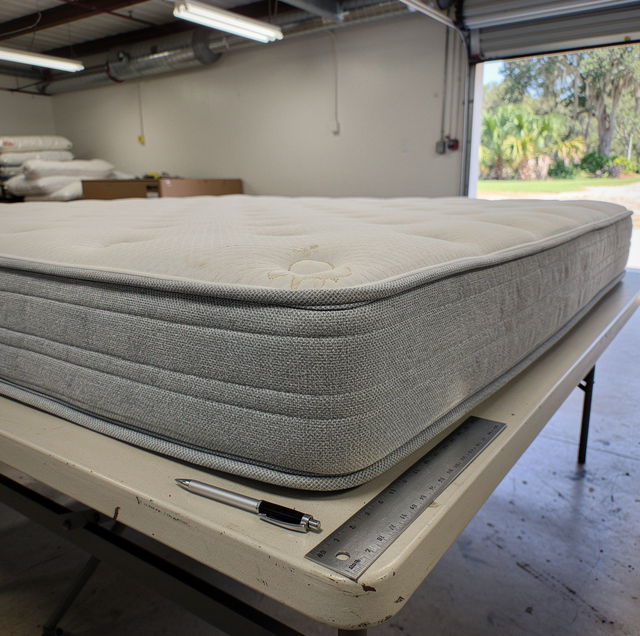
Before your mattress earns a spot on a resale floor, someone puts their hands on it. The intake check is short: a look at the ticking under strong light, a press along the center and both edges to feel how the surface responds, and a run of the fingers down every seam looking for give. That quick pass determines whether your mattress goes to donation or gets set aside for reasons unrelated to how clean it looks from across the room.
When a Stain Goes past the Ticking
The ticking is the layer you can see and touch, and it's woven tight enough to look normal even after fluid has worked its way through to the padding underneath. Once a stain reaches the fiber fill or foam beneath the ticking, nothing on the surface tells you it happened, because the material that absorbed it sits below where your hand or a flashlight can reach. A sealed food container doesn't tell you what's happened to what's inside just because the lid still looks fine, and a mattress holds the same problem: the ticking can look untouched while the layer underneath tells a different story. That's part of why a mattress that looks perfectly clean at a glance can still come back declined, since the check isn't a visual scan from a few feet away.
A stain that has reached the fill shows as stiffness in the padding and a color change at the seam line, and that condition disqualifies the piece regardless of what the top fabric shows. That's a flag rather than a final verdict: the crew notes what the check turns up, and the call on whether the mattress still goes to donation or gets set aside for removal instead is yours to make.
A Seam That Has Come Open
A mattress's ticking is stitched into a single sealed shell, and that seam is the only thing keeping the interior enclosed. Once a seam has come open, whether from a few inches of loose stitching or a full separation along an edge, the barrier no longer holds, and no one at intake will reach inside to confirm that the foam or fiber fill underneath is intact. Edges and corners are where a seam tends to fail first, since that's where the mattress flexes most during normal use.
Your mattress gets set aside for a torn seam even when everything visible through the gap looks fine, because the seam itself is what's being checked, not just what's visible through it. A resewn or taped seam doesn't affect the outcome, since the intake check looks for an intact factory seal, not a repair.
A Coil Unit That Has Lost Its Support
Coils are built to compress and spring back with every use, but once a section collapses, the wire has taken a permanent set. Press down over that zone, and it stays flat instead of rebounding, which is a different problem than a temporary dip that recovers as soon as you take your weight off it. A collapsed coil also changes how weight is distributed across the surface, which is part of why the edge is checked along with the center.
A section that stays compressed instead of springing back, or a spot where the frame can be felt through the padding, is what disqualifies the piece, because a mattress headed back to a showroom floor needs a support core that still holds weight evenly across the surface.
Photograph any stain, open seam, or soft spot before pickup day. A clear shot of the site, next to a ruler for scale, lets the flag decision be made ahead of time rather than at the curb.
A Foam Core That No Longer Springs Back
Foam ages differently than a coil unit. Instead of collapsing all at once, it gradually loses its ability to push back, and the spot where you sleep most stays lower than the rest of the surface even after the weight is gone. That's a structural failure inside the cushioning layer, not a surface issue, and pressing on it at intake shows the difference right away. Unlike a coil, foam doesn't make a sound or feel obviously different under a quick press. The tell is in how slowly, or whether, the surface comes back up after sustained pressure, and a slow or absent rebound is what disqualifies the core.
A mattress with a foam core that doesn't recover fails the check the same way a collapsed coil does. There's no way to restore broken-down foam, so the mattress doesn't get a second look once that's confirmed.
Any Sign of Pest Activity
Pest activity is the one condition that doesn't have a middle ground. Bugs and their eggs live inside seams, coil pockets, and the padding itself, not just on the surface, so once an intake worker confirms activity, there's no way to verify the interior is fully clear again. That's a different standard than staining or a torn seam, where the specific damage can be assessed and weighed on its own. Treatment doesn't change that outcome because a donation channel can't prove a mattress is clean on the inside, unlike checking a stain or a torn seam from the outside.
A confirmed pest case gets handled differently from the moment it's identified.
An Odor That Doesn't Air Out
An odor that keeps returning after the mattress has aired out comes from inside the foam or fiber layers, not from the surface. That disqualifies the mattress regardless of how faint or strong the smell is.
Water or Moisture That Got into the Core
Water that reaches the foam core doesn't stay where it landed. It works down through the padding and can carry mold growth that develops inside the material out of sight of the ticking side, even after the surface has dried completely. A mattress can feel dry to the touch and still carry that history underneath. That's true even if the mattress has since been moved to a dry room and had time to air out completely.
Any known exposure, whether from a roof leak, a flooded room, or standing moisture from a burst pipe, disqualifies the mattress regardless of how it currently feels or smells. There's no way for an intake worker to verify what happened inside the core from the outside, so a known history is enough on its own.
A mattress that's absorbed water can get noticeably heavier and shed material into the air when it's lifted or folded for transport, so keep pets and kids clear of the area while it's being moved.
Frequently Asked Questions
A protector or cover doesn't change the outcome. Intake staff lift or fold it back to check the ticking underneath directly, since a topper-style cover sits over the surface rather than replacing it. Whatever condition the mattress itself is in- stains, tears, or coil issues- is what gets evaluated, not what's covering it at the time.
Not exactly. A box spring or foundation has its own frame and fabric shell, so intake checks it for cracked or broken wood, sagging in the frame itself, and tears in the covering fabric rather than the coil or foam checks used on the mattress. Each piece is evaluated separately, and one passing doesn't guarantee the other does.
No, each half is checked on its own. If the foundation has cracked wood or sagging but the mattress itself is clean, the mattress can still move forward to donation on its own, and the same holds in reverse: a damaged mattress doesn't disqualify a foundation that passes its own check.
No to both. A topper or pad sits loose on top rather than being sewn into the mattress shell, and a bed frame is a separate piece of furniture, so neither affects whether the mattress itself passes. Each can be donated or set aside independently of what the mattress underneath is doing.
Yes. Both sleeping surfaces get the same ticking, seam, and coil checks a single-sided mattress goes through, and a stain or torn seam on either side disqualifies the whole piece, since a clean top surface doesn't offset a compromised bottom and the whole shell has to hold up to move forward.
It doesn't qualify for donation, but it still has to leave the house. A failed mattress goes out for disposal or recycling rather than the resale floor, and getting it out of the house is a separate job from the intake decision itself.
A mattress that fails intake still has to leave the house — you get one call that clears it out along with everything else you're getting rid of. Polk Services LLC serves Lakeland, Highland City, and Mulberry. Call (863) 344-5806.
