

Attached Deck Removal: What the Ledger Board Leaves Behind
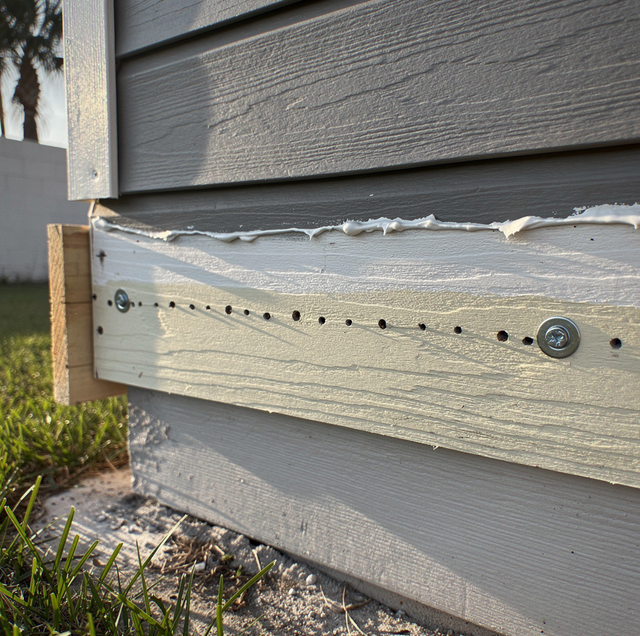
Quick Answer: An attached deck is fastened to the house by a ledger board. Removing it means backing out every fastener, taking the board off the wall, and sealing each opening it leaves with construction-grade sealant.
When a deck is scheduled to come off a house, the part homeowners picture is the platform: boards up, framing down, posts out, everything loaded and gone. The part nobody pictures is the strip of wall behind it. Flat against the house at the back edge of the deck, hidden under fascia trim and running the full width of the platform, is a single board that has not moved since the day it went in, and it is what makes an attached deck removal a job on the house rather than a job in the yard.
The Board Behind the Siding
That board is the ledger. It is typically the same lumber dimension as the deck joists, run horizontally, laid flat against the wall covering and bolted through it into the framing of the house. The joists that carry the walking surface either hang from steel hangers nailed to their faces or bear directly on it, which means the inner half of the platform is not standing on anything out in the yard. It is hanging on the wall.
What matters for a removal is more physical than that. Part of the deck is inside the wall. The fasteners run through the siding, through the sheathing behind it, and into the band of framing that wraps the floor structure, so taking the deck apart means taking the hardware back out of the house and then dealing with what it leaves behind.
Fastened into framing, not into siding: siding is a weather covering and carries nothing. The bolts or lag screws holding a ledger are driven into solid framing behind the covering, which is why the openings they leave go deeper than the surface anyone can see from the yard.
What Sits Between the Ledger and the Sheathing
That seam holds one of three things, and which one it is cannot be settled from the yard.
Some decks have a flashing detail: a bent piece of metal or a membrane strip lapped over the board's top edge to keep the seam closed. What the crew finds is the state that piece is in after years behind a deck, and metal corroded thin at the bend, or a membrane gone brittle and torn where the fasteners pinned it, says the seam stopped doing its job some time ago. Some have a stack of spacers or standoff washers holding the ledger a small distance off the wall, leaving a deliberate gap behind the board. And some have nothing between the lumber and the siding but two surfaces pressed together.
Each one changes what the crew has to do at the wall. The top leg of a flashing piece is captured under the siding above it, so it will not come away downward with the board; it has to be released at that course, as its own move rather than as part of the deck. A spacer stack is loose hardware left behind the board that drops out as the fasteners come out, and it has to be accounted for rather than left in the grass. Nothing at all means the board comes away flat, with the full impression of itself printed into the wall covering underneath.
At the walk-through, mention any siding work done since the deck went up. A patched or replaced course above the ledger changes what has to be released at the wall and what the crew expects to find behind the board.
The Hardware and Trim That Come off with It
The ledger never comes off on its own. Fixed to it, or covering it, is a short inventory of pieces that must all be released first.
The joist hangers: Each one is a steel bracket nailed through its flange into the face of the ledger, so every hanger is a small cluster of additional fasteners in that board.
The trim at the deck line: A band board, a run of skirt molding, or a fascia piece usually hides the top edge of the ledger and the joint above it, and it has to come off before anyone can see what they are working with.
Cut siding: On most attached decks, the siding was cut back around the deck framing rather than run behind it, so the pieces bordering the deck line are already interrupted, and some of them come away with the structure instead of staying on the wall.
Old sealant: A bead of caulk runs along the top edge of the ledger, hardened and usually cracked by the time anyone gets to it, and it gets cut rather than peeled so it does not take wall covering with it.
Then there is the fastener line itself. Heads may be exposed, countersunk, buried under caulk, painted over, or corroded into a shape a socket will no longer grip. It is common to find more than one kind of fastener on a single board, where somebody added hardware at some point without matching what was already there. None of that is visible until the decking above the ledger is off and the board is exposed along its length.
Do not back out fasteners from a ledger board yourself. It stays under load until the deck framing above it has been removed, and releasing its hardware early can cause the platform to drop without warning. Stay off and call someone.
The Wall as the Crew Finds It
Once the board is down, there is a horizontal band of house that has been covered since the deck was built, and it does not match the surrounding wall.
The siding inside that band has been out of the sun and out of the rain for the life of the deck. It is often a visibly different shade from the siding on either side, and where it was cut around framing, it simply stops, leaving square ends and open edges rather than a finished line. Running the length of the band is a row of holes, one at each fastener, sometimes with a washer still pressed into the surface, sometimes dished inward where a bolt drew the board tight against the wall over years of seasonal movement.
There may be staining, a darker patch, or a spot where the wall covering has gone soft. That is information, not a verdict, and it belongs to whoever works on the wall next. Nobody knows what is behind a ledger board until the board is off, which is why the wall is looked at and shown to the homeowner at that moment rather than described in advance.
Sealing the Penetrations Before the Crew Leaves
Every fastener that came out of that wall left an opening running through the wall covering, through the sheathing, and into framing. A removal that ends when the lumber is loaded is a removal that has handed the homeowner a row of open holes into the structure of the house.
So the openings get sealed with construction-grade sealant, one by one, as the closing step of the attached-deck workflow. It sits in the same sequence as pulling the deck boards and cutting the joists, inside the same visit and the same crew's scope, which is the practical reason this work gets described as work at the wall.
Two things make that sequencing matter. A sealed penetration is the difference between a wall that sheds water the way it did before the deck existed and a wall carrying a line of entry points at deck height. And those openings are easiest to reach at the exact moment the ledger is off, and nothing is standing in front of the wall. Anything deferred past that point has to be done later from a ladder, against a wall nobody has a reason to be at anymore.
The Deck That Never Touched the House
Where a deck stands entirely on its own posts, none of the wall work above exists. There is no fastener line to back out, so there are no penetrations to seal. No trim line has to be cut, and no course of siding has to be released. No sheathing gets exposed, and there is no covered band of wall waiting behind a board, because no board was ever pressed against it.
That absence is the whole of it. Nothing is opened into the wall, nothing has to be closed on it, and it looks the same the evening the platform is gone as it did the morning the crew pulled in. Everything described above belongs to one board and the strip of house behind it, and where that board does not exist, the wall stage of the removal does not either.
Frequently Asked Questions
No. A demolition crew's work at that wall ends with the structure gone and the fastener openings sealed. Restoring the finish is different work: replacing the siding course that was cut around the framing, or matching the weathered band that spent years covered, is a siding trade's job and gets arranged separately from the removal.
Then the mounting points are treated differently. They get cleaned rather than sealed, and they stay open until the new install, because sealant driven into holes a builder is about to reuse or re-drill only has to be dug back out. Say so at the walk-through, since it changes what happens at the wall on the final pass.
Yes. Height and attachment are independent of each other. A ground-level deck built at threshold height, low enough to step onto straight from the door, can still be fastened to the house at a ledger, and a platform standing well above grade can be entirely freestanding on its own posts. How high a deck sits says nothing about whether the wall is involved.
It turns up on older hardware that has corroded in place, and it does not stop the work. The head twists off, and the shank stays buried in the framing. The remaining shank is cut flush so nothing protrudes from the wall, and the opening around it is sealed the same way as a hole a fastener came cleanly out of.
It can. A multi-level, tiered platform may meet the wall at more than one level, carrying a separate line of attachment at each tier, and a stair landing built against the house can have its own smaller connection independent of the main deck. Each of those is a separate run of fasteners to remove and a separate set of openings to close.
Rarely. A ledger runs the full width of the deck and stays pinned to the wall at every fastener along that run, so it usually gets cut into shorter lengths between fastener clusters and taken down a section at a time. Each length releases on its own, which keeps one end of a long board from levering against the siding while the other end is still bolted.
An attached deck means work at the wall — book a free walk-through before demolition day. Polk Services LLC serves Lakeland, Highland City, and Mulberry. Call (863) 344-5806.
