

Where Old Deck Debris Goes, and Why Burning Is Not the Answer
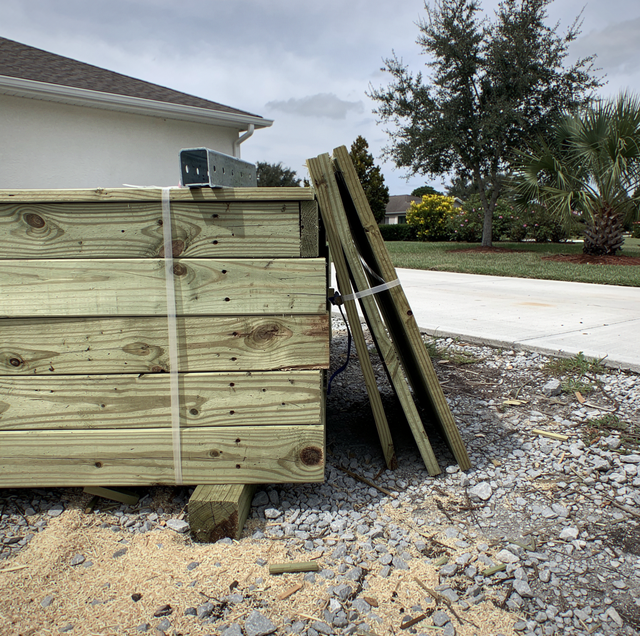
Quick Answer: A torn-out deck leaves as several sorted streams rather than one pile: treated lumber and cedar to a construction-debris facility, composite and PVC to landfill, metal to scrap, and concrete sorted by rebar content. None of it belongs in a fire.
A deck reads as one material while it is standing on its posts. It is four. Deck framing, deck boards, railing hardware, and footings are separate waste streams that happened to be screwed together for years, and once they come apart, they stop having anything in common.
What leaves the property looking like a single pile has already been split into several loads, and the sort that decides where every piece lands happens during the teardown rather than at the far end of it. To anyone watching from the porch, a loaded trailer looks like the end of the job. The part that determines where all of it goes was over before the first board came up.
Pressure-Treated Wood: Where the Framing and Decking Go
Pressure-treated lumber is not wood with a coating on it. It is wood with preservative driven into the cell structure under pressure, which is why a post can sit in wet ground for years and still hold a beam. The chemistry does not stay near the surface, and it does not weather out of the board over time.
Older residential treated wood is arsenical, preserved with chromated copper arsenate, a compound of chromium, copper, and arsenic used for decades against rot, fungi, and insects. Newer material is copper-based instead, using preservatives such as alkaline copper quaternary and copper azole. Both are handled as treated wood at disposal.
What counts as treated on a deck: More than most owners expect. Joists, beams, posts, stair stringers, rim board, and the ledger against the house are treated lumber on the great majority of decks built since treated framing became the standard for structure. That holds even where the walking surface is something else, so a composite deck produces both streams at once.
Treated lumber routes to a construction-debris facility, a receiving and sorting operation rather than a single destination. It has to arrive sorted because clean wood has uses treated wood is shut out of: untreated demolition lumber can be ground into mulch, animal bedding, or boiler fuel, and treated lumber enters none of those paths. Mixing the two contaminates a stream that had somewhere useful to go.
One field detail: some treated lumber carries rows of short knife slits across its faces, called incisions, cut before treatment so preservative can reach species that resist it. Crews read that pattern on sight.
Cedar and Redwood: Clean Wood That Still Needs Sorting
Cedar and redwood decks were built on a different premise. The heartwood of both contains natural extractives that resist decay without added chemicals, the premium alternative before composite arrived.
For disposal, cedar and redwood are clean wood. They still route to a construction-debris facility alongside the treated material, for a different reason.
Finish and mixed framing: An older cedar deck is rarely bare wood. It has been stained, sealed, or painted, sometimes repeatedly, and coatings change what a facility can do with the fiber. Beyond that, most cedar and redwood decks are cedar boards over a treated frame, because nobody built a substructure from premium siding-grade material. The load is mixed the moment it comes down.
Cedar is excluded from the clean-wood grinding stream by what was put on it. Treated lumber, by what was put in it.
Composite and PVC: The Exception That Goes to Landfill
Composite decking breaks the pattern, in the direction people least expect. It reads as the modern, engineered, environmentally minded choice, and at disposal, it is the one board on the deck with nowhere to go.
Wood-plastic composite is what the name says: wood flour blended with a plastic binder and extruded into a board. PVC decking is a cellular plastic with no wood content. Both behave the same way at the end of service.
Why the recycling path closes: Plastics recycling runs on sorted single resins. A recycler needs to know what a stream is made of before reprocessing it, and a composite board is a bonded blend that cannot be separated back out at any practical scale. It is not clean wood, so the wood stream rejects it. It is not a single clean resin, so the plastics stream rejects it. Composite and PVC route to landfill, because they are not recyclable at most facilities.
That deserves one qualification, because the marketing invites confusion. Several manufacturers advertise recycled content in the boards they sell. Recycled content describes what went into a new board. It is not evidence that a board coming off an existing frame can re-enter that stream, and the two are constantly conflated.
Metal: Hangers, Fasteners, Railings, and Aluminum Framing
Metal is the one deck material with an open recycling path, and a deck holds more of it than a walk-around suggests.
Structural hardware comes out first: joist hangers, hurricane ties, post bases and standoffs, carriage bolts, structural screws at the ledger, and deck screws or hidden clips to hold the surface down. Then the railing system, which on newer decks means aluminum balusters, posts and sleeves, cable railing hardware, or a full aluminum frame kit.
Ferrous and non-ferrous are separate streams: Hangers, ties, and fasteners are almost always galvanized or stainless steel, and a magnet finds them instantly. Aluminum balusters, framing, and railing extrusions are non-ferrous and get separated rather than thrown in with the steel. That separation is standard scrap practice, and it is the difference between metal that gets recycled and metal that rides a landfill load.
Scrap metal removal is a service in its own right, covering appliances, fencing, carports, structural steel, and farm metal. Deck hardware is small by comparison but follows the same route.
Concrete Footings and Pilings, Sorted by Rebar Content
Under every deck is something holding it off the ground, usually concrete. Poured pier footings, precast pier blocks, piers with embedded post anchors, and concrete-topped platforms all come out with the job, and they are the heaviest material on site.
Concrete routes to recycling or to landfill, and rebar content decides it. Clean concrete with little steel crushes into recycled aggregate, a real product with demand for base course and fill. Heavily reinforced concrete is a different processing problem: the steel has to come out before the stone is usable, and past a certain density of reinforcement that stops making sense.
Waterfront pilings are their own category, and their routing is the simple part. A piling that comes out of the bottom is a single large treated timber, so it rides with the treated lumber rather than with the concrete, however heavy it is, and however much it reads on site as a structural footing. Keeping debris out of the water is its own discipline, handled before any of this begins.
Why Burning Any of It Is the Wrong Answer
A burn pile is the oldest answer for a stack of old lumber, and for treated wood, it is the worst option available.
EPA guidance states that CCA-treated wood should not be open burned, because toxic chemicals may be released as part of the smoke and ashes. The same caution applies to the copper-based treated lumber sold today.
The mechanism is what separates this from a brush fire. The preservative was pressure-driven into the wood rather than painted on, so there is no surface layer to burn off and no clean wood underneath. The metallic components do not combust. They leave in the smoke or concentrate in the ash, and both end up somewhere: in the air over a yard, in a pile on the ground, in whatever the next rain moves.
Composite and PVC are no better candidates. Burning plastics in an uncontrolled outdoor fire is a combustion problem of a different kind, and a composite board holds both the plastic and the wood flour bound into it. Cedar and redwood are the only deck materials on this list that are simply wood, and that is the trap: a demolition pile is mixed by definition, and a fire cannot unmix it. A stack that is mostly clean cedar with treated joists and a few composite boards burns as the worst thing in it.
None of this is a handling problem to be managed on site. It is the reason the material leaves on a truck, kept as a separate stream from the moment it comes down, and delivered to a facility equipped to take it.
How One Deck Leaves as Several Separate Loads
The sort happens during demolition, not after it. That is what separates a load that routes correctly from one that does not.
The teardown follows the streams: Railings and hardware come off first, with the metal set aside as it is removed. The walking surface comes up next, composite into its own stack the moment it does, because a single composite board mixed into a wood load has redefined that load. Framing follows, with hangers and ties pulled as members come free. Footings come last, once nothing is bearing on them.
Commingling gives up more than a few minutes: A mixed load gets routed by its most restrictive component, not its average one. Wood with composite in it is no longer a wood load. Concrete with treated timbers buried in it is no longer clean concrete. Every stream contaminated on the trailer loses its intended destination.
A composite deck on a treated frame with aluminum railing and a set of concrete piers is four destinations, and a crew that treats it as one is making a choice about where all of it ends up. Separating the load so each material takes its correct path is not a service layered on top of the demolition. It is the demolition, done in order.
Frequently Asked Questions
Color is the usual first check, and it stops working with age. Copper-treated wood ranges from light green to intense green when new, while untreated and borate-treated lumber tends toward light yellow. Once both weather, they turn a similar silver, and EPA notes that sorting on green color alone cannot assure all treated wood is identified. The reliable identifiers are the end tag stamped on dimensional lumber, naming the preservative and treatment level, and chemical stain indicators such as chrome azurol, PAN indicator, or rubeanic acid.
It changes which preservative is likely in it. Chromated copper arsenate, the arsenical chemistry EPA describes, was phased out of residential wood treatment at the end of 2003. A deck framed well before that date is the likely CCA candidate, and one framed after it is more likely carrying a copper-based preservative instead. The date is a marker rather than a hard line: lumber already sitting in a yard did not disappear on it, and a deck rebuilt in stages can carry both generations in the same structure, older joists under newer rim board. Routing does not change either way, since both are treated wood.
They travel with the treated stream rather than getting swept into yard waste. EPA guidance says composting or mulching treated wood or its sawdust is not recommended, which rules out the destination small wood scrap would otherwise take. The same guidance recommends that treated wood go directly into a separate container before disposal, limiting weathering and chemical leaching while it waits to be hauled.
Usually not. A hidden-fastener system uses metal clips that seat into a groove milled in the board edge and screw down into the joist. When the decking lifts, the clips stay behind on the framing, still fastened. They come out with the joists during the framing stage and route to metal, not to landfill with the boards they held. A composite surface can produce a real pile of small steel hardware that never touches the composite stack.
The destination is the same, and the reason is stronger. Older composite boards are uncapped, with the wood-and-plastic blend exposed on all faces. Later boards are capped, carrying a co-extruded polymer shell bonded over the core during manufacture. That cap is a different polymer from the core, so a capped board is a wood-flour blend permanently fused inside a second plastic. It resists staining better in service and gives a recycler a third material to separate.
Not automatically. Crushing operations run material past magnetic separators that remove ferrous metal from the stream, so a modest amount of steel is a normal part of the process rather than a disqualifier. What matters is the amount of steel in the pour and how it is tied. A pier footing with a few short lengths processes differently from a heavily reinforced slab or a grade beam with a dense mat. The call is made on the reinforcement itself.
One load, sorted by material — ask how your deck leaves the property. Polk Services LLC serves Lakeland, Highland City, and Mulberry. Call (863) 344-5806.
