

Concrete vs. Gravel Driveways: What Long Runs Actually Need
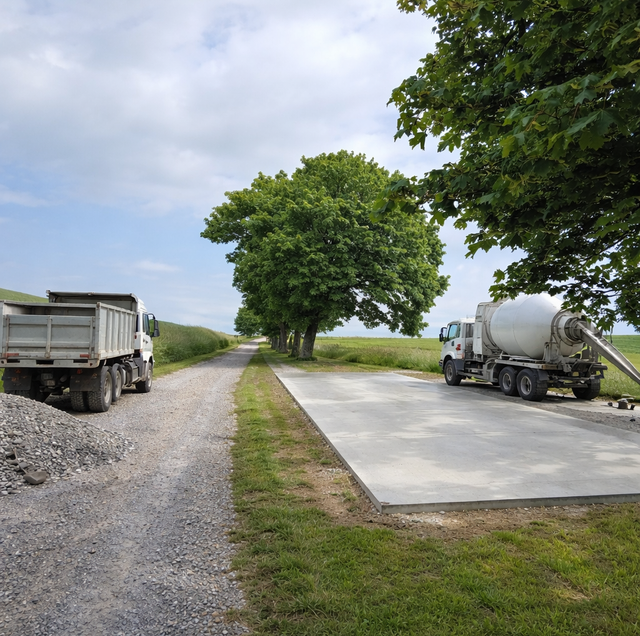
If your driveway runs a few hundred feet or more from the road to the house, the math on concrete versus gravel changes in ways a short suburban driveway never has to deal with. A rural property might need a driveway that's ten, twenty, even fifty times longer than a typical in-town lot, and every difference between the two materials gets multiplied by that length. What's a minor drawback over sixty feet becomes a serious one over six hundred.
This isn't a case for one material over the other in every situation. Concrete and gravel both do their jobs. The point is to understand what actually happens to each one over a long run, so you're choosing based on how the driveway will behave in year five and year fifteen, not just how it looks the day it's finished.
How Length Changes The Equation
A short concrete driveway and a long one aren't just different sizes of the same project. Concrete is poured in sections separated by control joints, and every joint is a place where the slab can crack, shift, or let water in underneath. A driveway with a handful of joints is easy to keep an eye on. A driveway with dozens of joints running the length of a rural lot has dozens of places where a problem can start, and ground movement from heavy rain saturation followed by dry stretches is a year-round reality almost anywhere: expansive clay soils swell and shrink through those moisture cycles enough to crack a rigid slab, while loose, sandy soils settle unevenly under load if the base beneath them wasn't compacted correctly to begin with.
Materials also have to get to the site. A concrete truck has a limited capacity and must pour before the mix sets, which limits how far from the truck's access point a continuous pour can practically extend. Gravel, on the other hand, is a dump-truck material. It gets spread and compacted at whatever pace the job allows, and there's no clock running against a curing chemical reaction. For a driveway that stretches well past where a house's front walk would end, that difference in how the material behaves on-site, not just what it costs, matters.
What Concrete Offers Over a Long Run
Concrete gives you a hard, flat, uniform surface. It doesn't rut, it doesn't need periodic regrading, and it sheds standing water well when it's sloped correctly. For a short driveway near the house, those are real advantages, and plenty of homeowners are happy with how it performs.
The tradeoffs show up over distance and time. Concrete cracks. Manufacturers and installers will tell you it's a matter of when and where, not if, because concrete is a rigid material sitting on ground that isn't rigid. Tree roots, soil settling, water intrusion under a joint, and ordinary thermal expansion all contribute. A hairline crack on a short driveway is a cosmetic issue. A crack on a driveway a quarter mile long can run for feet before you find where it started, and once water gets into a crack and works underneath the slab, the repair usually means cutting out and replacing that whole section rather than patching a small area.
Runoff is another factor that gets bigger with distance. Concrete is a solid, impervious surface, so rainwater that lands on it has nowhere to go but sideways, off the edge, and downhill. On a short driveway that's a minor detail handled by a gentle slope. On a long rural run, that same water has a lot more surface to collect from before it reaches the low point, which can mean more volume moving at once toward a septic field, a well head, or a low corner of the property than the ground there was ever built to absorb. Gravel, by contrast, is permeable. Water works down into the material and the base beneath it, rather than sheeting off in one concentrated direction as it does off a slab, which spreads the load out instead of sending the full volume to one runoff point. A properly graded gravel driveway still needs a crown or slope to carry off whatever the base doesn't absorb, but it isn't shouldering the entire rainfall the way an impervious surface does.
Repair is really the core issue for long rural runs. When gravel develops a low spot, a rut, or a washout, you can fix that specific stretch without touching the rest of the driveway. When a concrete slab fails in one section, the match between new and old concrete is never invisible. Color, texture, and cure age never line up perfectly, so a repaired slab driveway usually ends up with a visible patchwork of different-aged sections over time, especially on a run long enough to require several repairs over its life.
What Gravel Offers Over a Long Run
Gravel's core advantage on a long driveway is its forgiving nature. It's laid down in a compacted base, built up section by section, and any part of it can be repaired, topped off, or regraded independently without disturbing the rest. That matters more the longer the driveway gets, because a longer run has more total surface exposed to root growth, drainage patterns, heavy vehicle traffic, and simple wear.
Not all gravel is the same, and material choice matters more on a long driveway than a short one because you're covering more area with it. Crushed asphalt millings pack down into a dense, semi-solid surface that resists washboarding and sheds water reasonably well once compacted, which is part of why they're a common default choice for driveway work. Crushed concrete performs similarly and gives a lighter, cleaner look. Limerock or limestone screenings compact into a firm, pale surface that's popular for a more finished appearance. Angular crushed stone locks together under traffic better than rounded material because the sharp edges bind against each other instead of rolling. Pea gravel and river rock are the weakest choices for a driveway of any length: the rounded stones never lock together, so they migrate under tire pressure, and on a long run, that means more area constantly needs to be raked back into place.
The maintenance gravel does need is real and shouldn't be understated. Any gravel surface benefits from periodic regrading to knock down ruts and redistribute material that's migrated toward the edges, and low spots that collect water need attention before they turn into potholes or washouts. The difference is that this maintenance is incremental and localized. You're never looking at replacing the whole driveway at once, and small sections can be topped off with fresh material as needed rather than requiring a full-depth repair.
Look And First Impression
Concrete reads as more finished and more formal. If the driveway leads to a property where that polished look matters for resale or curb appeal right at the road, concrete has an edge in that specific way. Gravel reads as more rustic and utilitarian, which naturally fits many rural properties, and a well-installed, well-maintained gravel driveway with clean edges and a consistent, compacted surface looks intentional rather than unfinished. Material choice affects this too: millings and crushed concrete give a darker, more uniform look, while limestone screenings give a lighter, more manicured appearance closer to what people picture when they think of a finished gravel drive.
At A Glance
| Concrete | Gravel | |
|---|---|---|
| Durability over long runs | High per-section, but rigid; joints and cracks compound over distance | Flexible; wears gradually rather than failing at a fixed point |
| Maintenance | Low routine upkeep, but repairs are full-section replacements | Periodic regrading and topping off, done in small, targeted areas |
| Install time (per linear foot) | Slower; pour and cure logistics limit how far a single day's work reaches | Faster; delivered, spread, and compacted at a steady pace regardless of length |
| Look | Polished, formal, uniform | Rustic to manicured depending on material chosen |
Why Length Tips the Scale Toward Gravel
Put the pieces together, and the case for gravel gets stronger the longer the driveway runs. The delivery and install logistics favor a material that doesn't need a continuous, time-pressured pour. The repair profile favors a material in which a single bad stretch doesn't force you to match old work to new. And the material itself, when it's the right choice like angular crushed stone or well-compacted millings, holds up under the kind of long-term vehicle and weather exposure a quarter-mile driveway sees far more of than a sixty-foot one does.
Concrete still earns its place in plenty of driveways, especially shorter ones near the house, where a hard, uniform surface is worth the trade-offs it entails. What changes is the math: stretch that same driveway from sixty feet to six hundred, and the practical realities of installing, repairing, and living with each option over years tend to tip the balance toward gravel, provided the ground underneath gets built right. A gravel driveway laid over soil that wasn't graded and compacted first will develop ruts and soft spots no matter how good the surface material is, and that groundwork matters more over a long run than anywhere else: get the base and drainage right the first time, over the full length, and it saves far more effort down the road than any decision about which stone to use on top of it.
Frequently Asked Questions
There's no single lifespan for either, but industry figures commonly put a well-built concrete driveway's service life somewhere around 25 to 30 years before major cracking forces full-section replacement, and that clock effectively resets for whichever section gets redone. Gravel doesn't have an equivalent endpoint: a well-installed gravel driveway with a properly compacted base gets a light top-off every few years as the surface layer wears, and that maintenance cycle can continue indefinitely rather than building toward a single replacement date.
Yes, that's a common approach on longer rural properties: concrete near the house or garage apron, gravel for the longer stretch back to the road, and it's usually handled as two separate scopes rather than one blended material. The gravel portion- base, fabric, and finish material from wherever the concrete ends out to the road- is the side we handle. The concrete work itself is a separate trade and gets quoted and scheduled on its own.
A top-off means spreading and compacting a fresh layer of matching material over the worn spots, typically an inch or two in the low and thin areas rather than the whole surface. Putting it off once the base starts showing through in the wheel paths lets water reach the compacted base directly instead of draining through a buffer of loose stone first, which is usually when a driveway that only looked thin starts developing the soft spots and ruts that turn a simple top-off into a base repair.
Rutting is almost always a drainage or base problem, not a material problem. Water that isn't shed off the surface softens the compacted base underneath, and once the base gets soft, tires push the top material into ruts. Rounded materials like pea gravel and river rock also rut faster than angular stone because they don't interlock under tire pressure.
Width multiplies the same logistics problems length does. A wider concrete pour needs more trucks staged closer together to beat the set time, which gets harder the farther the pour site is from the road. A wider gravel driveway just means more material spread and compacted in the same pass, with no time pressure attached.
Yes. Wherever vehicles turn around, back up to a garage, or pull off toward a side yard, the stone takes far more scrubbing and twisting force than the straight run of driveway, since tires are pivoting under load there instead of just rolling. That stretch benefits from a slightly deeper base and a finish material with strong interlock, like millings or crushed concrete, even on a long driveway that uses a lighter-duty material elsewhere, since it's usually the first place ruts and bare patches show up on an otherwise solid gravel run.
Get a free estimate for your long driveway — we'll assess your site and recommend the right gravel type and grading plan. Polk Services LLC serves Lakeland, Highland City, and Mulberry. Call (863) 344-5806.
