

Pool Removal Without Taking Down the Fence: What Decides It
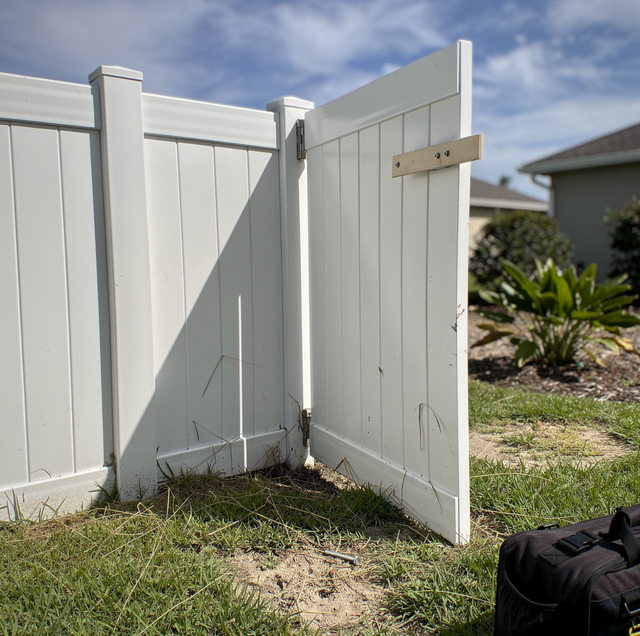
Quick Answer: The posts are set in the ground and stay there. The panels or fabric are fastened to the posts and come off instead, closing back up at the end of each working day and going back on permanently when the job finishes.
A fence is two jobs stacked on top of each other, and only one of them is ever in the way. On most jobs, the posts stay in the ground for the whole run, and only the panels along the equipment's path come off. Those go back up at the end of each working day so the yard is not standing open overnight, and they go back permanently once the pool work is done. What comes apart, and how easily, depends on how that particular fence is built, and not on the fact that a pool is being removed at all.
Why Removing a Section Beats Removing the Whole Fence
The posts are the structural part, usually set a few feet down and often anchored in concrete, and they carry the weight and hold the line of the whole run. The pickets, rails, fabric or panels are the infill, and they are attached to the posts with fasteners meant to be undone: screws, nails, tension hardware, brackets or slots. Taking down an entire fence run means digging out every post along that stretch, which is a different scope of work than freeing the fasteners on a handful of panels. Freeing panels is faster, disturbs less ground, and leaves the posts exactly where they were, which matters once the pool work wraps up and the fence has to look and function the way it did before. That is why the contractor's default move, when a fence stands in the way of getting equipment or debris through, is to open a section rather than clear the whole line.
Which panels come off and how many depend entirely on where the machine needs to travel and how wide that path has to be.
How Wood and Shadowbox Fences Come Apart
On a wood board or shadowbox fence, the pickets are screwed or nailed directly to horizontal rails, and the rails themselves are either toe-fastened into the posts at an angle or sit in metal or wood brackets bolted to the post face. Freeing a section usually means backing out the picket fasteners first, then lifting the rail clear of its bracket or working the toe-nails loose so the rail comes away without splitting the post.
Older wood fences are the ones most likely to break at the fastener: Years of weather leave screws stripped and nails rusted into the grain, so a fastener that would back out cleanly on a newer fence instead shears off or pulls a chunk of wood with it. That is a maintenance condition of the fence itself, and it says nothing about whether opening a section was the right call.
Ask whether the rails are toe-nailed or bracketed before anything starts. A bracketed rail lifts out in one move; a toe-nailed one has to be worked loose, and that difference decides whether a section takes minutes or an hour.
How Chain Link, Vinyl and Metal Fences Come Apart
Each fence type comes apart by a different mechanism, and that mechanism determines whether opening a section is quick or awkward.
Chain link: The fabric is held to the terminal posts by tension bands and bolts, and it is tied to the line posts and the top rail with tie wires spaced along the run. Cutting the tie wires and loosening the tension band bolts lets a whole stretch of fabric unhook and roll back on itself, still attached at one end if that is useful, or lifted clear entirely.
Cut tie-wire ends stay sharp along the whole run and sit at hand height once the fabric is rolled back. Treat the entire stretch as a snag hazard while a section is open, not just the cut ends themselves.
Vinyl privacy fence: the rails seat into routed slots molded into the posts, and the panel usually locks in with a cap or a small locking tab at the top. Free the cap and any tab, and the panel lifts straight up and out of the slots, often with nothing more than a screw or two at each rail to back out, and on some systems nothing at all.
Aluminum or steel picket fence: each section is a welded panel, and depending on the system it either bolts to brackets mounted on the posts or slides out of a routed post the way a vinyl panel does. Which of the two you have determines whether anything needs to be unbolted at all, so it gets checked at the post rather than assumed from the material.
Vinyl tends to be the fastest to open and close, since the panel carries its own weight in the post slot rather than hanging on fasteners. Chain link and metal picket sit in the middle. Wood is the one where the fence's condition, rather than its type, usually decides how the work goes.
What Decides Whether the Fence Has to Move at All
Some jobs need no fence work whatsoever. The question comes down to a relationship between two numbers: how wide the equipment is once you add the working clearance it needs on each side, measured against the widest existing opening the fence already has, usually a gate.
A gate wide enough on paper does not help if it opens onto the wrong side of the yard. The machine has to reach the pool from that opening, and the route between the gate and the pool is its own separate question, covered in pool demolition with no side-yard access. If no existing opening is wide enough, or the wide opening does not line up with a workable route, a section of fence is removed to create a temporary opening exactly where the equipment needs to pass.
Putting Panels and Posts Back
The reason panels come off instead of the whole fence in the first place is reinstatement: the posts never left the ground, so the line and spacing they establish never moved either. Rails and pickets, or fabric, or bolt-on panels, go back onto the same posts in the same positions, and the fence reads the same as it did before the work started. That is also what makes closing the opening at the end of each day a few minutes' work instead of a production in itself.
The exception is a post that has to come out, whether because it stood directly in the equipment's path or because it turned out to be rotted or rusted through at the base. That is fence repair, not a pool-removal item. The crew flags it, temporarily closes the line so the yard is not left open, and the permanent reset is handled by a fence contractor, since a post set in fresh concrete needs time to firm up before it carries load again.
A gate post is the one most likely to raise that question, because it does more work than a line post. It carries the weight of a swinging gate on a cantilever, which puts more stress on that one post than on any other point in the run, so a gate post that is already leaning tends to be the one that will not go back as it was.
A Quick Word with the Neighbor
When the fence in question sits along a shared property line, a short conversation with the neighbor before work starts is a good idea, purely as a courtesy. Let them know a section will be open during working hours, roughly which days, and that it closes each evening and reverts to permanent use when the pool work is done. That conversation is about scheduling and keeping a good relationship with whoever shares that line, and nothing more. Anything about who owns which part of the fence is a separate matter for the property owners themselves.
When Removing the Fence Entirely Makes Sense
Some homeowners are not putting the fence back at all, whether they are changing the yard layout or the fence has reached the end of its life anyway. That changes the sequence more than it sounds like it would. A fence coming out for good needs no panel marking, no staging space to lay sections flat, and no evening close-up, so the opening can be as wide as the work actually wants and the posts come out with the rest of it. If that is the plan, fence removal is its own service the crew handles separately from the pool work, and saying so early is what keeps the panels from being carefully marked for a reinstatement nobody wanted.
Frequently Asked Questions
Sections and hardware get marked before anything comes off, usually with a strip of tape or a grease pencil noting which post each panel or run of pickets came from. On a fence where spacing varies slightly from bay to bay, or on a slope, putting a panel back in the wrong spot can leave visible gaps, so the marking step matters more than it might seem.
That changes which panels can be freed and which cannot. A mow strip is a poured band running under the fence line, and on many installs the posts are set through it rather than beside it, so the strip has to be intact for the post to stay put. Panels above it come off normally, but the opening cannot be widened by pulling a post without breaking the strip, so the temporary opening usually ends up where an existing gate or a joint in the strip already falls.
It depends on the piece. Boards, rails, and bolt-on panels go back as they were, and a routed vinyl or aluminum panel reseats on the same screws it came off, or on none at all. Chain-link tension bands and the carriage bolts through them are the pieces most often swapped, because the bolt threads corrode inside the band and a band that has been forced open no longer clamps evenly against the terminal post.
Irrigation tubing stapled along a rail, or a spring-loaded latch mounted to a gate frame, gets unclipped and set aside before that section comes off, not left to snap or bend. The latch goes back the way it came off. If it was already worn or binding before the section came down, that is a fence contractor's item rather than something the reattachment fixes.
Not quite. On a slope, rails are often stepped down from post to post or racked at an angle to follow the grade, rather than running level, so panels are shaped to that specific stretch and will not swap cleanly with a section from elsewhere on the property. That is another reason the crew marks each panel to its original post rather than treating them as interchangeable.
Yes, and it is worth doing the same day, since the panels close again each evening. A run that has been closed in for years often hides a washed-out channel where roof runoff crosses under it, or a line of soil built up against the boards on the higher side. Say so on the morning the section comes off and that stretch can be left clear until you have had a look at it.
A fence line handled this way is meant to be unremarkable afterward. Same posts, same spacing, same line along the property, with the only trace being a few new fixings in slightly different positions and a strip of ground under the reopened section that has seen daylight for the first time in years.
Schedule a pool removal that leaves your fence line intact — the crew opens a section, closes it up each evening, and puts it back for good. Polk Services LLC serves Lakeland, Highland City, and Mulberry. Call (863) 344-5806.
