

Pool Demolition With No Side-Yard Access: What Happens
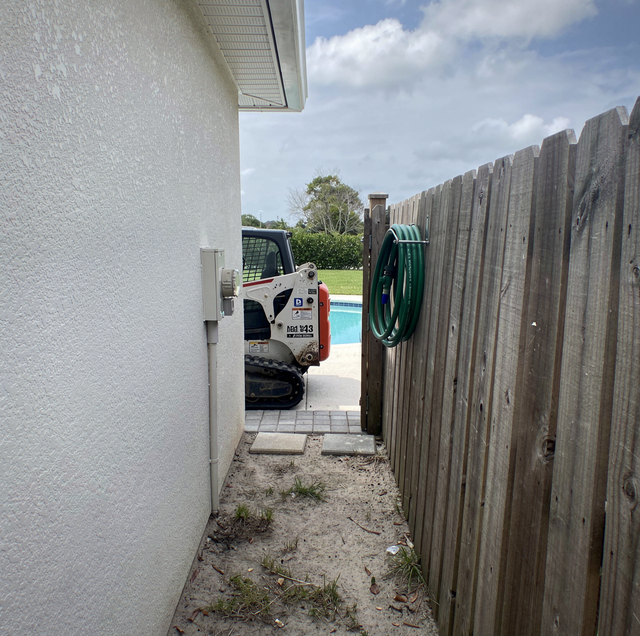
Quick Answer: Tight side-yard access rarely stops a pool removal. What determines the approach is the narrowest pinch point along the entire route to the backyard, along with overhead clearance and the volume of material that actually has to leave the property.
A side yard you have to turn sideways to walk down feels like a verdict on the whole job. It is really a measurement, and it governs two separate things: what size machine can reach the backyard, and how much material can be moved back out of it. The machine that does the work on a tight residential lot is a compact tracked unit rather than the largest thing on a jobsite, and the volume that physically has to travel back up that side yard is far smaller than the pool looks from the deck.
The Narrowest Point on the Route Is the Real Constraint
The gate is one point on a route that starts at the curb, runs down one side of the house, crosses the fence line, and ends at the pool deck. The job is governed by the tightest spot anywhere along that run, so a wide gate at the end of a run that pinches to nothing partway is no help at all.
The scoping side of this, how the route feeds into the size of the job, is covered in what decides the size of a pool demolition job. What that article does not do is name the obstacles, and they are ordinary enough to get overlooked:
- A bay window or chimney bump-out: The wall line is not straight, so the real opening is the one measured at the bump-out, not along the clear stretch either side of it.
- A retaining wall or a step down to lower grade: This pinches horizontally and vertically at once, since a machine changing grade needs a shallow approach and clear ground at the bottom.
- A hose bib or backflow assembly: Small, fixed, plumbed into the wall, and directly in the way at machine height.
- An air-conditioning condenser pad: The unit sits off the wall on its own pad, and the refrigerant line set, the disconnect box behind it, and the service clearance around it all take room the machine wants.
- A utility meter box: A shallow box still shifts the usable opening toward the fence, and it sits at the height a machine body passes rather than at ground level.
- A downspout and splash block: The downspout takes room at the wall, the splash block sits in the travel path, and neither survives a track running over it.
- A mature trunk: Widest at the root flare, exactly where a machine passes closest. Light-duty tree removal and limb work are services the crew handles, but a large mature tree over a house or a service line is a specialist's job, so the plan usually works around the trunk rather than through it.
You may have read that a machine can be lifted over a house when the side yard will not pass it. Other trades do that with a crane on some sites. This contractor does not run cranes, conveyors, or material-handling booms, so lifting a machine over the roof is not the approach here and is not what happens on these jobs. The route on the ground is the route the work uses.
Why Most of the Pool Never Leaves the Yard
On a gunite shell, which is most of them, broken concrete goes back down into the cavity, so the volume that has to physically leave the property is a fraction of the pool you are standing next to. The shell looks like an enormous quantity of material; the part carried up the side yard is a much smaller pile.
That one fact decouples the job from truck access. On plenty of demolition work, the limiting factor really is how close a truck can back up to the work, because everything broken loose has to be lifted into it and driven off. A pool removal does not run that way. The truck or container stands at the curb or on the driveway, and only the surplus makes the trip out. A route too tight for continuous truck-scale hauling can still move the quantity actually involved.
The size of that surplus depends on whether the removal is partial or full, which the article on partial versus full pool removal already covers. For access purposes, what matters is the ratio: the narrow route is not carrying the pool; it is carrying what remains after the cavity takes back what it can hold.
Overhead Clearance Is a Separate Check
A side yard that passes the tape at ground level can still be closed off above it, so vertical clearance gets its own walk.
- A low limb: A branch reaching over the side yard or the back corner of the lot sets the ceiling for anything moving under it. Clearing one may fall under the crew's light-duty tree and limb work or be assigned to a specialist, depending on the size of the tree and what is underneath it.
- An overhead service drop: The line from the pole to the weatherhead often crosses the exact corner of the yard a route wants to use.
- A deep eave or soffit: On a narrow side yard, the roof overhang can be the tightest point in the run, closing in from above while the wall closes in from the side.
- Gutters, floodlights and mounting brackets: Small hardware sitting right at canopy height.
The dimension being checked is the machine's tallest fixed point, canopy, or rollover structure, plus how high the arm rides while traveling. An operator can move with the arm carried low, so clearance gets checked in travel position as well as at work.
An overhead service drop crossing the work route is a live hazard and is never something to push past, prop up, or work beneath with a raised arm. Clearance around it is arranged with the utility before equipment moves.
What the Walk-Through Measures on a Tight Site
A walk-through on a tight lot is a measuring exercise with a tape and a camera:
- The narrowest point on each possible route, and where along the run it falls. Both sides of the house get walked, since the gate you use daily is not always the better route.
- Surface transitions: the lip where the driveway meets the street, a curb, a step between grades, a raised threshold across a walkway.
- Turn geometry at every corner.
- Overhead clearance, checked at those same points.
- Ground condition, and what sits just below it.
- Where the container stands, and where the machine stands while it works.
- Where deck material gets staged once it comes out.
Take the width with the tape held level and pulled tight, then check it again with a rigid stick laid across the gap. A tape that sags an inch reads an opening as passable that a machine will not clear.
What comes out of that walk is a decision rather than a page of numbers: which side of the house the route runs down, what gets protected first, and the order in which the work happens.
Protecting the Route the Machine Crosses
Once the route is settled, it gets protected. Mats or sheet material go down over the run so the tracks bear on the protection and the load spreads wider than the tracks alone. Turf under protection gets pressed flat and recovers; turf under a bare track gets torn, and a rut has to be regraded afterward. Along a residential route, what needs protecting is predictable:
- Turf and soft ground: The whole travel lane, for the machine and for barrow traffic, which wears a path faster than people expect.
- A paver walk: Pavers are individually bedded, so a point load can rock one out of plane or crack a corner. Mats bridge several at once so no single unit carries it.
- Irrigation heads: Located and flagged first, then covered or bridged. A head is a brittle fitting sitting slightly proud of grade, and repairs are an irrigation contractor's work, so along the route the plan is to not break them. Heads inside the work area itself are a different matter; covering them will pool and cause damage to the lawn, fence, or landscaping.
- Shallow service lines: Low-voltage lighting cable and irrigation laterals often run just under the surface along the same side yard, because that is where the easy trench line was.
- The driveway apron: The transition where wheels or tracks climb from street to concrete concentrates load at the lip.
Deck Removal as an Access Strategy
One part of the sequence does not move. The water still comes down, and the shell's floor is still perforated first, done from inside the shell and requiring no turning room at all, regardless of how the yard is reached. That step is covered in draining a pool before demolition. What a tight site changes is what happens after it. On an open lot, deck removal is one item in the sequence, and its timing barely matters. On a tight lot, it is the access plan.
The deck is usually the only flat, firm, open ground inside the fence line. Taking it out early creates a staging and turning area that did not exist when the crew arrived. Once the slab is gone, the machine has open, roughly level ground to work from and room to swing without pivoting on turf or squeezing between shell and fence. Deck material breaks up where it lies and travels a few feet instead of being walked up the side yard.
That is why the sequence on a tight site front-loads whatever creates room. The order of operations doubles as the access plan.
Moving What Actually Has to Leave
The surplus travels in many small loads rather than a few big ones. Barrows, a walk-behind track machine, or a compact loader all move material through an opening a full-size machine could never enter. Steel gets cut free and bundled so it carries in manageable pieces rather than as one tangled mat that snags on everything.
Loaded trips out and empty trips back share one narrow lane, so the route gets sequenced in one direction at a time and the pinch is never shared. Two people meeting there with a loaded barrow between them is how walls get scraped, and ankles get hurt, which is why the rule is one direction at a time rather than a matter of care.
A corner is a different problem from a straight run. A conventional machine turning sweeps its rear end through an arc wider than its body, which is one reason a reduced-tail-swing unit earns its place on a tight lot, and a loaded barrow needs room to swing the front wheel wide and set the legs down without clipping a wall or a fence post. A room at a corner is measured as a circle, not as the width along one side. A mid-route staging spot near the gate earns its place for the same reason: the machine keeps breaking and stacking without waiting on the trip out to the container.
Frequently Asked Questions
A grade change gets handled by shaping a temporary ramp from soil already on site and compacting it, so tracks climb and descend at a shallow angle. Letting a track drop over an edge loads the front idler hard and cuts a step into the lawn. The ramp comes back out during final grading, and sod can go over the disturbed strip.
Partly. Hand demolition uses electric or pneumatic breakers on the shell, with reinforcing steel cut free and bundled separately. It is slower and does not eliminate the need for a material route. Most tight jobs end up as a hybrid: hand breaking against a wall, and a compact machine working the open part of the yard once the deck is out.
Some lots really do have the house across the front and neighbors tight on both sides. The options are an agreement with a neighbor arranged ahead of time, a rear alley or service lane where one exists, or the second frontage a corner lot gives you when part of the fence line faces a side street. Arranging the first of those is between the property owners and not something the crew negotiates, and each option is confirmed before anything gets scheduled.
Rarely. A machine crossing is a brief moving load, and mats go down at the apron lip. The heavier concern is static: a container sitting in one spot for days rests its full weight on two long skid rails and its rear rollers, so it gets set on dunnage that spreads the load. Older concrete with an existing crack or a settled panel gets noted at the walk, and the dunnage gets placed to bridge it rather than sit on it.
Yes. Saturated soil loses bearing strength, so the same machine that crossed dry turf without a mark will rut a soaked route. Mats spread the load, and when a route is truly soft, the work shifts to tasks inside the fence line until the ground firms up. Sandy soils drain quickly, while soils holding more clay stay soft after the surface looks dry.
It does. Anything overhanging from the neighbor's side, a limb or a tall hedge, counts as an overhead obstruction the crew will not touch without the neighbor's say-so, so the route is planned under or around it. A neighbor's condenser, fence or planting close to the line is treated like any fixed obstacle: located during the walk, flagged and protected.
The jobs that go badly on tight lots are almost always the ones where a container was dropped, and a machine was booked off a photograph. The container ends up where the machine needed to stand, the machine ends up reaching over it, and a two-day job spends its first morning moving steel around a yard that was never measured.
Have the access route measured — the crew walks the whole run from curb to pool deck and plans the job around what it finds. Polk Services LLC serves Lakeland, Highland City, and Mulberry. Call (863) 344-5806.
