

Gravel Driveway Maintenance Schedule: 4 Timed Checkpoints
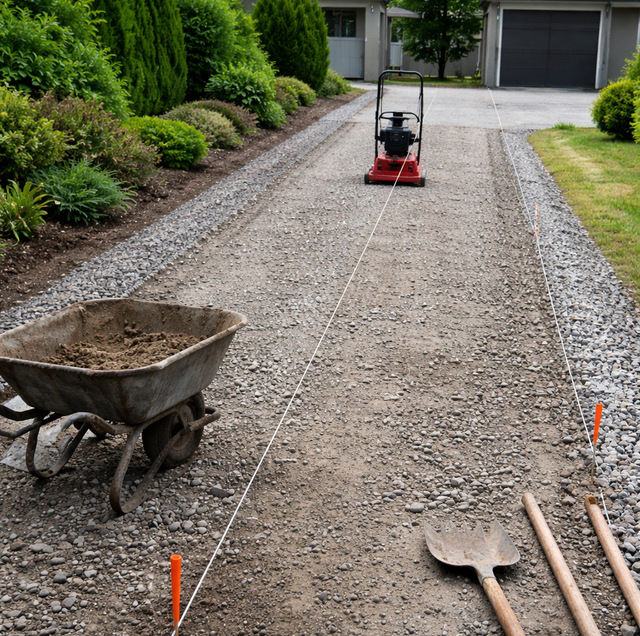
A gravel driveway wears down in small increments spread across months and years, not in one dramatic failure, which is exactly why a loose approach to upkeep lets small problems compound quietly until the whole surface feels different underfoot. The fix isn't more work; it's timed work: a handful of checks done at the right interval catch issues while they're still manageable, long before they turn into a full rebuild. Below is a practical schedule broken into four tiers, from things you glance at every so often to the signs that mean the base itself needs attention.
Routine Checks You Can Make Anytime
This tier doesn't need a marked date on the calendar, just a habit. Every few weeks, walk the length of the driveway instead of just driving over it, and look at three things.
Standing water: Any spot where water sits for more than a few hours after rain marks a low point in the grade, and low points tend to get lower as vehicles keep driving through them.
Thin or bare patches: Areas where the base layer or fabric underneath starts to show through the stone are wearing faster than the rest of the surface, usually because that spot carries heavier traffic or sits in a wheel path.
Edge drift: Gravel that has migrated past its original border and into the grass or a low ditch line is gravel that's no longer doing its job on the driving surface.
Spotting these early doesn't require immediate action on their own. It means you already have a priority list ready when you get to the once-a-year work below, instead of trying to remember where the soft spots were.
Once a Year: Regrading and Edge Restoration
Even a driveway that looks fine on a casual glance loses its shape a little every month. The clearest sign is the crown: lay a straightedge or string line across the width and check whether the center still sits noticeably higher than the edges. Once that check reads flat, the driveway has stopped shedding water the way it's supposed to, and a minor low spot is on its way to becoming a puddle that shows up after every rain.
The fix at this interval is a regrade: pulling migrated material back toward the center and re-establishing that crown, whether with a box blade, a grader attachment, or a mini skid steer on a smaller residential driveway. This is also the point to add a fresh topping of matching stone in the worn wheel paths and along edges where drift has been worst, rather than waiting for those spots to go bare. If your annual walk-checks flagged specific trouble areas, this is when you act on that list.
Every 3 to 5 Years: Assessing the Surface Layer
Annual regrading redistributes what's already there, but it doesn't add material back to the system. Over several years, overall stone depth thins as fines get pressed into the base, tracked off on tires, or lost past the edges faster than small top-ups replace it. At the 3-to-5-year mark, walk the entire surface, not just the wheel paths, and check depth broadly rather than spot by spot.
If you can see the base layer or geotextile fabric across wide sections of the driveway rather than in a few isolated wear spots, that's the signal to add a full fresh layer of stone across the whole surface instead of another round of patch topping. The stone you choose matters here: a chunkier, angular material tends to interlock and hold its position longer than a smaller, rounded stone, so a driveway topped with finer gravel may hit this checkpoint closer to the 3-year end of the range rather than the 5-year end.
Beyond 5 Years: Signs the Base Needs Rebuilding
Sometimes a fresh layer of stone doesn't hold, and that's a different problem than surface wear. It usually means the issue isn't the stone anymore; it's what's underneath, and that's a shift a short written log makes easier to catch than memory alone.
Keeping a quick note each time you do the 3-to-5-year surface check- how much fresh stone went down and roughly how long it held before thinning again- turns this tier from a guess into a trend. A driveway that needed a full topping at year 4 and again at year 6 is aging normally. One that needed a full topping at year 4 and again at year 5, with noticeably more stone the second time, is losing depth faster than fresh material can keep up with, which points to the base rather than the surface. That's also the point to check whether the original fabric layer, if one was installed, is still doing its job or has torn, letting the base start working into the soil above it.
There's no fixed date for this tier. Many residential driveways go a decade or more between full base rebuilds under ordinary use, but heavier or more frequent vehicle traffic, delivery trucks, trailers, or equipment shortens that window.
Fitting the Schedule to Your Driveway
The four tiers above are a starting framework, not a fixed calendar every driveway follows at the same pace. A driveway that only sees two passenger vehicles a day can often stretch each interval toward the longer end. One that handles a work truck, a trailer, or regular deliveries compresses faster, and the annual regrade may need to happen closer to twice a year to keep up. The tree canopy over part of the driveway retains moisture longer after rain, which can accelerate base softening in that section even while the rest of the driveway is holding up well. The routine walk-checks are what tell you which pattern you're dealing with, so use them to adjust the other three tiers rather than following the schedule blind.
Frequently Asked Questions
Consistency matters more than a specific week, but if you have a choice, schedule it after a heavier rain stretch has fully drained rather than during a dry spell. Regrading on saturated-then-drained ground gives you the clearest read on where water is actually pooling, so you correct the real low spots instead of guessing. Doing the work during a prolonged dry period can mask a grade problem that only shows up once the ground saturates again.
There's no single fixed number, but the practical trigger is visibility, not a percentage: once the base course or the geotextile fabric starts showing through the stone in worn areas rather than staying hidden under a full layer, that's the signal to top off. Waiting past that point means the tires contact the base layer directly on every pass, which accelerates both rutting and fabric wear.
That's usually a sign raking material back at the annual regrade isn't enough on its own for that specific spot, and installing physical edging, steel or timber edging along that stretch, slows migration between regrades in a way redistributing loose stone can't.
A driveway of typical residential length is usually regraded more efficiently with a mini skid steer and a grading attachment, especially for restoring the crown across the full width. Small, isolated spots, like a single wheel rut or a short stretch of edge drift, can sometimes be handled by hand with a rake and a hand tamper if you catch them early.
No. Fallen branches, leaf mats, or silt washed in during heavy runoff should be cleared as soon as it's safe to do so rather than left until the next routine or annual check. Debris sitting on gravel traps moisture beneath it, and that trapped moisture accelerates the same base-softening process that eventually shows up as a long-horizon rebuild signal.
It doesn't need to be an identical batch, but it should match the original stone's general size and angularity, not just its color. Mixing angular and rounded stone in the same surface layer can create loose spots where the two shapes don't interlock properly, undermining some of the stability the fresh layer was meant to provide.
Schedule a driveway assessment — get a clear read on which maintenance tier your gravel driveway needs right now. Polk Services LLC serves Lakeland, Highland City, and Mulberry. Call (863) 344-5806.
