

Removing a Pool Near a Well or Septic: What Breaks First
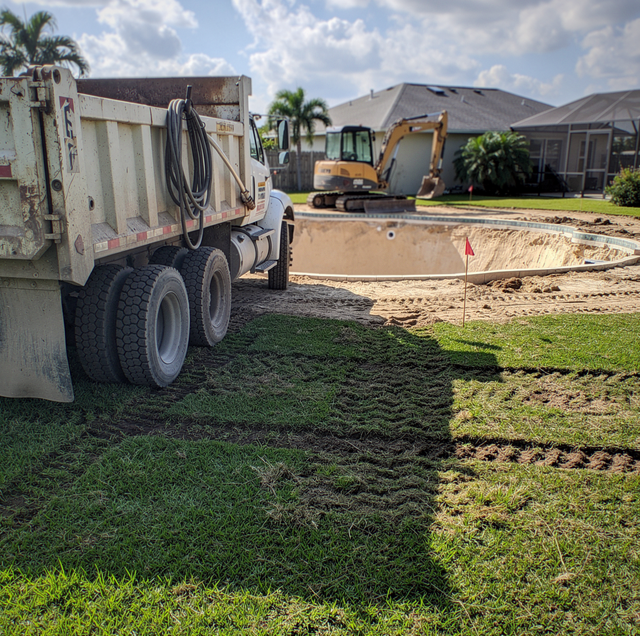
Quick Answer: A pool near a well or septic system is a routing problem more than a digging problem. The tank, the laterals, and the buried well line each fail in different ways, and each is managed by keeping the load off it.
On an older lot, the pool and the septic system rarely went in on the same day or as part of the same plan. Someone set the tank and the field where the soil drained and where a truck could reach. Years later, someone else put the pool where the yard had room and the afternoon sun landed. Nothing about their positions relative to each other was ever drawn on a page. Now the pool is coming out, and the question is less about breaking a shell than about where a loaded machine can stand, where a truck can back in, and what sits under the grass between them.
Finding the Tank, the Field and the Well
Before a plan means anything, the systems have to be on the ground rather than in memory.
The tank almost always has a lid, and on a newer install, a riser brings the lid up to grade, with a round cover you can see. Older tanks sit buried with no marker at all. Uncovering one is the septic contractor's work rather than a homeowner's: an exposed or unsecured lid is a hole in the ground with a confined space under it, and nobody should open one to look inside. A cleanout stub, a short capped pipe near the house, tells you which wall the line leaves from and roughly which direction it runs. Between the tank and the field, there is usually a distribution box, a small buried chamber that splits the flow into the laterals, which tells you the field lies beyond it rather than off to one side.
The field itself often prints on the lawn. Strips of grass over the laterals get more moisture than the ground between them, so they often stay greener in dry weather and grow faster after rain. Where the trench sits shallow, they can read the opposite way, thinner and quicker to brown, so what you are looking for is a repeating parallel pattern rather than a particular color. Look across the yard at a low angle, early or late in the day, and those parallel bands show up as stripes while the rest of the lawn stays uniform. That reading is a strong hint rather than a survey.
Records sometimes exist. Many counties keep a permit drawing on file with the health department, and property files, closing paperwork, and old inspection reports sometimes hold a sketch. Those are places to look.
None of that is the same as locating. A septic contractor locates and pumps a system; a demolition crew does not. If the tank cannot be found or the field edges are guesswork, bring in the septic contractor first and have the system marked before a machine rolls onto the lot.
What Actually Puts a Drain Field at Risk
Most people look at the excavator and assume it is the threat, because it is the biggest thing in the yard. It usually is not.
Ground pressure is weight divided by contact area. A tracked machine carries its weight on two long pads that lie flat on the ground, so the tonnage spreads over a large footprint. A loaded dump truck or a full roll-off container carries a similar weight, or more, on far less contact area: tire patches, or in the container's case, two narrow rails bearing on whatever happens to be under them. Divide by a much smaller area, and the pressure reaching the soil climbs sharply.
That flips the usual assumption. The danger to a drain field most often comes from the truck and the container rather than the excavator. A truck also moves in and out repeatedly, and repeated passes over one line do more to soil than a single pass ever does. Add the fact that a truck is loaded heaviest on the way out, exactly when a driver is least willing to take an awkward line, and the traffic pattern becomes the thing to control.
How a Drain Field Fails under Load
A drain field is not a solid object you can bruise and inspect. The laterals are perforated pipe laid in gravel trenches, with soil backfilled over the top, and the arrangement only works because the soil around and below the gravel remains open. Water leaves the pipe, moves through the stone, then soaks into soil full of small connected pore spaces.
Compaction closes those spaces. Press the soil and the grains pack tighter, the voids between them shrink, and water that used to move down through the profile starts to sit. The pipe can be perfectly intact, and the field can still stop working, because the failure is in the ground around the pipe.
Crushing is the other half. An excessive load in the wrong spot can collapse the pipe itself or shift the stone, so flow no longer spreads along the lateral. Either way, nothing about the damage shows at the surface on the day it happens. The lawn looks the same. Weeks or months later the system backs up, and by then the link between the container that sat in that corner and the problem inside the house is easy to miss.
That delay is the whole argument for routing around a field rather than testing whether it holds; there is no way to check afterward except to wait.
The Tank Lid and the Riser
Crossing a field is a pressure problem spread over a wide area. A tank is different: a buried structure with a void inside it and a lid spanning the top.
A tank lid spans an open void. A lid that holds a person can fail under a wheel or a track, and a collapse drops whatever is on top of it into the tank. Keep every machine off it.
That lid was made to carry the soil above it and nothing heavier. Older concrete lids age, the steel inside them rusts, and the bearing edge where the lid rests on the tank wall can spall away. A riser makes the lid easier to find and hit, since a riser ring with a light cover sits right at grade, where a tire can find it before a driver sees it. Once it is flagged, the route avoids it. A machine that needs to reach past the tank can usually work from a standing position off to the side, since an excavator works at reach.
The Well Casing and the Line to the House
A well appears as a steel or plastic casing standing above grade, with a cap on top. The cap keeps surface water and debris out of the casing, and it is easy to clip with a bucket swinging past or a mirror on a backing truck.
The bigger risk is buried. Somewhere between the well and the house runs a supply line, set at trench depth on a path nobody wrote down. A bucket tooth through that line, or a track that shifts the soil enough to pull a fitting apart, takes the house off water and puts a repair on the well contractor's schedule in the middle of a demolition. The safe working assumption is a straight run between well and house until someone proves otherwise.
Ground right against an older casing deserves the same care. Excavating close to a casing removes the soil that has been holding it steady, and a casing that gets nudged or loses its seal at the surface becomes a well contractor's repair. Well drilling, well repair, and anything inside the casing sit outside what a demolition crew does.
Where Pool Water and Washdown Go
Water is the part of the job people forget to route. The article on draining a pool before demolition covers groundwater and uplift, so the point here is only where that water ends up once it leaves the shell.
A drain field already carries a steady load from the house every day, and it works by providing water a path to move down through the soil. Putting a large surface volume onto the same ground saturates the soil the field depends on, and saturated soil compacts more easily under a wheel than dry soil does, which stacks one problem on the other. Washdown from cutting concrete and rinsing equipment counts too, smaller in volume but landing in one spot repeatedly.
The plan should name where the discharge goes and where the hose runs, in the same breath as where the truck parks. Both get decided before the first machine arrives.
One Route in and One Place for the Container
Everything above turns into three decisions.
Give the container company the drop location in writing. The driver who sets the box is often not the person who took the booking, and a box set well off the mark does not get repositioned once it has load in it.
One defined route: Pick a single path from the street to the pool and use it for every trip. One line across questionable ground beats five casual ones, because the compaction stays confined to a strip you chose.
Mats where the route has no choice: On a lot where the only access crosses part of the field, ground protection mats distribute a wheel load across the entire mat footprint rather than the tire patch. They go down before the first pass, since the earliest passes do the most to soil structure.
A container spot clear of the system: The container sits still and loaded for the length of the job, which is a sustained load in one place. Set it on the driveway or another hard surface if at all possible. If the driveway sits out of the machine's reach, moving material a longer distance beats parking loaded steel over a lateral.
Before anything rolls, have the tank, distribution box, field edges, and wellhead marked on the ground, and have the crew lead see all four in person. Ten minutes of walking changes more than any decision made later.
Frequently Asked Questions
The job can still be planned, starting from the safest assumption: treat the entire corridor between the house and the likeliest field as off-limits until it is marked. A septic contractor can trace the line electronically from a cleanout, producing a real line on the ground rather than a guess, and mark the field edges from it.
Not automatically, and the sharper difference is not size but how a machine turns. A tracked machine that counter-rotates in place shears the top layer of soil sideways, which does more to soil structure than driving straight across the same ground ever does, so straight travel and wide turns taken off the field belong in the operator's brief.
That slab has been acting as a load spreader, and removing it leaves the ground beneath it exposed. The machine stays on the remaining slab or on native ground away from the field rather than tracking onto the portion above the laterals, and the deck above the laterals gets broken from the far edge back so the breaker is never working directly over a trench. Working back toward the machine that way also means the exposed ground never carries the machine that exposed it.
Removing a pool does not touch the tank, so pumping is not part of the demolition. If a septic contractor is on site anyway to locate the system or look at the lid, pumping is their call and their work. One thing to know: an empty tank in saturated ground can be pushed upward by the surrounding water, which is one reason pumping is deliberately scheduled by the contractor who owns that system rather than treated as a convenience.
Two habits do most of it. Mark the casing with a tall stake or flag that stands above any spoil that piles up, because an operator's sightline disappears once material starts to stack. Then box it: a timber or plywood surround built around the casing keeps a swinging bucket or a passing tailgate off the cap. The box comes off at the end of the job, and the cap gets checked to confirm it is still seated.
Three symptoms, in the order they usually appear: fixtures draining slowly inside, ground over the field staying soft or holding water after ordinary rain, and grass in the lateral strips changing behavior against the rest of the lawn. A photograph of the field area before work starts gives a septic contractor something to compare the grass pattern against later, which is otherwise impossible to judge from memory. If something changes, a septic contractor evaluates it, and that diagnosis and any repair belong to them.
The one thing a homeowner can provide that nobody else can is the location of everything. Old paperwork, a remembered pumping visit, the corner of the yard that has always stayed soggy, the spot the previous owner told you never to park on: all of that is worth saying out loud, because it is faster than any amount of looking at grass.
Talk through the site before the machines arrive — the crew plans the route around your tank, field and well. Polk Services LLC serves Lakeland, Highland City, and Mulberry. Call (863) 344-5806.
