

Can You Build over a Filled-In Pool? What Decides It
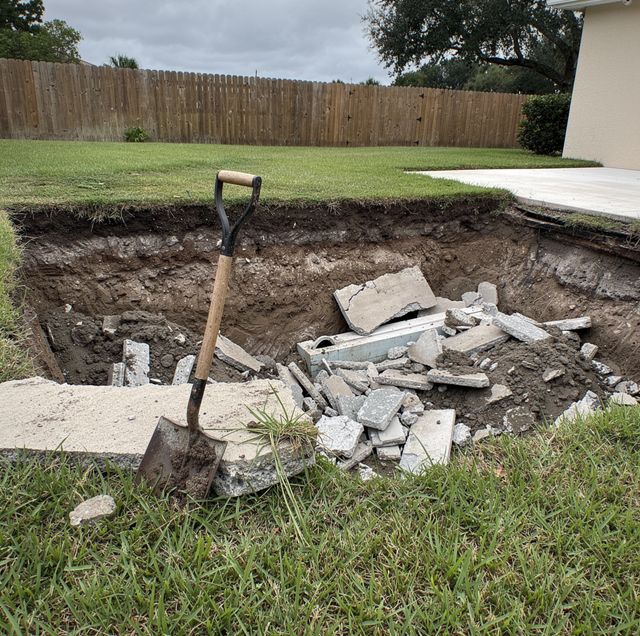
Yes, you can build over the footprint of a filled-in pool, and it is done routinely. Whether it goes well depends almost entirely on a decision made before demolition starts, rather than after: what that footprint will become.
Most people ask about ground that is already filled, which is late. Everything that determines the answer is decided while the shell is still in the ground, and once the fill is in, changing it means digging the footprint out a second time.
Yes, and the Qualification That Comes with It
The honest short answer comes with a warning, and that warning is real. A filled cavity is ground that was placed rather than ground that was simply there. Undisturbed ground around the old pool has been sitting and consolidating for as long as the property has existed. The material inside the old shell has been there since the day a crew put it in, and it behaves according to what went in and how carefully it was placed.
That is the whole of the concern. It is not that filled pools are inherently unstable. It is that a filled footprint sits next to ground with a completely different history, and any surface laid across the boundary between the two has to accommodate their different behavior.
There is one version of the work that is not a base for building on, and it is not a defect: a partial removal deliberately leaves the lower shell in the ground, floor perforated so it drains, under compacted fill. That is sound ground for lawn or garden, and it is not ground for a structure, because an intact wall line runs through the footprint at a depth nobody can see. Beyond that, the range of outcomes has less to do with the pool than with what the crew was told to prepare the ground for.
Decide the end use before you schedule the demolition. Telling the crew a slab is coming changes what gets hauled off and what gets buried, and that choice cannot be undone once the footprint is filled.
Sort the Question by Load, Not by the Pool
The useful way to think about it is not whether a filled pool is safe to build on, but how much a particular end use asks of the ground beneath it. That question has a ladder, and every rung changes what the demolition should do.
Lawn and planting beds sit at the forgiving end. Sod and root systems tolerate uneven surfaces and slight movement, and if a low spot appears a season later, it is filled with more soil.
Hardscape sits in the middle and is the rung people underestimate. A patio, a walkway, or a paver field spans the ground rather than following it. A soft pocket under one corner does not remain a local problem, because the rigid surface above it telegraphs outward movement as a dip, a lipped joint, or a crack that opens along the weak line.
Anything with a foundation is the demanding end, and that end belongs to whoever designs and builds the structure.
| End use | What it asks of the ground | How a weak pocket shows itself | What that means for the demolition |
|---|---|---|---|
| Lawn, planting beds, open yard | Very little. Roots and sod tolerate unevenness and small movement | A shallow dip noticeable after rain, corrected with soil and new sod | Burying the broken shell in the cavity is usually fine |
| Gravel drive or parking pad | Moderate. Loose stone shifts with the ground under it | Ruts and a settled wheel track needing regrading and more stone | Burial generally workable, with real attention to how the fill was placed |
| Patio, walkway, paver hardscape | High across the whole plane, because the surface spans rather than follows | A visible low spot, a raised joint edge, or cracking over the soft area | Uniformity of the fill matters more than the depth of it |
| Freestanding slab building or shed | Higher still, concentrated toward the slab edges | Cracking, a door that stops latching, a slab out of level | Hauling more of the shell off the property becomes the usual answer |
| Anything with a foundation, or attached to the house | The demanding end. Requirements are set by whoever designs and builds it | Movement that surfaces in the structure rather than in the yard | The designer decides; demolition supplies uniform ground and a record |
The Trade Buried in the Cavity
Breaking the shell and the deck and burying that material in the cavity is standard practice, and it is standard for a good reason. Every cubic yard of broken concrete that stays on site is a cubic yard of fill dirt that does not have to be imported and a load that does not have to leave the property.
But it has a consequence that only matters at the top of the load ladder. Ground that received the broken shell is not uniform material. It is a mixture of concrete pieces of varying size with fill knitted around and between them. When compacted properly, in thin layers rather than dumped in one go, it makes perfectly good ground for a lawn, beds, and, in most cases, gravel. What it is not is consistent from one point to the next, and consistency is exactly what a rigid surface or a bearing structure cares about.
So where a structure is planned, the usual answer inverts. The more of the shell is hauled off the property, the more clean fill is imported, and the crew deliberately gives up the displacement advantage to get ground that is the same material all the way across the footprint. That is a real trade, taken in extra hauling and extra imported material, and it is made on purpose and in advance because of what is coming later.
The difference is real, but it is not something a homeowner is well placed to judge from the surface, which is why the record of how the fill went in matters more than any test done afterward.
Who Sets the Requirements, and What They Will Want to Know
The people who design and build the structure set its requirements. Not the demolition crew, and not an article. What the demolition controls is what is actually down there and what record exists of how it got there.
Approaches for building over a filled footprint run from a slab designed to span the fill at one end to excavating the footprint and replacing the material entirely at the other. Both are legitimate in the right situation, and both are the structure designer's call to make, informed by what the ground actually is. A demolition contractor's job is to make that ground knowable rather than to pick the answer.
The same holds for the question that comes up most often, which is how close a new structure can sit to the old pool line. That is not a distance to take from anywhere but the person designing what is being built. What is worth knowing is that the disturbed zone is always wider than the pool was. Machines need room to work along the walls, so the ground that got opened up extends past where the coping used to sit, and the boundary between placed and undisturbed material is not the outline you remember.
What to Keep in Writing Afterward
Three things are useful to hold onto once the job is done: what was left in the ground, what was hauled off the property, and how the fill was placed and compacted. None of this is an obligation. It is simply far easier to have than to reconstruct, and it is the first thing a builder or designer will ask about years later when the footprint stops being a memory and becomes a site.
Ask for photographs of the open cavity, the material going in, and the finished grade. A record of what is under the footprint is far easier to gather during the work than to reconstruct afterward.
Why the Window Closes
The reason this has to be decided early is blunt. Once the shell is broken, buried and covered, changing the answer means excavating the footprint a second time, pulling out material that was just placed, and starting the fill over. The work is not impossible. It is the same work twice.
Time is also part of the picture. Placed fill keeps settling after the crew leaves, and no single number covers how long, because it depends on the material, the placement, and the ground it sits in. That is why the record matters more than the calendar: what was hauled, what was buried, and how it went in is knowable on the day and close to unknowable afterward.
Frequently Asked Questions
It changes what the fill column is made of, which is the part that matters here. A gunite shell buried in its own cavity leaves ground that is concrete pieces with fill knitted between them, so uniformity is the thing to watch. A fiberglass or vinyl-liner pool contributes very little material to the hole, so the column ends up closer to plain imported fill and closer to uniform without anyone deciding to make it so. How each shell type comes apart is covered in what goes back into a cavity.
It does, and not for the reason people expect. Buried steel is inert as far as the fill is concerned. The issue is depth: the bar, sitting near the top of the fill column where a former wall line ran, is exactly what a shallow-footing excavation meets first. A slab edge sited over an old wall line can mean steel at spade depth, which is worth knowing before the trench is set out rather than when it is dug.
Skimmer and return lines run out from the shell to the equipment location and are pulled where they are accessible, so they cannot channel water along their length. What happens to the runs that cannot be reached, including the main drain under the deep end, is covered in what goes back into a cavity. The equipment pad itself is a small concrete slab, and it usually comes out in the same visit as the deck since the machine is already on site.
Often more, because it is usually the larger area and it is the part a patio or slab is most likely to sit on. Deck concrete was poured on ground that was never excavated to pool depth, so once it comes out you have a shallow disturbed band around a deep disturbed core, two different depths of placed material meeting under the same future surface. Where the slab edge lands relative to that change is worth knowing before the design is finalized.
Those concentrate their weight onto a handful of post locations rather than spreading it, so even a light structure asks a lot of a few small spots. Where those posts land relative to the old shell walls matters, and a post that lands on the boundary between placed fill and undisturbed ground is in the worst spot of all, because the two sides of it settle differently.
Before, always. The point specific to building is that the window is short, and it closes on its own: once sod, pavers, or a slab goes over the top, the surface stops reporting anything, and the reading has to be taken in the months between the crew leaving and the covering going on.
The decision in front of you is a small one, and it has to be made when you are booking the demolition, rather than when you are planning the patio. Name what the footprint is going to become, say it out loud before the method is set, and the crew can build the job around it. Say nothing, and the ground gets prepared for the most common answer, which may not be yours.
Planning a pool removal with a patio, slab, or structure coming after it? Tell us the end use before demolition is scheduled so the method can be tailored to it. Polk Services LLC serves Lakeland, Highland City, and Mulberry. Call (863) 344-5806.
