

Trees or a Garden Where a Pool Used to Be: What Works
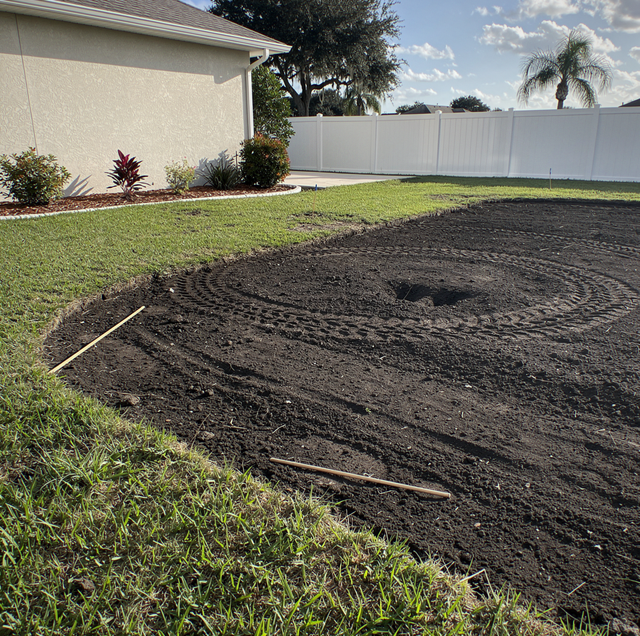
Roots are not just an anchor. They are how a plant drinks and how it breathes, so a root system needs loose material it can push into, air pockets between the soil particles, and a path for water to move away once it has done its job. Grass asks very little of that. A tree asks a great deal of it, spread wide and reaching well below the surface. That is the real question behind planting over a filled pool cavity: not whether something can physically grow there, but whether the ground underneath offers what that particular plant needs.
Quick Answer: Grass, shrubs and bedding plants generally do fine in the topsoil above a filled pool. A tree is the harder call: its roots eventually reach the fill or the old shell below, and what is down there shapes how it grows.
A patch of undisturbed yard, built up over years of settling, root activity, and organic breakdown, is not the same ground as a cavity filled on a schedule, in layers, with material chosen for stability instead of for growing. The two support very different things.
The Layers under That Patch of Yard
A filled pool cavity is not one uniform block. It is built in layers, and each layer answers a different part of the planting question.
- Topsoil: Placed on top at the end of the job, and the layer any lawn, bedding plant, or vegetable start actually roots into.
- Clean fill: Dirt placed and compacted in stages below the topsoil, with nothing in it that will rot, compress or hold a hollow. That is the whole point, since anything that breaks down later leaves voids under whatever sits above it.
- Broken shell material: In both a full and a partial removal, the broken shell and deck concrete usually go back into the cavity and the fill knits around the pieces. What differs is the floor. A partial removal leaves the old pool floor in place with holes cut through it. A full removal breaks that floor out along with everything else.
A lawn only ever touches the first layer. A tree, given years, eventually reaches all three.
Why a Lawn and a Tree Get Different Answers
This is the central distinction, and it is worth being precise about it rather than treating planting as a single question with a single answer.
Grass and shallow-rooted bedding plants are satisfied by the topsoil layer alone. Their roots remain in the loosely worked layer at the surface, and as long as that layer is reasonably deep and properly worked, they do not know or care what lies beneath it. That is also why a lawn over a filled cavity pairs naturally with sod installation: the growing need is shallow, and surface preparation is what matters most.
A shrub wants more room than that. Its root system spreads wider and reaches somewhat deeper than a lawn's, so a shallow topsoil layer that grass tolerates without complaint can leave a shrub cramped once it matures.
A tree wants far more again. Given enough years, a tree's roots reach past the topsoil into the fill column, and eventually toward whatever sits at the bottom of it. When roots meet compacted fill, they tend to spread sideways along the boundary instead of pushing straight through it, and when they meet broken shell or a solid floor, they do the same thing. A tree can still grow well over ground like this, but its root structure ends up shaped by what it ran into as much as by the species itself.
Before committing to a tree's spot, take a probe reading in several places rather than one. A single sounding over the old deep end reads nothing like one taken a few steps toward where the shallow end used to be.
Where the Water Goes
Water follows the same path down through this ground that roots eventually do, and what happens when it reaches the bottom of the fill column matters as much as depth does.
Rain and irrigation move down through the topsoil, then through the fill beneath it, until they reach whatever is at the bottom. In a full removal that is undisturbed native soil, water carries on into it much as it would anywhere else in the yard. In a partial removal, that is the old pool floor, and this is exactly why the floor is perforated rather than left solid: the holes let water keep moving down instead of collecting on top of an intact concrete pan and turning the fill column into a slow-draining tub.
For planting, the practical effect is that a properly filled cavity should not hold standing water at the surface any differently from the rest of the yard. If a section of ground over an old pool stays soggy well after everything around it has dried, that is worth noticing before you plant anything with roots that dislike wet feet, because it points to a drainage problem in that spot rather than a normal condition of filled ground.
Checking the Growing Layer before a Garden Bed
A vegetable bed lives entirely in its root zone, so the question is not whether the ground can technically support a garden. It is whether the growing layer over the fill is deep enough for what you intend to grow, and that is worth settling before you plant rather than after.
The relationship is simple even without a number attached to it. A bed of shallow-rooted greens or herbs asks less of the topsoil than a bed of tomatoes, squash, or root vegetables developing a deeper, wider root mass over a full season. If the topsoil feels thin when you dig a test hole by hand, that is a signal to build the growing layer up before planting straight into what is there. Additional topsoil can be brought in and worked into the existing layer to deepen a bed; that is surface preparation, not a change to the fill column underneath.
This is also where the boundary between the crew's work and a planting decision is worth being clear about. The contractor grades the ground, lays the topsoil, and can install sod as a finished lawn surface. Choosing what to plant in a bed, spacing it, and deciding what will do well in your soil and light is a call for you or for a nursery or grower to make.
Why a Partial and a Full Removal Give Different Tree Answers
The difference between a partial and a full removal, covered elsewhere for how each affects the project itself, also changes what to expect from a tree planted over that ground years later.
Both usually leave broken concrete in the ground, so the difference is rarely whether anything hard is down there. The difference is whether what is down there is continuous.
A full removal breaks the floor and the walls out with everything else, so what sits below the fill is broken pieces at every size, with dirt worked into the gaps between them. Roots work down into that, meeting edges and gaps rather than the surface, and they can often find a way past a piece and keep going.
A partial removal leaves the old floor in place, perforated but continuous, with the lower wall line still standing around it. Roots reaching that meet a surface rather than a scatter, and they stop deepening at it and run sideways along it instead. The lawn and bedding-plant answer is the same either way, since shallow plants never reach that far down. The tree answer is where the two actually diverge.
A partial removal leaves an intact wall line following the old pool's edge, below the fill but shallower than the rest. Dig by hand rather than by machine anywhere along that line before planting into it.
Settlement and Timing
What matters for planting is narrower than that. A tree or a shrub is set to a root flare, and a root flare set while the grade under it is still moving does not stay where you put it: it ends up buried as the surface drops around it, or standing proud as the ground beside it falls away. A lawn you can patch and regrade. Something meant to stand for years you cannot.
Frequently Asked Questions
For shallow-rooted plants, largely yes. A raised bed built with its own soil sits above the native profile, so a garden's typical root zone stays entirely within soil you controlled, regardless of what is in the fill below. A tree planted inside or near a raised bed still eventually sends roots down past the bed's own soil and into the fill underneath, so a raised bed does not change the answer for a tree the way it does for annuals and vegetables.
Yes, though a sharp interface between two different soils becomes the depth at which roots stop and turn, which is the opposite of what deepening a bed is meant to achieve. That is the reason new material gets blended into the layer already there instead of laid across the top of it: what you are after is one growing zone that reads continuously, and not two stacked ones with a boundary between them.
No. Edging, timbers, or a low wall around a bed only shapes the surface and holds soil in place at ground level. None of it adds depth to the fill column beneath the bed or changes where the fill, the shell material, or the old floor sits. Depth still has to come from the growing layer itself rather than from its borders.
For growing, no: it's treated like the rest of the footprint and isn't assumed to be better ground just because equipment once stood on it. For probing, yes, and this one matters. Abandoned conduit and a capped gas line can still be inside that footprint, so keep the probe well clear of where the pad stood and take your depth reading elsewhere over the old cavity.
Yes, and so does where over the old pool it goes. Over the old shallow end, the fill column is thin and whatever is below it sits closest to the surface, so a deep-rooting tree meets that boundary soonest. Over the deep end, the column is at its thickest, and a root system has the most loose material to work in before it meets anything at all. A small ornamental tree is forgiving of either. A large shade tree does better over the old deep end, or off the footprint entirely.
Exposure matters more over a filled footprint than it would in open ground. A root plate grown wider and shallower than the species normally builds holds well against ordinary loads and less well against a steady push from one side, so a tree going in on the exposed edge of a yard, with nothing upwind of it, is the case where support through establishment earns its place. How long that support stays on is a call for whoever plants it, since leaving a tree staked too long works against the trunk taper that eventually holds it up on its own.
Five years on, a yard that got this right does not read as a filled pool at all. The lawn runs unbroken across the footprint; a bed sits wherever the growing layer was built up for it; and the shade tree stands over what used to be the deep end, the part of the footprint with the most loose material beneath it. Five years on, a yard that got it wrong is legible from the patio: a shallow dish holding water after rain, a tree standing slightly out of plumb, a bed drying faster than the one beside it. Both yards started from the same ground, and the difference between them was settled by a probe and a decision about where things went.
Ask about grading and sod after a pool removal — the crew finishes the ground and lays the lawn once the fill has had time to settle. Polk Services LLC serves Lakeland, Highland City, and Mulberry. Call (863) 344-5806.
