

Removing a Pool Before Listing: How the Timeline Fits
Quick Answer: Pool removal before a listing runs as a chain of dependencies. Utility disconnection and permit processing gate the dig, and the two stages after grading, ground settling and surface establishment, run on their own clock.
Most demolition work gets scheduled around when the machines and the crew are free. A pool removal ahead of a listing is not planned that way, because the end date exists before anyone has walked the yard. The question stops being how fast the shell can come out and becomes which parts of the job can be pulled earlier in the calendar and which parts refuse to move at all.
Scoping and Scheduling the Work
Nothing downstream can be booked until someone has stood in the yard and agreed what is coming out and how the ground will be left. That visit produces a scope and a sequence, and the sequence is the part that matters here, because every later stage inherits its start date from the one before it. Whether the removal is partial or full is its own decision, with its own article; the schedule only cares that the decision is made and does not leave it open.
What sets the length of this stage is usually you rather than the contractor. Three things can start the same afternoon the scope is agreed:
- Book the licensed trades: The disconnection work belongs to them, and their calendar is not the crew's calendar.
- Answer the deck and fence questions: Both change the scope, and a scope that keeps changing cannot be scheduled.
- Clear the yard: What to move before a pool demolition crew arrives is covered in its own article, and none of it waits on anything else being finished.
Started early, those three stop being the item everyone else is waiting on. Left until the crew calls to confirm, any one of them can push the whole chain back.
Utility Disconnection by the Licensed Trades
Power to the pump and any heater, the water feed, and a gas line, if a gas heater sits on the pad, all have to be addressed before machines go near the shell. A licensed electrician, plumber, or gas fitter does that work. The demolition crew does not, and should not be asked to. Pool utility disconnection has its own article; what the schedule needs from it is that it gates everything behind it and cannot overlap the dig.
An abandoned pool circuit can stay energized even with a breaker labeled off. A pad fed from a subpanel can also carry a second feed the main panel never names, which is why the electrician traces circuits rather than trusting labels.
This is the stage that slips most often, and the reason is scheduling, not difficulty. What you are asking for is a slot on somebody else's calendar, so make that call early in the project, before a dig date is on paper.
Anything That Has to Be Filed Runs in Parallel
Where the job involves an application to the local building office, that step has its own queue, which belongs to the office. The contractor does not set how long a review takes and cannot move it along by working faster. Sort out at scoping who is submitting whatever needs submitting, so the application is not sitting on a desk waiting for someone to claim it.
The useful move is to start this alongside the trade bookings instead of after them. A pending application does not need the yard clear, the equipment dead, or a machine on site, so treating it as a step that follows the prep gives away the front end of your own schedule for nothing.
Demolition and Backfill
Three things must be true before this stage can open: the utilities are disconnected and verified, anything that needed to be filed is resolved, and the yard is clear enough to work in.
What sets the length is the amount of material moving and the way the fill is placed. Fill goes in as lifts, and each lift is compacted before the next one goes on top of it. That is a sequencing rather than a crew-size problem: a second machine does not allow anyone to compact two lifts at once. It is also the stage where doing the work properly and doing it quickly pull against each other, which is why arriving here with room left in the calendar is necessary.
Final Grading Sets the Shape Water Follows
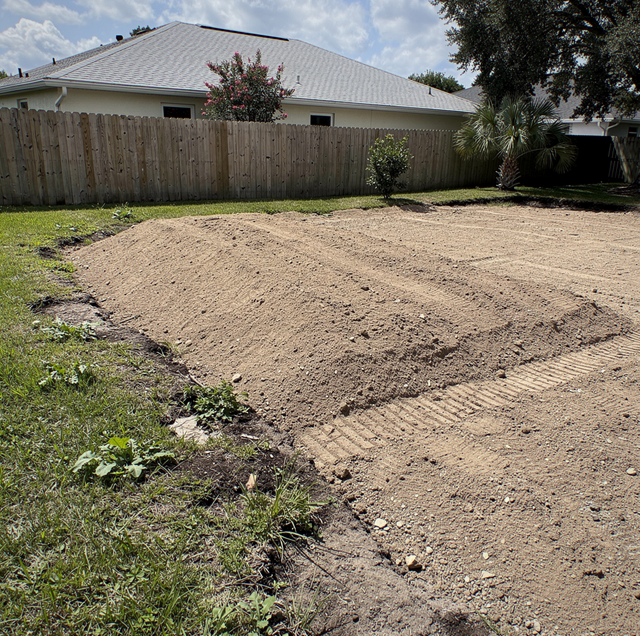
Grading begins once the fill is at elevation and compacted. It ties the new ground into the surrounding ground, sets the fall away from the house, and fills the ruts the machines left behind. Its length is set by the area, by how much material has to be brought in or pushed around, and by whether the ground is dry enough to hold a blade.
Grading is the line in the project worth marking on your calendar, because it is the last stage anyone can hurry. Everything before it is schedulable work performed by on-site personnel. Everything after it happens whether anyone shows up or not.
Settling Runs on Its Own Clock
A filled pool leaves a column of material far deeper than the surrounding soil. Compaction in lifts takes out most of the consolidation, though never all of it: water moves down through the column, fines migrate into voids, and the material carries its own weight onto itself. The surface answers by dropping, usually most over the deepest part of the old shell, which is why a settling fill tends to show a shallow dish rather than an even drop across the area.
No amount of crew time shortens this. There is no version of the job where more people make a column consolidate sooner. Water moving through the fill is the only real influence anyone has over it.
Establishing a Surface over the Fill
Sod arrives as a mat and is attached to nothing. It looks finished the moment it goes down, and it does not behave like lawn until its roots have grown down out of that mat and knitted into the soil beneath.
What the schedule needs from it is one thing: the order matters. Sod laid over ground that has not finished consolidating follows that ground down, so a dish that would have been a quick regrade on bare dirt becomes a low spot with turf sitting in it, and correcting it afterward means lifting sections and resetting them instead of running a blade over open ground.
Ask where the finish grade over the fill sits relative to the surrounding yard, and get it resolved before the crew leaves. Without that reference, a shallow dish later is impossible to tell from the grade you were given.
Why the Yard Looks Unfinished after It Is Finished
Finished for the crew and finished in a photograph are two different standards, and the gap between them is the part people miss. Fresh sod photographs as fresh sod: the seams read as lines, the new area sits at a different color from the rest of the yard, and no mowing pattern runs across it because it has not been mowed. A regraded strip reads the same way, and so do tire tracks, the scar where material was stockpiled, and the bare ground at the edges where the machines turned around.
None of that is a defect. It is what a yard looks like shortly after it has been worked, and a camera records it accurately. The visual finish comes after the physical one, and how much later depends on the two stages nobody can control. That gap belongs on the calendar rather than arriving as a surprise the week everything else is ready.
Frequently Asked Questions
It changes the middle of it. Fill cannot be compacted when the material is too wet, so a soaked site means spreading material out to dry it back before it can be placed and rolled, and machines working saturated ground rut it and pump the subgrade. Sod is the other weather-sensitive step, since it requires moist ground and suffers in standing water or baked soil. Neither delay can be worked around by pushing the crew harder.
Not indefinitely. Paint and flags fade, wash off, or get mowed away, and a locate is tied to the work window it was requested for. If your start slides, the contractor goes back to the locating service before anyone digs, and that turnaround belongs to the service rather than to the crew. It is a small item that quietly becomes the reason a rescheduled dig does not start on the new date either.
It behaves differently on a schedule. Seed begins as bare soil and passes through germination and thin, patchy coverage before it reads as lawn, and germination answers to soil temperature and frequent light watering rather than to a calendar. Seed does have one advantage over fill that is still moving: reseeding a low spot after a touch-up regrade is far less involved than lifting and resetting turf.
Because cut sod is perishable, and a pallet that waits is a pallet that has to be reordered. That reorder is a fresh slot on a grower's calendar and a fresh delivery, so a sod date that slips does not slip by the day it was missed; it slips to whenever the next load can be cut. It is the one item in this whole sequence where being ready early is worth more than being ready on time.
Lines and heads inside the work area do not survive the dig; that is an expected outcome of clearing the footprint, not something to be solved beforehand. The repair belongs on your schedule. Rerouting the zone and resetting heads afterward is work for whoever maintains the system, and it has to land between final grading and sod, because a new lawn going onto ground with no working zone over it is a lawn you will be watering by hand. Book it when you book the sod, not after.
On a schedule, the only question is whether the picture is still changing between soakings. Something that keeps moving after each heavy rain is a column still tightening, and something that reads the same across several of them is the signal the surface work has been waiting for.
Nothing on this list is long on its own. An application, an electrician's slot, a dig, a grade: each one is short, and each one inherits its start from the thing before it, which is what turns a set of short items into a schedule that runs past a date nobody can move. A fixed end date does not need a faster crew. It needs the front of the chain called in the same week the removal is decided, so that the one stage which refuses to be hurried at all still has calendar left when it finally starts.
Get the pool removal on the calendar early — the crew handles demolition, backfill, final grading and sod installation so the yard has time to settle, on pool demolition in Auburndale and across the radius. Polk Services LLC serves Lakeland, Highland City, and Mulberry. Call (863) 344-5806.
