

Concrete Spalling, Scaling and Pop-Outs: Patch or Remove
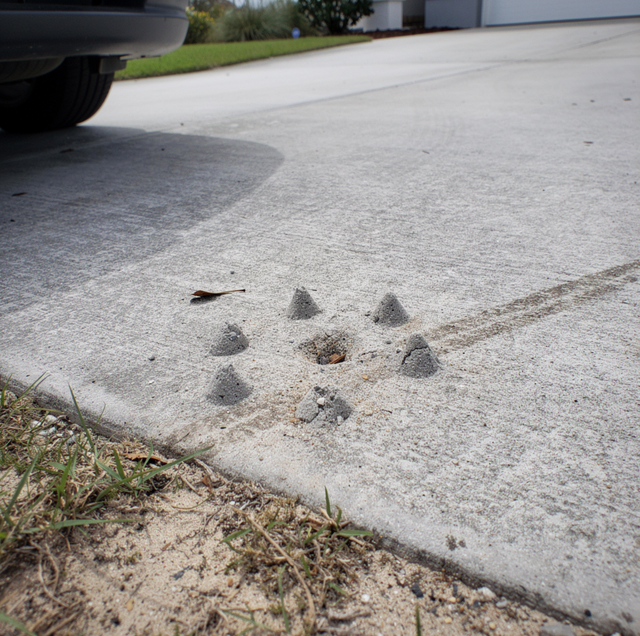
You sweep the driveway, and the broom brings up more than leaves. There is a fine gray grit riding in the bristles, and the patch it came from now reads a shade lighter than the concrete around it. Drag a shoe across that patch and a thin flake lifts and crumbles. Over by the garage door, a piece the size of your palm has broken off the surface, leaving a rough hollow with a rust-brown streak running through it. Out on the apron, there is a scatter of small, round craters, each with a chip of stone still sitting at the bottom.
Those are three different failures sitting on the same slab, and they do not mean the same thing. One of them is a surface you can live with or have refinished. One of them is a warning that the steel inside the concrete is coming apart. Telling them apart, by what you can see and what you can feel underfoot, is the first real step toward knowing whether this slab has anything left to give.
Scaling, Spalling and Pop-Outs Are Three Different Failures
Scaling is the top skin of the concrete giving up. The cement paste at the surface erodes and lifts away in thin sheets and irregular patches, leaving the sand and stone below it standing proud and rough. Scaled areas feel gritty underfoot and shed a little more material every time water runs across them. The damage is broad and shallow. You can rub the edge of a scaled patch with a thumb and get sand on your hand. Nothing about it is deep.
Spalling is deeper. Whole chunks break away from the slab, often in a rough oval or a long strip, and the hollow left behind has real depth to it. Look for two tells. The first is position: concrete spalling tends to run along a line rather than occur at random, because it follows a reinforcing bar or a mesh wire buried beneath it. The second is color. A rust-brown or orange stain in the broken area, or bleeding out of a hairline crack above it, points straight at corroding steel. Around the edge of a spalled area, the sound changes. Sound concrete rings under a light tap. Concrete that has separated from the slab beneath it thuds, dull and flat, and that dull-sounding rim is usually wider than the hole you can see. Tapping to listen is fair game for a homeowner. Chipping into it to find out what is underneath is a contractor's call.
Pop-outs are the smallest of the three and the least alarming. Each one is a small, shallow conical crater, and at the bottom of most of them you will find the culprit: a single piece of aggregate that has fractured or expanded, pushing the concrete above it off. Pop-outs are a story about one stone, not about the whole slab. A driveway can carry a scatter of them for a very long time without anything else being wrong with it.
Symptom, Cause and What It Means
| What you see and feel | What is driving it | What it usually means |
|---|---|---|
| Thin flakes and sheets lifting, sandy grit, aggregate standing proud | Weak or over-worked surface paste eroding | Surface condition, not a structural one |
| Broad rough patches with no depth, no steel showing | Scaling across a weak finished layer | Cosmetic; refinishing is an option |
| Deep chunks gone along a line, rust staining | Reinforcement corroding and expanding under the cover | The slab is failing from the inside out |
| Dull, hollow sound over a wide area | Concrete already separated from what is below it | More is loose than you can see |
| Small conical craters with a stone chip at the bottom | One unsound or reactive aggregate particle | Isolated; not a whole-slab condition |
| Damage back at or beside an earlier patch | Corroding steel still active under the repair | Each repair holds for less time than the one before |
What Is Happening under the Surface
Plenty of driveway, walkway, and slab concrete contains steel, either reinforcing bar or a grid of welded wire, though older residential pours are often lightly reinforced or not reinforced at all. Steel in sound, dry, alkaline concrete is protected and remains so for a long time. Steel that is exposed to water and to chlorides carried in that water starts to rust.
That is where concrete spalling actually begins. Rust occupies noticeably more volume than the steel it replaced. The corroding bar swells inside a material that has no room to give, and the pressure has to go somewhere. It goes up, breaking the concrete cover off the bar from underneath. By the time a chunk falls off the surface, the failure has already started well before, down at the bar.
Two things make that chain run faster. One is water that never leaves. A slab that stays wet, or sits on ground that holds moisture against its underside, keeps feeding the corrosion. The other is thin or missing cover. If the mesh or bar ended up close to the surface, there is very little concrete standing between the steel and everything that reaches it, and the slab starts shedding cover early in its life.
Scaling has a different root. It is usually a finishing problem baked in on the day of the pour: a surface worked too hard or too early, water pulled up into the top skin, and a thin weak layer left sitting on top of good concrete. That is why scaling can be broad and ugly and still be shallow. Pop-outs are different again, and simpler. A single particle in the mix was unsound or reactive; it broke down or expanded, taking a small cone of concrete with it.
This is also why a patch over spalling so often fails. Filling the hole restores what you can see. It does nothing to address the bar that made the hole, which is still corroding beneath the new material and continuing to expand.
Exposed rebar or mesh in a walking surface is a real hazard, and a delaminated area can give way under a foot or a jack stand. Keep traffic and anything heavy off it until the slab has been assessed.
Why Wet Ground and Humidity Drive Concrete Spalling
In cold regions, the mechanism that breaks concrete surfaces is freeze-thaw: water in the pores freezes, expands, and fractures the material from the inside. That is not the driver in a warm climate, and building your thinking around it will point you to the wrong conclusions.
What does the damage in warm, humid conditions is time spent wet. Heavy seasonal rain, irrigation running against a slab edge, sandy subgrade that stays damp long after the surface looks dry, shade that keeps an area from ever drying out, chlorides that arrive with groundwater or with anything spilled on the surface, and ground that has washed out from under the slab and holds water against it. Add strong sun on the exposed side, and the slab cycles between soaked and baked over and over. Steel under those conditions corrodes steadily rather than in bursts, which is why the damage tends to appear gradually and then accelerate.
Surface failure and cracking usually show up together, and the crack pattern is its own separate diagnosis with its own rules.
The Line between a Surface Problem and a Finished Slab
Here is the judgment a demolition contractor makes standing on the slab.
A surface problem: The damage stops at the surface; the concrete underneath is sound and rings when tapped; no steel is visible anywhere; there is no rust staining; and the slab sits flat and stable, with no rocking or movement at the joints. Scaling on otherwise good concrete falls here. So does a scatter of pop-outs. You can leave it alone, or you can bring in a concrete contractor to resurface or patch it, because that is their trade and not ours. One thing to raise before you go that route: whether a delaminated surface can take anything laid over it is a question for the concrete contractor who would place it.
A finished slab: any of these are true:
- The damage reaches or exposes reinforcing steel anywhere on the slab.
- Tapping produces a dull, hollow sound over a wide area rather than one small spot, which means the separation is far bigger than the visible damage.
- Damage has come back at or beside a previous patch, which tells you the corrosion under it never stopped.
- Surface failure is paired with structural cracking, sections at different heights, or panels that move under a vehicle.
- Rust staining is showing at multiple places along the same line, which usually means a whole bar or a whole run of mesh is going.
The distinction is not how bad it looks. It is whether the concrete still has intact material protecting intact steel. Once that is gone, every repair is to the top of a slab whose reinforcement is actively expanding beneath it, and each one lasts less time than the one before.
Chalk the outline of any hollow-sounding area and leave it there. Check the same spot again after a stretch of wet weather. If the outline has grown outward, the delamination is spreading, and a patch will not hold.
Taking Out a Slab That Is Already Coming Apart
Taking out a failed slab is mostly a matter of controlling where it breaks, so the concrete that stays behind- an adjoining walkway, a garage slab, a curb- does not fracture along with the part coming out. From there, the slab is reduced to pieces small enough to lift and load.
Reinforcement changes how the slab lifts, holding a broken section together so it comes clear as one connected piece. The steel comes up with the material rather than staying in the ground.
The conditions that corroded the steel are still in the ground once the slab is off, and correcting them is a separate scope with its own decisions.
What we handle is the removal, the haul-off, and the site work behind it. Putting new concrete down is somebody else's trade, and it is worth having that conversation before the old slab comes out so the site is left graded the way the next contractor needs it.
Frequently Asked Questions
Get a flake up and look at its back. A coating lifts as a thin, flexible film, and the concrete beneath is smooth and intact. Real scaling breaks into brittle pieces that crumble to sand and paste between your fingers, and what is under them is rough. Coating failure is a finish issue and says nothing about the slab.
No. A round, diffuse blotch is often surface staining from something that sat there, a metal chair leg, a wheelbarrow, an anchor bolt, or iron carried in irrigation water. One test settles it: surface staining lightens with a scrub and does not return, while staining fed by corroding steel returns after cleaning because the source is beneath the concrete rather than on it.
Already scaled and swollen. The steel that pushed the cover off is the physical record of what took the concrete apart, and it comes out of the ground rather than being left in the subgrade, where it would keep corroding up through whatever is placed over it later.
Sound concrete breaks into panels a machine can pick up whole. A slab that has already let go internally comes apart into crumbs and loose sheets that must be scraped and shoveled rather than lifted, so the loading sets the pace.
A small spall leaves a flat-bottomed break with a squared-off rim, and the paste and the aggregate are sheared through together on one plane, often with a stain sitting in the bottom of it. That flat plane is the shape of a break that began below the surface and worked upward, so even a small one gets read against the rest of the slab rather than treated as a single blemish.
Yes, and the mix is what makes the slab hard to read. Loose scale thuds under a tap in exactly the way a delaminated area does, so a slab scaling across its open field sounds dull almost everywhere and the tap tells you nothing. On that slab, the scaled patches get swept and scraped down to hard concrete first, and the hollow boundary is mapped only across the areas where the top skin is still intact.
Tap out the slab, chalk what sounds hollow, then have those areas looked at — you find out whether the damage stops at the surface or the steel underneath is already gone. Polk Services LLC serves Lakeland, Highland City, and Mulberry. Call (863) 344-5806.
