

How Thick Is Your Slab? The One Number That Decides the Job
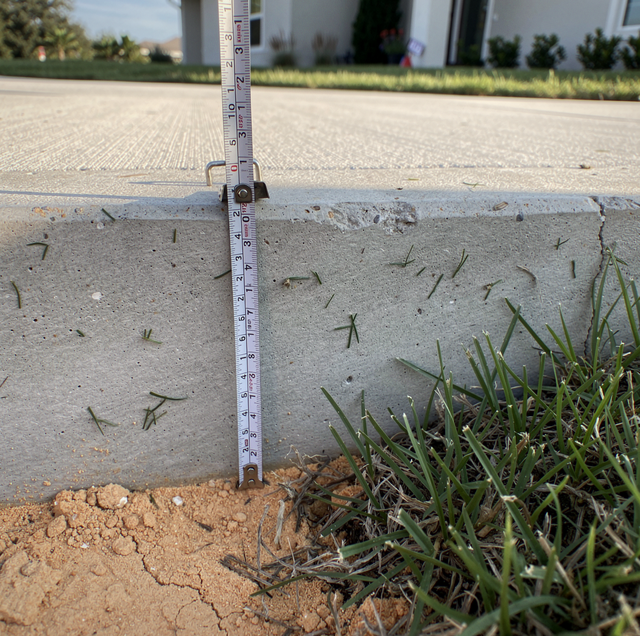
Crouch down where the driveway steps off into the grass. Hook the end of a tape over the top of the concrete, hold it flat against the open face, and read down to where the concrete stops. Four inches. Six. Something between the two, or something uneven enough that you shift over a foot and read it again.
That one number settles more about a concrete removal than anything else you can see from above. It points to the machine and the attachment that suit the job. It decides whether the slab comes up in big liftable panels or has to be worked in smaller pieces. It sets how many passes it takes to cross the area, and it hints at what the crew finds once the first panel lifts.
Where the Slab Will Show You Its Thickness
Concrete hides its own dimensions. From above, it is a flat gray surface, and the number lives at the edges. Most slabs have at least one edge already open to the air.
The driveway apron: Where a driveway meets the street or a sidewalk, the concrete steps down and the face shows.
A step down to grass: Patios and walkways often sit proud of the lawn on one side, where rain and mowing pulled the soil back.
The garage door threshold: The edge at the door line is open by design, and usually square enough to read straight off.
An existing saw cut or a broken corner: If someone cut the slab for a plumbing repair, or a corner snapped off, the full depth sits right there.
An expansion joint that has opened: Joints widen as a slab moves, and when one spreads far enough, concrete on both sides shows.
A section lifted by a root: Where a tree root has raised a panel, the lifted side tilts up and shows its underside and depth.
The lip where a walkway meets a patio: Two pours placed at different times rarely finish level, and the taller one shows its edge.
Brush soil back from the face until you can see exactly where the concrete ends. Reading to the top of a dirt line is how people end up short.
An exposed edge at a step-down to grass is often undermined, with soil washed out beneath it. Kneel on the slab itself, keeping your weight off the lip and the overhang while you take the reading.
Start with the Pour Era, Then Check It
Before the tape comes out, the house's age gives you a first guess. Residential concrete poured in the 1970s is often about 4 inches thick. Work poured in the 1990s and later is often 6 inches. That is a tendency rather than a rule, and what the slab was meant to carry moves it more than the decade does.
That guess earns its keep for one reason: it tells you which answer to expect, so you notice quickly when the tape says something else. Older slabs often came in heavier because the original owner meant to park something on them. Newer pours tucked into a back corner often came in light because nobody expected weight there. The house's age narrows the range. The tape closes it.
Measure at More Than One Edge
A slab takes the shape of the ground under it. Where the ground dipped, the concrete filled the dip and runs deeper. Where the ground crowned, it runs thinner. Because the top surface is screeded flat, all of that variation lives on the bottom face, out of sight.
An edge reading tells you about that edge. The concrete was placed on whatever ground was there that morning, so the bottom face varies while the top stays flat, and a perimeter formed deeper than the interior appears thicker than the field behind it. A single reading at one apron only starts the picture.
Take a second reading anywhere else concrete is open: the far side of the same driveway, a joint line at a patio, the threshold at the garage. If the readings agree, you have your number. If they disagree, the deeper one governs, because the thickest section sets how the whole slab has to be worked.
When only one edge is open: Take the reading you can get and note it as one edge only. That is honest information, and it still helps. Nobody needs you to open a new edge, and breaking concrete for a reading is a crew's work.
Photograph the edge with your tape held against it so the number is readable in the frame. A photo of the measurement travels far better than a number in a text message when someone is planning the work ahead.
What a Thinner Slab Changes about the Work
Thin concrete tends to break clean, and it breaks into pieces a machine can pick up whole. A full-size skid steer with a hydraulic breaker attachment opens the slab and works across it while panels release in single pieces that go straight into the dump trailer. Fewer passes, less repositioning. Once the panels are loose, the compact mini skid steer can often do the carrying, which matters where the ground is soft, or the working room is tight.
Two things pull against that. A light slab is more likely to have been poured straight onto soil with nothing under it, so the ground it comes off can be loose and uneven. And a thin slab already cracked into many separate pieces stops behaving like panels. Each piece is handled individually, which slows the work more than thickness alone would suggest.
What a Thicker Slab Changes about the Work
Thicker concrete gets worked in smaller bites. The breaker takes more passes to open a line across it, and the slab comes apart in pieces sized to what the machine can lift rather than in full panels. That usually calls for the full-size skid steer, because the breaker needs weight behind it and the loader needs capacity to move what comes free.
Reinforcement usually appears at the same moment as thickness does, because both are visible along the same broken edge. Heavier pieces also change how the trailer loads, since thick concrete reaches weight capacity long before it fills the box. A thick slab simply needs a different sequence, planned before anyone starts.
What Is Under the Slab
The same open edge that gives you thickness tells you what the concrete rests on. Look at the bottom inch of the face and just below it.
A base course: A band of crushed rock, shell, or compacted fines under the concrete means the slab was built on a prepared base. Bases drain, and the ground under them tends to be firm.
Bare soil or sand: If the face goes straight from concrete into native ground with no distinct layer, the slab was poured on grade. That is common under a thin older pour, and the surface left behind will need grading attention.
A washed-out gap: An air space under the slab bottom means water has been moving through and carrying fines away.
Another slab: Every so often, an older pour turns up beneath a newer one, where someone added height instead of removing it.
Two surface clues also point downward. A cleanout cap or floor drain set flush in the concrete means a line runs somewhere beneath the slab, and so does a stub of conduit near the edge. Both are worth pointing out early, because what runs under a slab shapes the order of the work.
What the Number Tells a Crew Before They Arrive
By the time you finish measuring, you hold most of what anyone needs to plan the removal: the readings and where you took them, a photo of the tape against the face, whether the bottom edge sat on a base or on soil, and what the slab used to carry. Two readings and a photo is the whole handoff.
Frequently Asked Questions
Some slabs were poured with a thickened perimeter, where the concrete turns down into a deeper band around the outside while the interior stays at normal depth. It shows up most where a slab once carried a wall line. If your edge reading runs much deeper than one taken at an interior joint, a turned-down perimeter is the likely reason.
Then your tape is reading more than the structural concrete. Tile, a mortar setting bed, or a later topping pour all add height at a threshold, so the total can run well over the slab itself. Look for a horizontal seam in the face where the color or texture changes, and measure from that seam down.
Sections sitting over a void drop instead of lifting when the machine takes them, so they come out in smaller pieces rather than as whole panels. The space under them also has to be filled before anything new goes back on that ground.
Sometimes, and the reading you took is what decides it. A slab thin enough to release in whole panels can often have the carrying done by the machine that fits a standard gate opening, with the breaking worked from the nearest open side. Where the number comes back thick, the gate becomes the constraint: a gate leaf lifts off its hinges, and a fence panel unscrews from its posts, and both go back the same day.
The thickness you measured predicts the fill that depression will take. The space left behind is the concrete's own depth plus whatever base course sat under it, so a slab that reads deep at the edge leaves a hole deeper than the surface ever suggests. That is why the reading keeps working for you after the concrete is gone.
Not in the way people expect. Thickness affects the method more than hours, and hours are set by access and haul-off distance far more than by the number on your tape. A thick slab beside the driveway can finish sooner than a thin one at the back of a fenced yard.
Measure the edge and send us the number with a photo — the crew arrives already knowing what it is breaking. Polk Services LLC serves Lakeland, Highland City, and Mulberry. Call (863) 344-5806.
