

Rebar Removal: Why Reinforcement Decides Where Concrete Goes
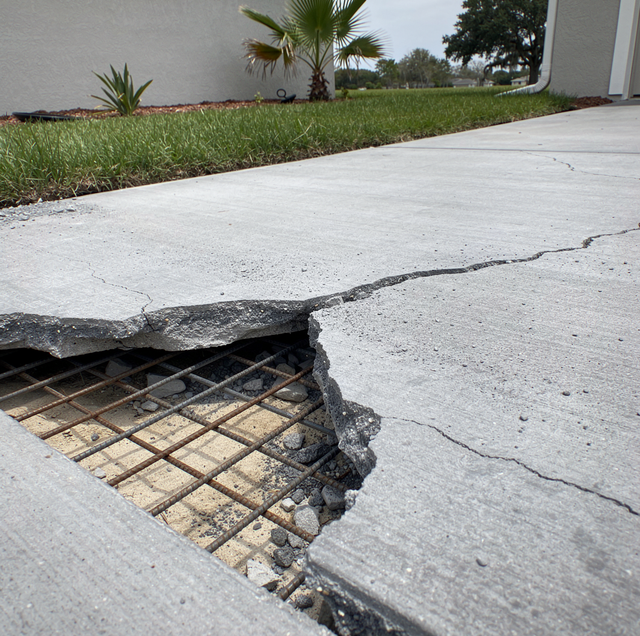
There is a point during concrete demolition when the breaker stops moving forward. The tool is still working, and the surface is still coming apart, but the operator can feel through the machine that something under the slab is holding on. The sound flattens out. A piece that should drop away sinks a little, then springs back up when the pressure is released. Nothing has been dug out, and nothing has been loaded, and everyone standing there already knows what is in that slab.
Reinforcement is the reason. It is also the detail most likely to change what a concrete removal involves, and the one you are least likely to think of when you first describe the slab to someone. You will mention the patio, the driveway apron, the old shed pad, the cracks. Almost nobody mentions the steel, because almost nobody knows it is there. You can read it from the outside, though, and what you find changes both the work and the route the material takes off your property.
What Is Inside the Slab
Four things are possible, and they are not equally common.
Reinforcing bar: A steel rod with ridges rolled into its surface so the concrete grips it instead of sliding along it. In flatwork it is usually laid in a grid and tied together with wire at the intersections, then supported off the ground so the pour surrounds it. That grid is the thing your breaker finds.
Welded wire mesh: A lighter grid of smooth wire welded at the crossings, delivered in rolls or flat sheets and spread over the base before the pour. Mesh is meant to sit inside the slab, but it very often ends up flattened against the ground underneath or riding up close to the surface, and where it ended up changes what your breaker runs into on the way down.
Fiber reinforcement: Short strands blended into the wet concrete at the plant or in the truck. There is no grid and nothing to pull out. A fresh break face looks slightly whiskered where the strands bridge the crack.
Nothing at all: Plenty of older residential flatwork was built with light reinforcement or no steel at all. A plain patio or walk breaks into pieces, and the pieces come up as pieces.
How to Tell Without Breaking Anything
You can usually get close from the surface, and you should not go chipping at concrete to find out.
Look at any broken corner or damaged patch: Wherever concrete has already come away, steel is either visible in the void or it is not. A corner that has lost a chunk is the most honest window you have.
Look for rust staining that runs in a line: A brown streak that follows a straight path across the surface, or that repeats at even intervals, is a tell that steel sits under it. A random stain from a planter or a piece of furniture wanders. A line does not.
Look at how the cracks have behaved: A slab that is clearly cracked but whose pieces have not opened up, dropped, or shifted relative to one another is being held. Something is spanning that crack. Concrete that cracks with nothing in it tends to come apart and settle unevenly along the break.
Drag a magnet across the surface: A magnet only responds where the cover over the steel is thin, so it maps the shallow runs of the grid. Those shallow runs matter, because they are the ones that will surface first once breaking starts. Deeper steel gives nothing back, so a quiet magnet is no proof of a plain slab.
Check the broken corner in shade rather than in full sun. Rust bleed and the whiskering left by fiber both wash out in bright light, and a shaded break face shows what is actually in the concrete.
What Reinforcement Does to the Break
Steel changes the character of the whole removal in one specific way: it keeps the slab connected after the concrete has already failed.
An unreinforced slab comes apart into panels, the panels are loose, and a machine picks them up. A reinforced slab breaks just as readily, but the section stays in one piece because the grid runs through every crack you make. Crews call what is left a mat, and a mat has to be handled deliberately. Three things follow from that.
The steel becomes its own task: Breaking concrete and freeing steel are two operations, not one. The second happens after the first, along the whole run, and it takes time a plain slab never asks for.
The material lifts as sheets rather than clean chunks: When a mat comes up, it comes up with broken concrete hanging off the grid, sagging in the middle and swinging at the ends. That is slower to move, and it fills a truck differently.
The work has to start from an edge: A reinforced section is worked from a free edge or an existing joint and taken back across the slab, rather than opened up in the middle where there is nothing to break toward.
Cut ends of reinforcement stand up out of a partly broken slab and are easy to miss underfoot. They are a puncture and trip hazard, so keep people and pets off the area until the material has been loaded out.
Where the Concrete Goes after It Comes Up
Clean broken concrete is a resource. Hauled to a recycling facility, it is run through a crusher and comes back out as reusable base material.
Concrete that comes out with reinforcement cast through it has no such option. Neither does concrete that arrives mingled with wood, roofing, plastic, dirt, or general demolition debris. A load like that is no longer a single clean material, so it routes to a landfill instead. The same slab, broken the same way, ends up somewhere completely different depending on what rides along with it. Steel in your slab reaches past the breaking and settles the destination of every piece that leaves the property.
That routing gets decided at the gate, by eye, before a trailer is ever unloaded. A load that arrives visibly threaded with steel can be turned away on sight, and then it has to be taken somewhere else or sorted and brought back, which is a wasted run either way. Separating the steel during load-out is what keeps that from happening.
What Separation at Load-out Protects
The recycling option survives or dies during load-out, the least glamorous hour of the job and the one that decides the routing.
Working the steel free of the concrete before anything gets loaded keeps the two materials separate. The concrete goes in as concrete. The reinforcement gets stacked on its own and goes to a metal recycler. It adds no real handling either, because the mat has to be broken down anyway before it will fit on a truck.
The failure mode is the shortcut: everything scooped together, concrete and grid and whatever else was on the site that day, into one pile. Once a load is mixed, it is mixed for good. Nobody sorts it downstream, and the whole thing gets treated as general debris. Eco-friendly disposal happens at the truck, or it does not happen.
Why This Belongs in the First Conversation
Reinforcement changes what the work involves more than almost any other feature of a slab, and it is the thing homeowners are least likely to volunteer. Someone estimating your removal will ask about size and access. If nobody asks what is inside, say it anyway.
You do not need to be certain. "There is steel showing at the broken corner," or "there is a rust line running across it," or "it is cracked, but nothing has moved," is enough to change how the job gets planned. Send a photo of a broken edge if you have one. Saying it early is what keeps the steel from turning up as a discovery halfway through the breakout.
Frequently Asked Questions
Not to the same degree, and it behaves differently on the way out. Freed mesh tends to come up in springy curls that want to roll back on themselves the moment the concrete lets go, so it gets flattened and bundled rather than stacked the way straight bar is. Lighter work, still its own step.
Where flatwork is poured against existing concrete, short steel pins are sometimes set into the adjacent slab to pin the two together. That means the two pours are joined by steel rather than merely butted against each other, and that connection has to be parted before the section will separate.
Stacked separately and hauled as its own load. Bar goes out straight and bundled by length; freed mesh gets flattened first so it does not spring back open on the trailer. Neither rides out in the concrete load, because a single length of bar in a clean load is enough to change where that whole trailer goes.
It is uncommon in residential flatwork, but it is easy to rule out. A post-tensioned slab holds steel tendons that were pulled tight after the pour, and the tells are small round patched pockets spaced along an edge where the ends were finished off, sometimes with a stamped warning plate nearby. Flag anything like that before a tool touches the concrete, because it is handled completely differently.
It changes load-out more than it changes breaking. Soft ground allows a connected section to drag along the subgrade rather than lift cleanly. On a reinforced slab, waiting for firmer ground often makes for a cleaner lift.
Often, yes. In a subdivision built out in one stretch, the flatwork was frequently poured by the same crew to the same spec, so what shows in a neighbor's broken corner, in the apron you share, or in a sidewalk panel poured the same season is reasonable evidence about what is in yours.
Say what is in the slab before the work is quoted — the crew shows up equipped to free the steel and route both materials the right way, on concrete demolition in Lithia and Bartow. Polk Services LLC serves Lakeland, Highland City, and Mulberry. Call (863) 344-5806.
