

Does the Pool Cage Come Down First, Last, or Not at All?
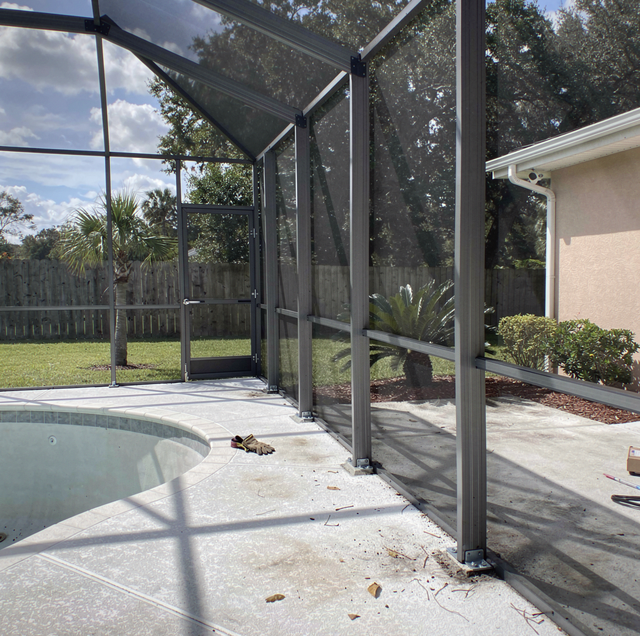
Quick Answer: No. The cage can come off first, come off last, or stay up. What settles it is where the footers sit, because they decide whether the deck gets removed out to the fence or cut back short of them.
A screen cage stands on footers, and those footers sit in, or beside, the same deck slab a pool demolition is there to break out. That one fact is what makes the cage a decision rather than a given, and it has three real answers: take the cage down before the crew starts, take it down as the last piece of the job, or leave it standing entirely.
The Three Options, and What Each Means for the Work
Cage off at the start: Gives the machine open access from every side of the shell and the clearest possible working room for the whole job. There is nothing to work around, no footers to dodge, and no frame overhead limiting how the pool, deck, and coping come out. This is the option most jobs default to when the cage is not part of the owner's plan for the finished yard.
Cage off at the end: Keeps the yard contained while the deck and shell are demolished, then the frame and mesh come down as the last step once the rest of the site is open. Some owners want the site closed off from the rest of the yard for as much of the job as possible, and this order does that without changing how the pool itself is removed.
Cage kept standing: Means the machine works around posts and footers for the entire job, start to finish. There is no point in the job when the site opens up completely; every phase, from excavation through final grading, occurs with the frame still overhead.
Cage-off-at-the-start is the default, and it is the assumption behind most descriptions of how a demolition runs, including the day-by-day account of what happens during a pool demolition step by step. The reason it is the default is working room: there is very little of it under a standing cage, and a machine cannot position itself inside the footprint at all. Keeping the cage means accepting what follows from that. More hand work near the posts, more passes with a smaller machine, and no machine positions inside the cage line for the whole job. That is a choice an owner makes deliberately at the walk-through, and it is not what happens if nobody raises it.
Laid side by side, the practical difference between the three looks like this:
| Option | Working Area | Machine Access | Typical Fit |
|---|---|---|---|
| Cage off at the start | Wide open from day one | Reaches every side of the shell with nothing in the way | Fastest full removal, cage not being kept |
| Cage off at the end | Contained perimeter through most of the job | Same open access once the cage clears, tighter until then | Owner wants the yard closed in as long as possible |
| Cage kept standing | Posts and footers present the whole job | Every pass planned around what is still up | Owner wants to keep the covered outdoor room |
What Actually Decides the Answer
Four things settle it on any given job.
How big the cage is: A small frame over a compact pool leaves plenty of clear yard around it, while a cage that runs to the fence lines on two or three sides does not.
Where the machine can reach from: Some yards have one usable approach, and if that approach runs straight through where the cage stands, the cage has to move regardless of anyone's preference.
Whether the deck under the cage is coming out too: A deck staying in place changes the whole footprint the demolition has to work inside.
What the owner wants the space to become: An open yard ready for sod is a different target from a filled lot with a covered structure still standing.
The Case for Keeping the Cage
Keeping the cage is a legitimate choice in its own right. An owner who wants a covered outdoor room and no longer wants the pool underneath it has a real reason to keep the frame standing: shade from direct sun, a barrier against insects and falling leaves, and a covered deck that stays usable in weather that would otherwise chase everyone inside. That is the whole of the case, and it is enough on its own.
If the cage is staying, say so when booking the walk-through. The deck cut line gets set against the footers on the ground, and whoever measures needs to arrive already knowing the deck stops short of them.
Keeping it does change the work. The deck stops short of the footers instead of running out to the fence, and why that follows from where the footers sit is covered in what decides the size of a pool demolition job. What that leaves you with is worth picturing: a standing cage over regraded fill, ringed by a border of the original deck concrete, with new grading running up to that border and stopping, and sod going down over it on whatever timeline you set. It reads as a deliberate edge if the border is even, and as an oversight if it is ragged, which is why the cut line is set on the ground rather than off a drawing.
One more thing worth knowing if a future enclosure is actually the plan: most enclosure installers expect whatever is currently standing to be fully removed before a new structure goes up. If the real goal is a new cage down the road, cage-off-at-start is usually the more useful choice, and it is worth saying so before the deck scope gets set.
The Cage and the Deck Are One Question
The reason cage and deck cannot be scoped separately comes down to footers. In many installations, the frame sits on a dedicated concrete footer poured along the deck's perimeter; in others, the anchors go straight into the existing deck slab. Either way, a decision about the cage is already a decision about the deck, whether anyone frames it that way or not. Scope the deck removal first and decide on the cage later; there is a real chance the deck plan will need to be redone once the cage answer comes in.
A cage left standing after the shell and cavity are gone becomes a structure sitting over ground that was just excavated and rebuilt beneath it, with nothing left where the water used to be. That is a different situation from the one the cage was originally built into, and it is exactly why the cage decision has to be made before the deck is scoped instead of worked out midway through the job.
Getting a Removed Cage Out of the Yard
A cage that is coming down does not leave the yard intact. The aluminum framing and the screen mesh get separated on site, since the two materials route to different places from there: the aluminum goes into the scrap stream and the mesh does not, so it gets bagged for standard debris disposal instead. That is simply how the two materials are handled once they are apart.
A cage partway through disassembly is not the structure it once was. Once a bay's bolts are backed off, the frame is leaning on connections no longer made up, so keep the area clear and never leave one standing overnight.
The bigger practical issue is getting the frame out at all. Plenty of back yards were built with the cage already in place and very little clearance between the frame and the fence line, so there is often no way to lift sections out whole. The frame gets broken down into pieces sized to pass through whatever gate or side-yard access actually exists, which is as much a factor in how the cage-removal step gets planned as anything about the pool itself.
Frequently Asked Questions
Small ones, and the crew takes the mesh off first. Splitting a frame with the screen still in it tends to tear the mesh out of its track and leave it hanging, so the panels are stripped before any post-to-beam connection is touched. That order holds regardless of which of the three timing options is used.
Many cages tie a top rail into a ledger fastened to the house or an adjoining structure; others are freestanding and carry the whole load on their own posts. Which of the two you have changes the order the crew takes it down in, and it is one of the first things looked at when the cage is scoped.
Not usually. The sections are unbolted or cut at joints sized for that specific footprint, so pieces from one cage rarely reassemble into a workable frame for a different layout, even though the aluminum itself is still sound material.
The screws and mounting track are pulled out of the slab in the same pass as the framework, since leaving embedded hardware along a section of deck that is not being removed creates a snag point in the concrete that stays put.
Fasteners at the base of each one are checked and secured before work starts alongside them, because a post that shifts while equipment is near it is a hazard rather than an inconvenience. Where a post sits inside the reach of the machine and cannot be worked around, that section of deck comes out by hand.
Usually. Where the roof runs to a ridge beam, that beam is released as one run before it is cut down to whatever length the gate will take, which is a different sequence from the wall bays. Mansard and hip roofs without a full-length ridge come apart bay by bay instead.
This is the decision the rest of the job depends on, so the one thing worth raising at the walk-through is simple: is the cage coming off first, coming off last, or staying up, and does the deck plan already assume that answer?
Schedule a pool demolition walk-through — get a clear answer on the cage before the deck scope is written. Polk Services LLC serves Lakeland, Highland City, and Mulberry. Call (863) 344-5806.
