

High Water Table Lot? Why Raising the Grade Backfires
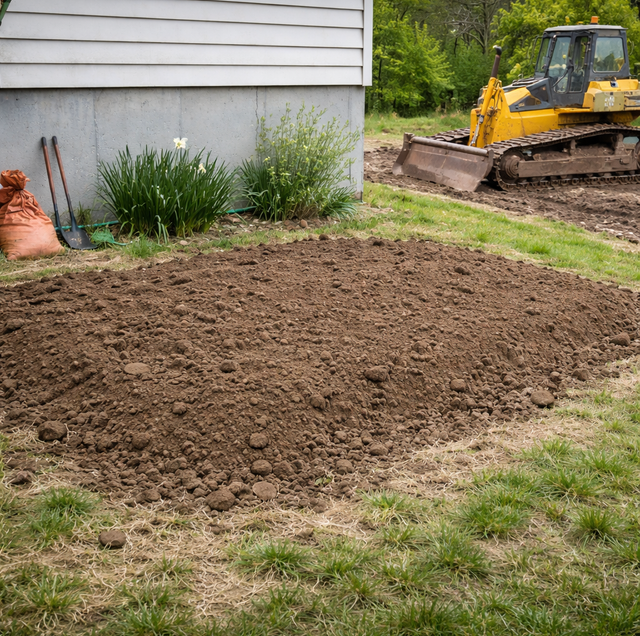
Quick Answer: Piling fill on a low, high-water-table lot usually creates a new problem: the extra height needs somewhere to shed runoff, often toward a neighbor's yard or the street. A lower pad with real freeboard and working drainage usually holds up better in the long term.
A lot that sits low and wet for weeks after every rain has an obvious-looking fix: bring in a few loads of fill, spread it out, and get the whole yard sitting a foot or so higher. It reads like solving a math problem. The ground is too low, so raise it. Anyone who has priced out a load of fill dirt has probably run that number in their head.
The math looks clean until the water and the soil underneath get a vote. Raising a lot doesn't lower the water table, and it doesn't change how much weight the ground under the new fill can hold once it's saturated. Both of those limits tend to show up later, sometimes months later, in ways that cost more to fix than the fill did to bring in.
Where the Water Goes When You Raise Your Own Ground
Water on a flat or low lot spreads out because there's nowhere lower nearby to push it. The moment one section is built higher than the surrounding ground, that changes. Water follows the path of least resistance downhill, and if your pad is now the high point, every drop that used to soak in or spread thin across your own yard runs off toward whatever sits lower instead. On most residential lots, that's the neighbor's yard on one or two sides, or the street and its drainage system out front.
This isn't a matter of intent. A homeowner who fills their lot isn't choosing to send water anywhere; the new slope does that on its own. But the physical effect is real: a neighbor who never had standing water in a back corner can start seeing it right at the property line, where your new fill ends and their unchanged grade begins. A roadside swale or culvert built to handle runoff from a flatter lot can start backing up once several feet of new slope are dumping water into it faster, in a narrower band than before.
If getting the pad right means cutting a trench for a French drain or a swale, call 811 before digging. It's a free service that marks buried gas, power, water, and communication lines first.
How Much Fill Saturated Native Soil Can Carry
The second limit sits under the fill, not on top of it. A high water table means the native soil at some depth stays close to saturated most of the year, and saturated soil behaves nothing like dry soil under a load. Dry clay or sandy loam supports a fair amount of weight without moving. Add enough water to fill the spaces between soil particles and that same soil loses much of its ability to hold shape under pressure, closer to wet sand at the tide line that feels firm for a second, then gives way as repeated weight traps water in the pores faster than it can escape, building up pressure between the grains until they stop gripping each other and the ground loses its footing.
Pile several feet of new fill on ground that behaves that way and the fill's own weight pushes down on soil that can't fully support it. The result usually isn't a clean, even sinking; it's uneven settling: one section compresses more than another because the native soil underneath was never uniform to start with. In the worst cases, a heavy, poorly compacted fill mass on a weak subgrade can shear, meaning a section slides along a failure plane in the soft soil below rather than settling straight down. Cracked flatwork, a dipped fence line, or a tilted shed pad a few years later are common results.
Compaction in shallow lifts helps, but doesn't remove the limit: Bringing fill in a few inches at a time and compacting each layer produces a far more stable result than dumping a full truckload in one pass. It's still working against the same saturated subgrade, though, so there's a real ceiling on how much a lot can safely carry no matter how carefully the fill goes in. That ceiling is set by the soil that was already there.
A rough field check: dig a two-foot-deep hole and watch how fast it fills. Groundwater within a few inches that doesn't drop in a couple hours means that soil is already near its moisture limit, a gamble for stacked fill weight.
The Water Table's Level Shifts by Season, the Condition Doesn't
A high water table is a year-round site condition, not a wet-season inconvenience. The ground doesn't dry out and act like a normal building lot for part of the year, and then turn swampy the rest of the year. What shifts is the water's elevation within that soil profile: during heavier rain months it sits closer to the surface, and during drier stretches it drops several inches to a couple of feet without disappearing. A fix that only accounts for the water level on the day the fill goes in, rather than the highest elevation it reaches in a typical year, is planning for the wrong day.
Working With a High Water Table Instead of Trying to Outbuild It
A wet, low lot doesn't have to stay wet. It just means the fix usually isn't "make the whole lot taller." A few approaches work with the water table's elevation instead of fighting it.
Raised planting beds instead of raised ground: Framed or block-edged beds filled with a lighter, well-draining planting mix let roots sit above the saturated zone without moving the grade of the whole yard or sending extra runoff toward a fence line. The bed drains through its own base rather than through the native soil beneath, avoiding wet, dying roots without touching the surrounding ground elevation at all.
A French drain that daylights instead of pooling in a pit: A gravel-wrapped perforated pipe set at a gentle, continuous fall can carry water off a wet section of yard to an outlet that's actually lower, sometimes a roadside swale, sometimes a low corner of the lot, where the pipe exits above grade instead of dead-ending into a sealed pit. That outlet has to sit lower in elevation than everywhere the pipe collects from, or the drain backs up the same way the yard did. Where a lot is flat enough that no lower point exists, a small collection basin feeding a sump pump becomes the practical substitute for gravity.
A pad designed with real freeboard, not just a taller yard: For a structure, a shed, or any pad that needs to stay dry, the target isn't raising the entire lot. It's setting the finished pad at an elevation with enough margin, often called freeboard, above the highest water elevation that spot sees in a typical wet season, confirmed by a test hole checked more than once rather than guessed from one dry-day visit. A modest, well-compacted pad sized to the structure carries far less risk of uneven settling than lifting acres of open yard the same amount, and it doesn't create a new high point that pushes runoff onto ground that used to absorb its own share of rain.
Together, these three solve the actual problems a high water table causes: wet roots, a wet structure, and standing water, without the runoff and settling problems that come from piling dirt higher across the whole lot.
Reading a Lot Before Deciding Anything
None of this is a case for leaving a wet lot as it is. It's a case for figuring out where the water table sits throughout the season, where the lot's natural low points are, and where a neighboring property or the street already handles drainage before moving a single yard of fill. A lot that's low because of a shallow water table needs a different plan than a lot that's low because of a poorly shaped grade over otherwise firm soil, and treating both with the same "add more dirt" instinct is how a fixable drainage issue turns into a property-line dispute or a cracked slab a few years down the road.
Frequently Asked Questions
Yes, and it's often the most practical mix. A modest pad raise of a few inches, feathered into the surrounding grade over ten to fifteen feet so it doesn't create an abrupt shelf, can carry a walkway or small sitting area, while raised beds handle the rest of the planting and drainage. A layer of geotextile fabric between the wet subgrade and new fill also prevents fine native soil from pumping up into the fill as it settles, helping that shallow raise remain stable longer.
Dig a test hole about two feet deep and check it after a heavy rain, then again during a dry stretch a few weeks later, since one visit only shows that day's level. Soil color is another clue: gray, mottled, or rust-streaked soil at a given depth usually means water sits there often enough to change the soil's chemistry, even when the surface looks dry. A county soil survey map can also flag a seasonal high water table depth for that soil type as a starting estimate.
The ground around a shared fence line usually shows it first: posts that start to lean or loosen as the soil around their footings stays wet longer than it used to, or a strip of the neighbor's lawn that goes soft and slow to dry along just the section closest to your new fill. It's a physical consequence of the new slope, not intent, and it's exactly what a feathered, gradual transition at the property line avoids.
A gravity-fed drain only works if the outlet sits lower than every point it collects from, so on a lot with no natural low point, a buried pipe looping back to the same elevation it started at won't drain anything. A sump pump substitutes mechanical lift for that missing elevation drop, but it comes with its own dependency: it needs power to run, so a flat, high-water-table lot leaning on a sump pump also needs a plan for what happens to that low spot during a multi-day outage, whether that's a battery backup on the pump or simply enough basin capacity to hold water until power's back.
A few signs are fairly reliable: a hairline crack running roughly parallel to where the new fill meets the old grade, a small vertical step where there wasn't one before, a fence post or shed corner starting to lean, or water pooling in a ring around the edge of the filled area instead of in the low spot it was meant to cover. Any of those means the fill has moved, not settled evenly and stopped.
There's no fixed number that fits every lot, since it depends on how much the water elevation swings between wet and dry season on that specific ground, which is why a test hole checked across different times of year matters more than a generic figure. As a general planning cushion, many site crews aim for at least a foot of margin above the highest water mark they can confirm, more on a lot that has flooded before, but that's a starting point to verify, not a number to apply blind.
Fill dirt isn't the enemy in any of this. Used in a modest, well-compacted layer that's feathered into the surrounding grade, it's part of a real fix. The mistake is treating a whole low lot the way you'd treat a single wet spot, piling enough dirt on top to out-build the water table instead of designing around where that water actually sits and where it needs to go once it leaves your ground.
Get your lot's water table and drainage options assessed before you order fill — find out whether a raised pad, a French drain, or a redesigned grade actually fits your lot. Polk Services LLC serves Lakeland, Highland City, and Mulberry. Call (863) 344-5806.
