

Gravel Driveway High Water Table: 5 Build Choices That Matter
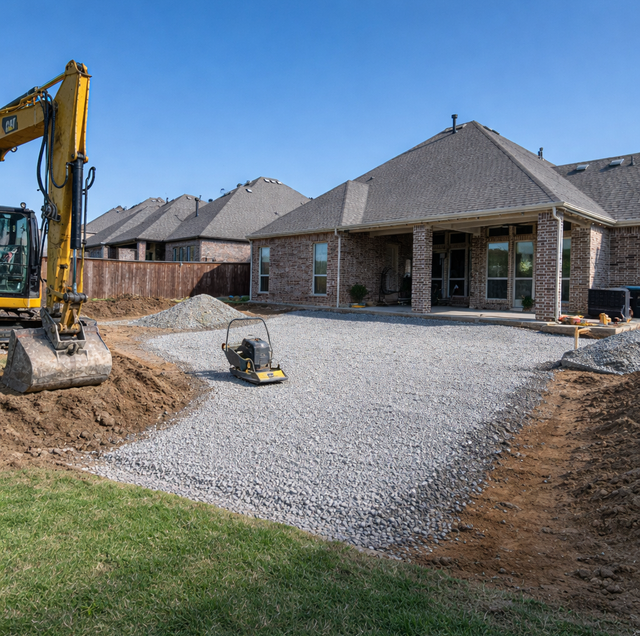
A high water table is not the same thing as a yard that puddles after a storm. It's a property characteristic: the depth below the surface where the soil is saturated for long stretches of the year, sometimes year-round. Lots close to lakes, ponds, and wetlands; low-lying parcels; and anywhere the native soil is sandy enough to let groundwater rise quickly to the surface are the properties most likely to have one. Heavy rainfall during the wetter months adds to it, but it's one factor among several, not the reason the water table sits where it does. A lot can have a high water table in the driest month of the year just as easily as after a week of storms.
That distinction matters because it changes how a gravel driveway must be built, not just how it must be shaped or drained on the surface. Surface grading and crowning solve a different problem (getting rainwater to run off instead of pool), and that's covered in depth elsewhere. What follows here is about the ground itself: what's underneath the stone, how saturated soil behaves under the weight of a vehicle, and which materials hold up when the water table sits a foot or two below where your tires will be.
Why the Subgrade Needs More Attention Here
On a typical lot, the soil under a gravel driveway is dry and firm enough to carry load on its own, and the base stone just needs to be compacted on top of it. Near a high water table, the subgrade is often a different animal. Organic or soft material, muck, peat pockets, or fine silty sand that's been saturated for months doesn't behave like firm sand or clay. Under repeated weight, it compresses, shifts, and eventually pumps up into the stone above it. A driveway built directly on top of that kind of subgrade will settle unevenly no matter how good the surface stone is.
The fix isn't complicated, but it does add a step most dry lots skip: identifying and removing the weak, organic material in the driveway footprint before any base goes down, and replacing it with material that can actually bear a load, compacted in layers rather than dumped and driven over. Skipping that step is the single most common reason a driveway near wet ground develops ruts or soft spots within a year or two, long before the stone itself would normally wear out.
Choosing a Base Material That Won't Hold Water
Not all base stone behaves the same way once it gets wet, and that difference matters a lot more on a high-water-table lot than it does on a dry one. Angular crushed stone, the kind with sharp broken faces rather than rounded edges, locks together under compaction the way a good base needs to. Rounded pea gravel doesn't interlock the same way and tends to roll and shift under tires, which is a bigger liability on wet ground than on dry ground, since there's less margin for a loose, shifting base. Material with a good share of fines, like limerock screenings or crushed millings, is what lets a base compact tight and stay locked together, and that's still the right property to want. The trade-off on wet ground is that the same fines that make the base compact well also slow how quickly water can move through it, which is one more reason the base goes in deeper and over fabric here rather than being built thinner, as it might on a dry lot.
On a lot with a high water table, it's also worth building the base layer somewhat deeper than you would on dry, well-drained ground, and compacting it in lifts rather than one thick pass. The goal is to keep the working, load-bearing part of the driveway as far above the saturated zone as the site reasonably allows, and to provide a path for water to move laterally through the stone rather than becoming trapped against the subgrade.
Where Geotextile Fabric Earns Its Place
A woven or non-woven geotextile fabric laid between the subgrade and the base stone does one specific job: it keeps the two layers separate. Without it, fine, wet soil from below gradually works its way up into the void spaces in the stone above, a process sometimes called pumping, especially under repeated flex from vehicle weight. Once that happens, the base loses the drainage capacity it was installed for, and the stone starts behaving more like it's sitting in mud than sitting on a firm foundation.
Fabric isn't a fix for a truly poor subgrade on its own, and it's not something every gravel driveway needs. But on ground that stays wet near the surface, where the subsoil beneath the stone is often fine and saturated, it's one of the more useful, lower-effort steps you can take, since it protects the base layer's ability to drain for the life of the driveway rather than just at installation.
Picking Finish Stone for Wet Ground
The same logic that applies to base material applies to whatever stone sits on top and gets driven on. An angular, well-graded finish stone interlocks and sheds water instead of holding it. A rounded stone, or one with a lot of fine material mixed in, turns to a soft, slick surface when it's saturated, which on a lot that stays wet more of the year than a typical dry lot is a real difference in how the driveway feels and holds up day to day, not a cosmetic one.
What Grading Can and Cannot Fix
Shaping the surface so rainwater runs off instead of pooling is real, useful work, and it solves a real problem: water sitting on top of the driveway. It does not solve the different problem of groundwater sitting close to the surface underneath the driveway. Those are two separate mechanisms, and it's worth being clear-eyed about which one you're dealing with before deciding what the site actually needs.
A perimeter edge drain along one or both sides of the driveway is a separate, active step some persistently wet lots benefit from, distinct from grading alone. It's a different question than whether an ordinary driveway needs one for routine surface drainage, which usually comes down on the side of grading being enough; a lot with a confirmed high water table is closer to the case where that extra step earns its keep.
One limit is easy to miss: no amount of grading, base depth, or stone selection lowers the water table itself. The water table is set by regional hydrology (how close you are to a lake or wetland, elevation, how fast the local soil transmits groundwater), and it isn't something a driveway project changes. What good site prep and material choice actually accomplish is a driveway that performs well despite a high water table: firm, stable, and free-draining above ground, while the wet ground itself remains unchanged. Anyone who tells you a driveway installation will "fix" a high water table is overstating what grading and stone can do.
Checking Your Own Lot's Water Table
If you're not sure whether your property has a truly high water table or just drains slowly after rain, the USDA NRCS Web Soil Survey is a free public resource that lists a general water table depth range for the soil type mapped on most parcels. It's a useful starting point for getting a rough sense of your site, though it's a general soil-type estimate rather than a survey of your specific yard, and actual conditions can vary within a mapped area.
Frequently Asked Questions
There's no single number that fits every site, but as a general anchor: a standard dry-lot base commonly runs 4 to 6 inches, and a high-water-table lot commonly pushes that closer to 8 inches or more, depending on how close the water sits to the surface and what the existing subgrade is made of. That extra depth still gets built and compacted in stages rather than as one thick layer, the same lift-by-lift approach any properly built base uses, just carried one or two lifts deeper here.
A high water table means the soil is saturated at a shallow depth for extended periods, sometimes measured in a seasonal range like a few inches to a couple of feet below grade depending on time of year. A slow-draining lot, by contrast, usually has water sitting on the surface after rain but the soil below is not chronically saturated; it clears within a day or two once the surface water finds somewhere to go. The two problems can look similar from the porch but call for different fixes.
Limerock is a common regional base material and can work in the right application, but it tends to contain more fine material than angular crushed granite and can hold more moisture once compacted, which is a real consideration on ground that's already wet below the surface. It's worth weighing material choice against site conditions rather than defaulting to whatever's most available.
Any gravel driveway benefits from occasional top-dressing and re-grading as stone migrates and settles with use, but a driveway on a high-water-table lot is more prone to localized dips if a pocket of soft or organic subsoil (sometimes called muck) was missed during subgrade prep. If a soft spot shows up, it usually means that specific area needs to be excavated and rebuilt rather than just topped off with more stone.
On properties served by a septic system rather than sewer, drain fields are permitted with required separation distances from hardscape like a compacted driveway, and those distances vary by jurisdiction. A shallow water table can also affect how the septic system was originally designed and sited. If your property has a septic drain field, its recorded location on the permit or site plan is worth checking before finalizing the driveway layout, since running heavy compacted base material too close to it can affect the field's performance.
Beyond checking a general soil-survey resource, one hands-on sign is digging a shallow test hole in the yard: soil that shows gray or orange mottled streaking (sometimes called redoximorphic features) close to the surface is a sign the ground is regularly saturated at that depth, even if it looks and feels dry on a given day. That kind of mottling is a longer-term indicator than whether the hole fills with water on the day you dig it.
Get a gravel driveway site assessment — we evaluate your soil and grading needs before recommending a base plan. Polk Services LLC serves Lakeland, Highland City, and Mulberry. Call (863) 344-5806.
