

The Driveway Apron: What It Changes about a Demolition
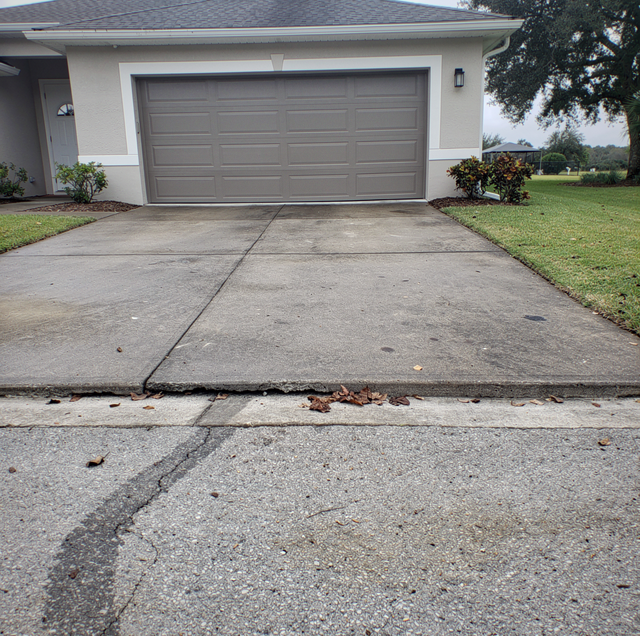
There is a line across your driveway a short way in from the street. On one side the concrete is a shade grayer, or a shade more weathered, and the surface texture changes: a little coarser, brushed in a different direction, or worn smoother by traffic. A joint runs the full width of the drive, and it is straighter than any crack ever is. You have walked and driven over that line for years without giving it a thought.
That line is where one job ends, and another begins. The concrete in front of it is the driveway apron, and once someone shows up to break out a driveway, it behaves differently from everything behind it in nearly every way that matters.
What the Apron Is
The apron is the transition strip between the street or the curb and the driveway proper. It is the section that flares wider as it approaches the road so a vehicle can swing in without dropping a wheel off the edge. If a sidewalk crosses your driveway, the walk usually runs through the apron as its own panel with joints on both sides of it. At the street edge, the apron meets a dropped curb section, the curb cut, which is a separate piece of concrete again.
So the short stretch of pavement between your slab and the road is often three elements rather than one, placed at different times, sitting on different bases, doing different jobs. That is why a strip that looks like nothing from the driver's seat complicates work that otherwise looks simple.
Why the Apron Is Built to a Different Standard
Placed with the street, not with the house: In most neighborhoods, the apron was installed as part of the road and sidewalk work by a different crew, to a different specification, often before the house behind it existed. The driveway you use every day was placed later and met that existing edge. The joint you can see is where the two met.
The load it carries: Every delivery van, every moving truck, every load of block or lumber, and every garbage truck wheel that clips the edge on the swing crosses that strip. The slab behind it carries cars. The apron carries everything that has ever come to the address, and it takes that weight at the exact point where a vehicle is turning and loading its outside wheels hardest. Because of that, an apron tends to be thicker than the residential slab behind it and to carry more steel.
Its own failure pattern: Cracking that starts where truck wheels land and spreads outward, crumbling along the street edge, a panel sitting a little lower than the one behind it: those are apron problems, and they turn up while the driveway proper still looks fine.
What the Seam Does to a Demolition
A removal that runs from the garage door out to the street does not stay the same job the whole way. It crosses that seam, and on the far side the material changes underneath the crew's hands.
Break behavior: Denser concrete with more steel in it does not break into the same-sized pieces. Sections lift heavier and hold together longer, and the weight per square foot of surface goes up. That shows up as more trips to cover the same pavement footprint.
All or nothing: Stopping partway across it leaves a narrow strip of concrete with open ground behind it and the street in front of it, which is a poor piece of pavement to leave standing. Where an apron is coming out, the whole element comes out, and where it is staying, it stays whole.
The seam as a scope boundary: Many concrete removals are written to stop right there. The slab behind comes out, the apron stays, and the exposed edge at the seam becomes the new front boundary of the work. That is a clean place to end because the two sides were never one pour to begin with.
The Sidewalk Panel and the Curb Cut
The sidewalk panel: Where a sidewalk runs through the apron, that panel has its own joints on both sides and behaves as its own element. It is usually handled separately from the driveway, and on most residential removals it stays exactly where it is. Folding it into the driveway scope by accident is one of the easier ways for a plan to be wrong before anyone starts.
The curb cut: The dropped section of curb at the street edge belongs to the curb line as a piece of construction, not to your driveway pour. It is normally left alone. Taking a driveway out does not involve it, and street and curb work is a different trade using different equipment.
Where the three meet: The apron, the sidewalk panel, and the curb cut all touch each other, and those contact lines are where a break wants to run. When the work has to stop at one of them, the crew keeps the machine's force directed back into the material leaving, so nothing gets pushed toward the panels that are staying.
The Apron Is Also the Access Route
Every machine and every load crosses the apron. For the length of the job, that strip carries every trip in and out.
Protection for an apron that is staying: A tracked machine pivoting in place grinds at whatever it is standing on. Crews plan their turns onto material that is coming out anyway, keep the pivoting off concrete that is staying, and hold the loaded travel to a consistent line instead of spreading wear across the whole strip.
The order when the apron is coming out: It comes out last, and this is the sequencing decision that catches people. It seems natural to start at the street and work up the drive, and it is the one order that will not work.
The apron is the route every machine and every load has to use. Break it out on the first morning, and the equipment is stranded behind a drop at the street, so it goes last.
Holding the apron until the end keeps the route usable right up to the moment when there is nothing left to carry over it, and it avoids having to work the rest of the removal around a hole in the only exit.
What Gets Settled before a Date Is Set
Where the removal stops: The section nearest the street is typically handled through a different process than the rest of the drive. The local authority is the body to ask about that section, and asking early is what keeps a scheduled date from sliding.
How the answer varies: The process is not the same everywhere in this service area. Properties a short drive apart can fall under different offices with different steps, so what applies at one address is not a safe assumption at the next one.
When you ask about the section nearest the street, have the address and a photo of the seam ready. Where that joint sits relative to the sidewalk is what the answer usually turns on.
Who handles the paperwork: Where a permit applies, this crew helps coordinate it and follows whatever the process requires. It never pulls or issues a permit itself, and it does not speak for the office that does.
What goes back afterward: Breaking out, hauling off, and grading is where this scope ends. Putting an apron back in concrete is another contractor's work, and their start date usually drives when the removal should happen. If nothing hard is going back on the section behind the seam, the open ground can be graded and finished in gravel or sod instead.
Frequently Asked Questions
Usually, yes, and it is a common scope. One thing to plan for: once the slab behind it is gone, the apron's back edge will be exposed and open at the sides, while its street edge will stay as it was. That edge gets backfilled and compacted against it, so nothing washes out behind it and undermines it.
It stays and takes on a new job. The concrete lip serves as the transition that holds loose material back from the street, so the gravel is kept low against the apron rather than running level with the top of the apron. Sloping the surface back toward the property helps keep rain from carrying material over the edge.
It goes by several names: the parkway strip, the verge, or the tree lawn. It matters on a removal because machines cross it to reach the driveway, and it ruts easily when the ground is soft. Settle up front whether that strip gets restored with sod once the work is finished.
It should not. An apron typically butts against the back of the curb without being bonded into it, so the two have been moving independently for years, and the curb face usually carries a fine shadow line where they meet. A curb that shows a continuous bonded line instead was poured monolithically with the apron, which changes the plan.
Yes, and this changes the job more than anything else on the list. On a ditch road, the apron is usually a crossing with a culvert pipe running underneath it. The pipe, both of its ends, and the fill over it get identified before any breaking starts, because the crossing has to keep working after the concrete is gone.
A replacement apron is normally formed and poured to the road authority's own details rather than to the driveway behind it. That means its thickness and its joint spacing are set by the road standard rather than by the slab it meets. The two pieces of work get scoped and scheduled separately for that reason, even when they happen days apart.
Settle where the removal stops before a date goes on the calendar — you get a removal plan that stops in the right place and an access route that stays usable to the last load, on concrete demolition in Plant City and Bartow. Polk Services LLC serves Lakeland, Highland City, and Mulberry. Call (863) 344-5806.
