

Dumped Fill vs. Compacted Lifts: Why the Shortcut Sinks
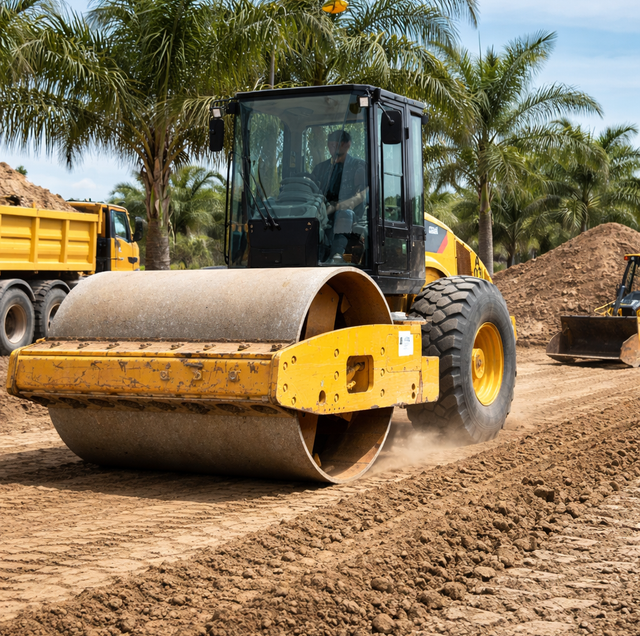
Quick Answer: Dumping fill in a single thick layer only compacts the surface crust; the interior remains loose and full of air pockets until it settles unevenly months later. Compacting it in thin lifts presses out those voids before anything gets built on top.
Why a Dumped Pile of Fill Can Look Solid and Still Be Hollow Underneath
A dump truck backs up, drops a load, and a skid steer or a box blade spreads it out into a rough grade. Run a compactor or a roller over the top once, maybe let a truck or two drive across it, and the surface firms up nicely. It holds a footprint. It looks and feels like ground that's ready to build on.
It isn't, not all the way through. The compaction from a single pass, or from the fill's own weight settling on itself, only reaches a few inches deep. Below that crust, the clumps and clods of fill are still sitting loosely against each other, with small pockets of air trapped between them that never got pressed out. A loose pile of dirt behaves much like a bag of potting soil dumped out of its sack: press the outside flat with a hand, and it holds its shape, but push a finger into the middle, and it's still loose and full of gaps. Fill dirt dumped in a single thick layer does the same thing on a larger scale, and there's no way to tell just by looking at the graded surface.
What Those Air Voids Do to the Ground Over the Following Months
The voids don't stay put. Fill keeps settling under its own weight for a long stretch after it's placed, and rain soaking in and then drying out, over and over, shifts individual soil grains into whatever gap is nearest. Each cycle presses the loose material a little tighter, and the ground drops a little lower. That process isn't tied to one storm or one rainy stretch, either. In a hot, humid climate with heavy seasonal rain, wetting and drying happens through dew, irrigation runoff, and afternoon downpours nearly year-round, not just during a single wet season, and in drier climates the same cycle still runs on watering schedules and temperature swings. The mechanism doesn't take a season off.
Because the voids were never evenly distributed to begin with, denser where the compactor happened to pass more than once, looser at the edges and corners, the settling isn't even either. That's the real problem with dump-and-grade: it doesn't just settle, it settles unevenly, and whatever sits on top has to absorb that unevenness. A concrete patio poured over a dumped, ungraded fill pad develops hairline cracks as one corner drops faster than the rest. Sod laid over the same fill shows a shallow dish or a soft spot within a season. A shed corner or a fence post set in fill that was never compacted in layers can lean measurably without anyone ever digging near it.
How Compacting in Lift-By-Lift Layers Avoids the Problem
The fix is mechanical, not magic: spread only a few inches of fill at a time, run the compactor over that layer, and only then add the next few inches. Each layer is called a lift, and it gets its own dedicated pass (or several) before it's buried under more material.
The reason this works comes down to how far compaction energy actually travels through loose material. A plate compactor or roller presses and vibrates the ground beneath it, but that energy dissipates the deeper it has to punch through uncompacted fill. Run a compactor over two feet of loose dirt, and it can look like it's doing plenty of work, denting the surface, throwing up a little dust, but most of that energy is spent in the top handful of inches. The material a foot and a half down never feels it. Keep each layer thin enough that the compactor's energy reaches all the way through, and the whole lift densifies rather than just the crust. Stack enough properly compacted lifts, and there's no leftover loose layer buried in the middle, because there was never a layer thick enough to hide one.
Lift Thickness, Equipment, and Moisture: The Three Variables That Actually Set the Outcome
Lift thickness: A realistic range is 4 to 8 inches per lift, depending on the fill material and the equipment doing the compacting. A walk-behind plate compactor, common on smaller grading and driveway-prep jobs, does its best work on lifts toward the thinner end of that range, especially in sandy or granular fill. A heavier vibratory roller, used on larger runs, can push toward the thicker end because it applies more force to the ground per pass.
Equipment match: A flat-plate compactor is built for granular, sandy fill and works well in tight spots. Clay-heavy, cohesive soil behaves differently: a flat plate tends to bounce off a sticky surface instead of transferring energy downward, which is where a rammer (sometimes called a jumping jack) earns its keep, since its narrower foot and higher impact force punch into cohesive material instead of skating across it. Picking the wrong tool for the material is its own way to end up with a lift that looks compacted but isn't.
Moisture content: This is the variable most often skipped, and it decides whether the other two even matter. Fill that's too dry won't bind, no matter how many passes it gets; the compactor just crumbles it, and it stays crumbly. Fill that's too wet won't compact either, since the water has nowhere to go and the compactor ends up shoving mud around instead of pressing soil grains together. There's a workable moisture range for every material, and on a working job it's usually judged by feel: a handful of the fill that holds a shape when squeezed but breaks cleanly at the edge, rather than crumbling to dust or oozing water, is close to right.
Deep fill work often means scraping off old sod or scarifying the existing ground before the first lift goes down. Call 811 before any digging or scarifying, even shallow, to get buried gas, power, water, and communication lines marked first.
Why the Shortcut Costs More Work Later, Not Less
Dump-and-grade earns its popularity honestly: it's faster to place, it needs fewer equipment passes, and a yard graded this way can look finished the same afternoon. None of that is a lie; it's just a partial picture. Lift-by-lift compaction takes longer up front because every few inches of fill gets its own compaction pass before the next layer goes down, and that staging takes real time and labor.
The shortcut's real cost doesn't disappear; it just moves downstream. A patio or slab poured over dumped, uncompacted fill can crack within a year as the ground beneath it continues to settle. Sod dips and ripples. A shed pad or a small addition's footing can tilt enough to need shimming. Fixing any of that after the fact usually means removing whatever was built on top, digging out the loose fill underneath, and compacting it correctly in lifts anyway, on top of the work it takes to break out and replace the flatwork or re-level the structure. Doing the lifts the first time avoids that whole second round of work, not just the day the grading crew leaves.
When Lift-By-Lift Compaction Matters Most
Depth is the deciding factor. Fill deeper than about a foot, and any fill going under something that will carry real weight- a patio, a shed pad, a driveway base, grading tight against a foundation- needs to go down in compacted lifts. There's simply too much material for a single pass to reach all the way through, and too much riding on it settling evenly.
Shallow, non-structural fill is more forgiving. Topping off a low spot by a few inches in an open part of the yard, or filling a small garden bed, doesn't leave much room for voids to hide in the first place, and a single pass or hand-tamping is often enough. The line to watch for is depth and what's on top of it: the deeper the fill and the heavier what's above it, the less margin there is for a shortcut to go unnoticed.
Frequently Asked Questions
There's no fixed timeline, but uneven settling from wetting and drying cycles commonly keeps showing up for several months to well over a year after dumped fill is placed, longer if the lifts were thick or the material was clay-heavy. Adding a heavy structure, like a shed or a home addition, on top speeds up localized settling right under that extra weight, which is one reason a footing set on dumped fill can lean faster than the surrounding yard.
There's no way to see it from the surface once it's graded, but a steel rod or a piece of rebar pushed into the soil by hand tells the story directly: ground compacted in lifts resists fairly evenly the whole way down, while dumped, uncompacted fill often goes firm for a few inches and then punches through into softer material underneath, a change in resistance you can feel through the rod even though nothing looks different on top.
Not by itself, and it can make the surface worse. Water poured onto a thick, uncompacted pile mostly saturates the top few inches and pools or runs off from there; it doesn't reach evenly down through loose material the way it would in a thin, spread-out lift. The result is often a muddy crust over ground that's still dry and loose underneath, which is the same core problem as before, just wetter on top.
The practical difference shows up in how many passes each one needs and where it can fit. A plate compactor typically requires three to four overlapping passes over the same lift to reach full density, since its footprint is small and its energy is concentrated straight downward. A ride-on roller can often achieve the same density in one or two passes because its drum spans a much wider strip, which is why rollers handle open, thicker lifts faster. A trench roller splits the difference: narrow enough to work a utility trench or a tight side-yard cut where a full-size roller won't fit, but with more compaction force per pass than a walk-behind plate.
Usually not, with one catch worth planning for: if there's any chance that the garden bed later gets a paver edge, a stepping-stone path, or a small retaining timber wall, it's worth compacting it in lifts from the start anyway. Going back to redo a shallow fix once something load-bearing sits on top of it means digging out material that's already settled around plant roots, which is messier than compacting it correctly the first time.
No, and this is the part that trips people up. A compactor's effective reach into the ground does go up with its energy output, which is exactly why a bigger roller compacts a thicker lift than a plate compactor can. But that reach is still finite for any machine: running even a heavy roller over two or three feet of loose fill in one shot means the energy dead-ends partway down no matter how many passes it makes. There's no substitute for breaking the fill into layers thin enough for the machine being used to reach all the way through.
Dump-and-grade and lift-by-lift compaction can look identical the day the work wraps up. The difference doesn't show up until months later, in a crack across a patio, a dip in the sod, or a post that's gone slightly out of plumb, and by then it's a repair instead of a step that could have been done right the first time.
Ask about lift-by-lift compaction on your next fill or grading job — get a stable base that won't settle unevenly on you later. Polk Services LLC serves Lakeland, Highland City, and Mulberry. Call (863) 344-5806.
