

Flood-Damaged Furniture Removal: What Water Changes
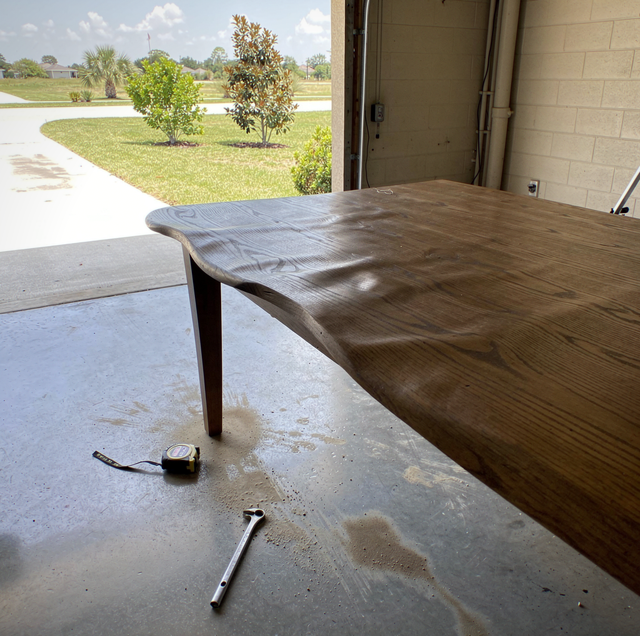
Before anyone decides what to do with a soaked piece of furniture, the piece itself has already changed. Wood and fiberboard draw in water and swell beyond their original dimensions, foam holds moisture throughout its depth, and metal fasteners begin to lose their grip on the fiber around them. None of that reverses on its own, and a dresser or sofa that sat in standing water is a structurally different object than it was dry, heavier and weaker in ways a glance won't show.
What Soaking Does to Solid Wood
Solid wood is not inert once it's wet. It swells and shrinks with moisture the same way it always has, just faster and further than normal humidity ever pushes it.
Swelling across the grain: Wood expands more across its grain than along it, so a saturated tabletop or panel gains width unevenly, and that uneven gain is what shows up later as warping.
Uneven drying: As a soaked piece dries, the outer surfaces lose moisture faster than the core, and the resulting mismatch between the outside and the inside causes checking, cupping, and splitting along the grain.
Glued joints under stress: Where two boards meet at a glued joint, the wood moves with moisture, but the glue line does not move the same way, so the bond can let go even when both boards still look intact.
Density plays a role: Denser hardwoods generally absorb water more slowly than softer woods, but once saturated, they hold onto that moisture longer, so a heavy wood piece can still be fully soaked well after a lighter one has begun to dry.
Engineered Wood and Particleboard after a Soak
Particleboard and MDF are wood fibers held together with adhesive and pressed into a panel, and water breaks that bond.
Where it shows first: Cut edges and screw holes are the most exposed points on any engineered panel, so that's usually where swelling appears first, well before the flat faces show anything at all.
No return to dimension: A swollen particleboard or MDF panel does not shrink back to its original size once it dries. The fiber has already pulled apart from the adhesive, and that separation is permanent, the same way a paperback book left out in the rain swells past the edges of its own cover and never sits flush again.
Veneer over the surface: A thin wood veneer bonded to a panel is held in place with an adhesive that is itself water-sensitive, so soaking lifts and bubbles the veneer even when the underlying panel still has some structure left.
Upholstery Foam and Fabric Once They're Wet
Upholstery foam is open-cell, meaning it's full of interconnected air pockets, and those pockets fill with and hold water throughout the entire thickness of a cushion rather than just the outer layer.
Fabric and batting wick further: The woven fabric and batting layered over foam pull moisture upward well beyond where the piece actually sat in water, a process usually called wicking.
The wicking line runs higher than the water line: A cushion or armrest that never touched standing water can still be saturated, because fabric and batting carry moisture up past the point where the water itself stopped.
Padding hidden inside the frame: Padding and webbing stretched across the underside of a seat or the inside of an arm can hold water long after the visible cushions are removed, since that layer sits inside the frame rather than on top of it.
Metal Fittings and Fasteners in a Wet Frame
Staples, screws, and other fasteners hold the frame together, but they don't hold up well when everything around them is wet.
Corrosion sets in: Metal fasteners exposed to standing water begin to corrode, and corroded metal loses its grip on the wood or fiber it's driven into.
A hold that used to be tight isn't: Even a screw that looks intact can back out or spin freely once the material around it has swollen and softened, which is a different failure than the metal itself breaking apart.
Hardware beyond fasteners: Hinges, drawer slides, and other moving metal hardware are just as exposed as staples and screws, and corrosion in a hinge or slide mechanism shows up as binding or seizing rather than simple rust stains.
Why Frame Joints Loosen and Fail
A frame joint is where wood, adhesive, and metal fasteners all meet at once, and each of those materials responds to water on its own timeline and in its own direction.
Wood at a joint swells one way, the adhesive holding it doesn't flex to match, and a corroding fastener loses its grip at the same time, so the joint that used to hold three materials together now has three materials working against each other. That is also why a joint can fail before the wood does: a board can still look straight and solid while the joint connecting it to the rest of the frame has already given way, because the joint concentrates stress from all three materials in one small area.
When a Piece Looks Dry but Isn't
A soaked piece of furniture can dry on the surface well before it dries all the way through, and that gap between how it looks and what it actually is matters more than it seems.
A piece that is far heavier than it should be is handled as saturated regardless of how it looks, since the surface can dry out long before the material underneath does.
Waterlogged furniture can weigh far more than its dry weight, and that weight is often concentrated unevenly in a foam core or swollen wood panel, which makes lifting and carrying it without the right technique and equipment a real injury risk.
Getting a Waterlogged Piece Out
A piece that's already swollen, corroded, or wicking moisture through its cushions doesn't get lighter or more stable while anyone waits, and it's handled and removed as the changed object it now is.
What this covers, and what it doesn't: Drying a piece out, treating it for mold, or otherwise restoring water-damaged material is a different trade, and that work gets referred out rather than attempted during removal.
Where it goes from there: A piece that's been sitting in water is flagged for disposal routing rather than donation, and the call is yours.
A few photos sent via text are usually enough to establish the scope of a waterlogged piece, even before anyone sees the swelling or corrosion in person.
Frequently Asked Questions
Check a broken or chipped edge. Solid wood shows continuous grain running through the break, while particleboard shows loose wood chips and visible resin binding the fibers together. That grain-versus-fiber distinction identifies the material only; it says nothing about how wet or salvageable the piece is.
No. Fabric wicks moisture upward through its weave, but leather absorbs water into its fibers directly and then stiffens and cracks unevenly as it dries, rather than staying pliable. That stiffening can appear even on sections that never touched standing water, since leather carries moisture across its surface differently than a woven fabric does.
Wicker and rattan are woven natural fibers, and soaking swells each strand individually, loosening the weave from the frame it's wrapped around. The points where the fiber binds to the frame usually give first, so a soaked wicker piece can lose its shape at those binding points before the fibers themselves show obvious damage.
Yes. A mattress foam core holds water disproportionately to how wet the surface looks, and box spring frames often contain metal coils that corrode once wet, losing tension and support. Because most of the water sits deep in the core rather than the surface layer, a mattress can be far heavier than it looks.
Not reliably. Laminate is a thin plastic layer bonded to a particleboard or fiberboard core, and water usually enters through the seams, edges, or screw holes rather than through the laminate surface itself. Once it reaches the core, the panel swells from within while the top laminate can still look untouched.
Swollen wood or particleboard expands within its own drawer track, and the fit that once had clearance now binds against the surrounding frame. A drawer that won't slide, even when the rest of the piece looks only lightly damp, is often a sign that the internal panels have already swollen more than the outer surface suggests.
If the piece is heavier than it was and the swelling has already started — getting it out now clears the room for whoever handles the drying. Polk Services LLC serves Lakeland, Highland City, and Mulberry. Call (863) 344-5806.
