

Gravel Driveway Edge Restoration: Get Your Lost Width Back
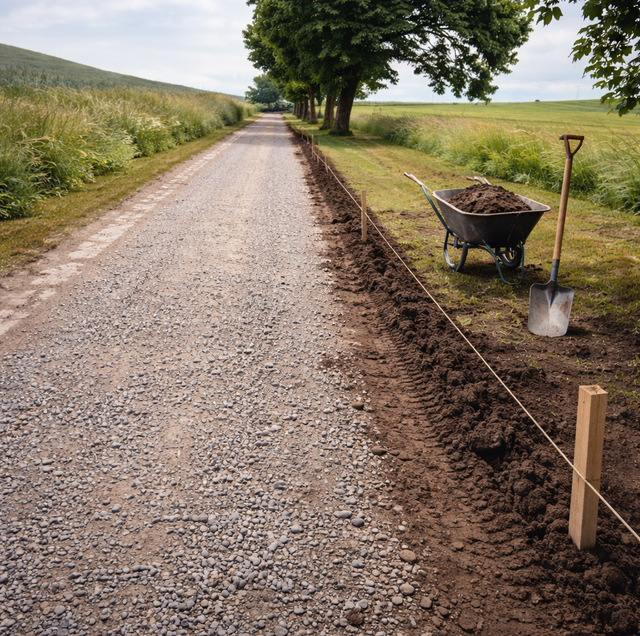
Measure straight across most gravel driveways that have sat in place for ten or fifteen years, then compare that number to the distance between two fixed points that haven't moved, like the corner of a garage and a fence post, and the difference is often surprising. A foot of width per side, sometimes more, has quietly worked its way into the lawn or the ditch line. Bringing that width back is a different job than simply maintaining a driveway that already holds its shape, and it helps to understand the difference before anyone shows up with a machine.
Finding Out How Much Width You Lost
Guessing at the loss doesn't get you anywhere useful, because the eye adjusts to a driveway shrinking a little at a time and stops noticing. What works is a fixed reference: the corner of a garage, a fence post, a shed foundation, a utility pedestal, an old sidewalk edge, anything that predates the driveway and hasn't moved since. Stretch a string or a mason's line between two such points on each side, level with where the drive originally ran, and the gap between that line and the current ragged gravel edge is the real number, not an estimate.
Check that measurement at several points along the run rather than relying on a single spot. Erosion is almost never even. A curve loses more width than a straight stretch because tires track wider through the turn. The area near a mailbox, a trash can pickup spot, or a second parking pad tends to lose the most, because that's where tires repeatedly clip the shoulder instead of staying centered. A driveway can look uniformly narrowed from the street and still be missing eight inches on one side and two feet on the other.
Not All the Lost Gravel Is Gone
Some of what's missing from the edge is sitting a few feet away in the grass or the ditch, not gone for good. That material got pushed there by tires, washed there by runoff, or scattered there by mowing equipment, and in theory it could go back where it came from. In practice, drifted gravel isn't structurally the same material anymore. It's mixed with topsoil, grass roots, and organic debris, and it was never compacted once it left the driveway surface. Raking it back into the gap and calling the job done gets you a strip that looks right for a season and then washes or ruts out again, because there's no compacted base holding it in place, only loose stone sitting on soft ground.
Reclaiming that drifted material still has a place in the job. Screened or picked clean of sod and organic matter, it can be blended back in as part of a new base lift rather than used on its own. But a restoration that relies only on what washed away, with nothing structural added underneath it, is patching the surface, not rebuilding the edge.
Rebuilding the Compacted Base at the Edge
The edge zone gets treated the same way the rest of the driveway was built, which is the part a quick touch-up skips. Sod and soil that creep into the strip get stripped out first because organic matter buried under gravel breaks down over time, leaving a soft spot that reopens the same failure. Underneath, a compactable base layer goes in: angular crushed stone, crushed concrete, or crushed asphalt millings all work, depending on what's available and what the rest of the driveway is built on. That base gets spread in lifts and run over with a plate compactor, not just dumped and left loose, because an uncompacted base is exactly what let the old edge migrate in the first place.
Utility pedestals, mailbox lighting, and irrigation lines often run shallow along the driveway edge, exactly where this strip gets stripped out and excavated. Call 811 for a locate before digging, even though the cut looks too shallow to worry about.
Once the base is solid, the top layer goes on to match the existing surface, whether that's limerock or limestone screenings, pea gravel, river rock, or a comparable stone. A geotextile fabric between the subgrade and base is especially worth using at the reclaimed edge, since that strip often sits over disturbed or organic-heavy soil that invites the base material to work its way down into the ground over time.
Regrading Before Restraint Goes In
Restoring the width means reshaping the ground it sits on, not just filling a trench. The edge zone gets regraded so the cross slope that sheds water off the driveway surface carries all the way to the new edge, with no hard step or ridge where old material meets new. A mini skid steer with a grading attachment or box blade is the right tool for this: it can feather that transition without tearing up the surrounding lawn the way full-size equipment would. Get the grade wrong here and the restored width holds its shape but drains poorly, which just trades one problem for another.
Locking the New Width in With Edge Restraint
Restraint, whether that's steel edging, wood edging, or a mow strip, comes after the width is restored, not instead of restoring it. Installed along the new true edge line, it gives tires, mower wheels, and runoff a hard boundary to stop at, rather than a soft transition they can keep chewing into. Installing restraint on an edge that's still sitting a foot or two narrower than it should be just locks in the smaller footprint for good, since the restraint holds whatever line it's set on. The order matters: reclaim the width first, then fix the boundary in place.
What Happens to the Edge After That
A newly rebuilt edge isn't finished the moment the restraint is in the ground. Rain events push loose material toward the low side of any unrestrained gap, and dry stretches loosen surface compaction enough for a tire to shave off a little more each time someone pulls in wide. Neither condition is worse than the other over a full year; both stress a fresh edge in different ways, which is part of why restraint and proper grading matter together rather than either one alone. A light top-off with matching stone every so often, once the restraint is holding, keeps small settling from turning back into the same slow drift that started the problem.
Frequently Asked Questions
A few inches of narrowing at scattered spots can often be corrected with regrading and a fresh top layer alone. Losses of a foot or more, especially where the string-line check shows the whole run has crept inward, usually mean the base itself is gone at the edge and needs to be rebuilt, not just topped off with new stone.
Regrading and base compaction can usually be done in a single mobilization. Restraint installation is sometimes scheduled as a follow-up, especially after heavier rain, so the rebuilt base has a chance to settle and drain before steel or wood edging is pinned into it permanently.
It can. A running grass that spreads by underground rhizomes, common in a lot of Florida lawns, tends to keep pushing new growth up through a reclaimed edge from roots that extend well past where the visible blades were cut back, so that strip may need a follow-up check for regrowth a season later even after a clean initial strip. Clumping grass or scattered weeds are more of a one-time removal, with little risk of regrowth.
Where drifted material has silted into a roadside ditch or drainage swale over the years, that buildup usually gets cleared as part of the same job, since it's often the same displaced gravel that's missing from the edge. Leaving it in place can raise the ditch bottom enough to slow water that used to drain freely past the driveway.
A stone base compacted mechanically is generally ready for normal traffic once the compaction passes are complete. Crushed asphalt millings behave a little differently: the asphalt binder in them firms up further as the material warms and gets rained on a few times, so a millings edge that feels loose the first week or two typically tightens up further on its own.
A small amount of settling in the first several weeks, roughly enough to notice if you run a hand across the transition, is typical and not a defect. What signals trouble is a ragged edge line reappearing, water pooling right at the new boundary instead of sheeting past it, or grass retaking the same strip within one growing season, any of which usually points to restraint that wasn't anchored deep enough or a base that wasn't compacted before it went in.
Get your driveway's lost width measured and restored — we'll rebuild the base, regrade the edge, and lock the new line in with restraint that holds. Polk Services LLC serves Lakeland, Highland City, and Mulberry. Call (863) 344-5806.
