

The Refrigerant Hiding in Wine Fridges, Beverage Centers and Dehumidifiers
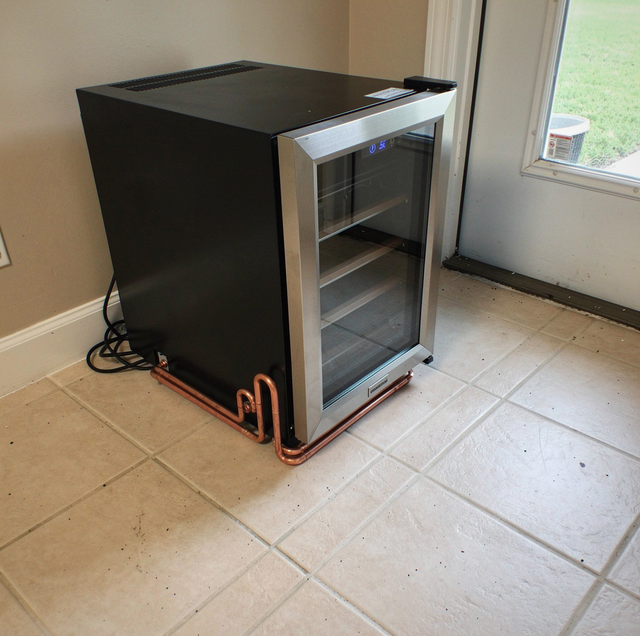
The wine cooler has been by the door for a week, unplugged, small enough that you carried it out of the kitchen alone. Beside it sits a dehumidifier from the basement and a beverage fridge that stopped holding temperature. All three look like awkward furniture waiting for a truck. All three are sealed cooling machines, which puts them in a different category than their size suggests and changes how they leave.
The Compressor at the Base Decides the Category
A sealed cooling system consists of a compressor, a condenser, an evaporator, and refrigerant moving between them in a circuit that is closed at the factory. Size has nothing to do with membership. A cabinet you can lift by yourself can hold the same architecture as an appliance that needed a dolly and help. The loop carries oil as well as refrigerant, circulating with the charge to keep the compressor lubricated, so the sealed portion of even a small appliance is never just a puff of gas.
The giveaway is physical. Look at the base of the unit for a compressor, a heavy dark canister with copper lines running out of it. A cabinet with no compressor on it is often thermoelectric, a solid-state design that moves heat via an electrical effect rather than a refrigerant charge, which is why a pair of wine coolers of nearly identical size can belong to different categories. None of this is a test you have to pass on your own. An unclear cabinet gets named as unclear during the walk-through and sorted there.
That category matters at the moment the appliance leaves. Anything carrying a loop is routed to a certified recovery facility, where the charge is pulled before any metal is scrapped, rather than going into a standard load. Photos texted ahead let a sealed unit get flagged before anyone arrives, and a written estimate confirms the complete scope.
A cabinet light enough to carry alone still holds a charged loop under pressure. That sense of harmlessness is what gets tubing snapped against a stair edge or a compressor pried out for scrap value. It travels as an intact appliance.
Wine Fridges and Beverage Centers Share a Look, Not a Build
Set a thermoelectric wine cooler beside a compressor-driven one, and you would struggle to tell them apart. Same footprint, same door, same rows of bottles behind it. Inside, they are unrelated machines. The thermoelectric cabinet contains no refrigerant and can travel with ordinary household goods. The compressor cabinet is a refrigeration appliance in a compact body and is handled as such.
Beverage centers push the confusion further because they are sold as furniture. They live under counters and inside bar cabinets; they get described by how many cans they hold rather than by what runs them, and they carry brand names you associate with kitchen gadgets rather than with appliances. None of that changes what is bolted to the base.
What this changes at pickup is the order of events. The unit gets identified before the truck is loaded rather than after. A cooler that turns out to have a compressor once it is already up on a load has to come back off and be set aside, and naming it on the floor skips that reshuffle entirely.
Warm coils only show up while a unit is running, so a cabinet unplugged for months gives you nothing to go by except touch. The base is the check that still works, since a compressor is visible whether or not the unit has power.
Portable and Window Cooling Units Are Complete Refrigeration Circuits
A portable air conditioner is a complete refrigeration circuit that happens to have casters. The compressor, the condenser, the evaporator, and the loop connecting them all sit inside one rolling shell, with an exhaust hose to push heat outdoors. Nothing about being movable makes it a different class of machine than the unit bolted into a window.
A window unit is the same idea in a fixed shell. The evaporator side faces the room, the condenser side hangs outside, and the loop runs between them through the middle of the cabinet. You never see the split because the whole thing arrives as one sealed box.
The reason these get misfiled is storage. They spend the off-season in a garage, an attic, or the back of a closet, stacked in with box fans, humidifiers, and space heaters, and they come back out as part of that pile. A box fan is a motor and blades. A space heater is a coil and a fan. The air conditioner wedged between them is a refrigeration appliance, and it is the only thing in that pile that cannot ride out in a general load.
A Dehumidifier Is a Refrigerator with a Different Job
A dehumidifier does not feel like a cooling appliance, because the room never gets colder. What it actually does is chill a coil until the air passing over it gives up moisture as condensation, then lets that air warm back up on the way out. Chilling a coil is refrigeration. The machine is a refrigerator that produces dry air rather than cold storage.
A peanut is a legume rather than a nut, and it stays one regardless of which aisle it gets shelved in.
That misfiling is the whole problem with dehumidifiers at cleanout time. They read as basement equipment. You group them with sump pumps, shop vacuums, and floor fans, all of which are motors in housings, none of which hold a sealed charge. The dehumidifier in that group is the outlier and needs to be named separately when the load is planned.
Water Coolers Divide by Whether They Chill
Water dispensers stand in offices and kitchens in nearly identical housings, and the front of the cabinet rarely tells you which kind you have. A dispenser that pours room-temperature water has a housing, a spigot, and sometimes a small pump. A dispenser with a chilling function has a small sealed loop doing the work, the same compressor, condenser, and evaporator arrangement scaled down to fit under the bottle.
Many of these units also heat. The hot side is an electric element in a tank and has nothing to do with a refrigerant loop, so a hot tap on the front tells you nothing either way. The chilled side is what you are looking for.
The check is the same as it is everywhere else. Look at the lower back panel. On most models, a compressor and a small set of coils sit right there, and the compressor is the part to find, since a dispenser already staged for a cleanout has usually been unplugged for weeks. Once you find one, the dispenser stops being office furniture and becomes an appliance with its own route out.
Small Chest and Countertop Freezers Are Full Systems in Small Cabinets
Freezing is harder work than chilling, not easier. A compact chest freezer in the garage, a countertop freezer in a home office, a dorm-sized unit that has been in a closet since college: each of them runs a working refrigeration circuit to maintain temperatures below freezing, and there is no simplified version of that circuit built for small cabinets.
These are the units most likely to end up at the curb by mistake, because one person can pick one up and walk it out. Portability reads as low stakes. A freezer that fits on a shelf still contains a compressor and a charged loop, and it belongs with the wine cooler and the dehumidifier rather than with the boxes going out beside it.
Chest models add a second trap. The cabinet is a plain insulated box with a lid and no mechanical hardware showing anywhere on it. The compressor sits behind a panel at one end, out of sight, and the coils on many models are built into the cabinet walls rather than hung on the back, so there is nothing obvious to point at.
Weight Is the Other Surprise in a Small Cabinet
A compressor is dense, and it is mounted low, usually toward the back of the base. That makes a small refrigeration appliance heavier than its dimensions would predict, and the weight sits unevenly, concentrated in one corner near the floor. A beverage center the size of a nightstand takes two hands and a plan, and it swings when you tilt it because the mass is not where your hands are.
Width is rarely what stops one of these. Standard interior door leaves run roughly 24 to 36 inches wide, and the 28- and 30-inch openings common on bedrooms and bathrooms are the ones that pinch a dresser or a sofa arm. A wine cooler or a countertop freezer clears those without a turn. What decides the carry is where the mass sits, not the gap at the frame.
Plan the handling around the base rather than around the box. Sealed units travel upright, get staged on their own instead of stacked into a load with light items, and get set down flat rather than leaned against a wall while everything else goes out. A dolly under one is doing real work even when the cabinet looks like a two-hand carry.
The size of the cabinet tells you how hard it is to move. The compressor at the base tells you what it is.
Frequently Asked Questions
Most sealed appliances carry a rating plate on the back panel, inside the door frame, or underneath the base. It lists the refrigerant the unit was charged with, along with the model and serial information. A thermoelectric cooler's plate lists voltage and wattage with no refrigerant line at all, making it a fast tiebreaker when the compressor compartment is hard to see. The plate answers whether there is a charge at all; which charge it is does not change where the unit goes.
No. Dual zone describes temperature control, not the cooling method. It means the cabinet has separate thermostats for the upper and lower compartments, and thermoelectric models offer that feature as readily as compressor models. Treat the zone count as a marketing spec rather than a clue about what is inside, and look at the base instead.
Nearly all household models are, but desiccant dehumidifiers are the exception. They pull moisture through an absorbent rotor and drive it off with heat, so they hold no refrigerant and no sealed loop. A ducted whole-home unit is installed equipment rather than a plug-in appliance, so it comes out through the trade that installed it, not through a cleanout.
No. A thermoelectric cabinet holds no charge and no sealed loop, so a dead one is an insulated box with a fan and a solid-state module inside it, and it travels out with ordinary household goods. A compressor cabinet that quit is the opposite case. A seized compressor or a dead control board stops the cycle without emptying the loop, so it routes exactly like one that still runs.
Yes. A portable ice maker looks like a kitchen gadget, but it freezes water onto chilled metal fingers using a compressor and a sealed loop, which is why it hums and warms along one side while it runs. The storage bin is unrefrigerated on most models, so the ice melts back into the reservoir.
A kegerator is a beverage cooler with a tap tower on top, so the cabinet itself is a sealed refrigeration appliance. The carbon dioxide cylinder that pushes the beer is separate pressurized hardware and no part of the cooling loop. Pressurized cylinders do not ride out with a load at all. That one goes back to a gas supplier or a cylinder exchange, and only the cabinet leaves with the pickup.
A small cabinet with a compressor in the base — identified before it goes on the truck, kept out of the standard load, and routed to a certified recovery facility instead of going out with the boxes. Polk Services LLC serves Lakeland, Highland City, and Mulberry. Call (863) 344-5806.
