

What Goes Under a Gravel Driveway: The 4 Layers That Matter
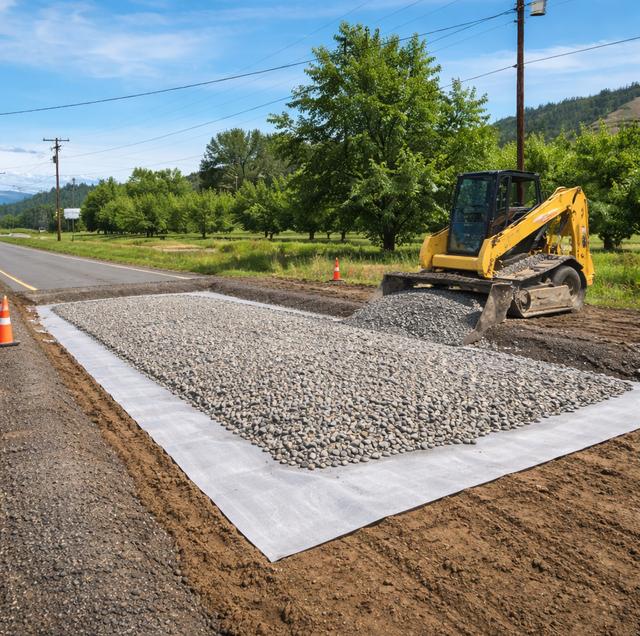
A driveway that's been topped off twice in two years and still looks thin isn't necessarily getting the wrong gravel. More often than not, the stone on top was never the problem. What decides whether a gravel driveway stays flat for a decade or turns into ruts and mud puddles within a year happens below the surface, in a stack of layers most homeowners never see and most quotes never break down. Here's what that layer system is, what each layer does, and why leaving one out causes problems that don't show up until much later.
The Four Layers Under a Driveway Built to Last
A properly built gravel driveway isn't one material dumped to depth. It's a stack of distinct layers, each doing a different job, built from the ground up.
Sub-Grade Prep: This is the native soil itself, and it's the layer most often rushed or skipped. Sub-grade prep means clearing away grass, topsoil, roots, and any other organic material down to the firmer soil beneath, then compacting the exposed soil before anything else goes on top of it. Organic matter left in place decomposes over time, leaving voids, and uncompacted soil keeps settling under its own weight long after the driveway is finished. Either one causes the layers above it to sink unevenly, no matter how good the stone on top is. On a lot with heavier growth or a rough grade to start, this step often means grading and light clearing work with a mini skid steer before compaction can even begin.
Have underground utility lines located and marked before sub-grade clearing starts. A skid steer blade doesn't know the difference between topsoil and a shallow irrigation, electric, or gas line, and even a few inches of stripping can catch one that isn't buried as deep as you'd expect.
Geotextile Fabric: This is the layer people misunderstand most. Geotextile fabric is not a waterproofing layer and isn't meant to prevent water from reaching the soil below; water passes through it freely. What it does is separate two materials that don't belong mixed together: the compacted stone above and the native soil below. Without that separation, stone particles slowly work their way down into the soil under the weight and vibration of traffic, especially in a low spot or anywhere the ground stays damp, while soft, wet soil works its way up into the stone from below. Over months of driving on it, that mixing is what turns a firm stone surface into something that feels soft, muddy, and short on stone even though nothing was ever hauled away. Some installers skip fabric on a subgrade that's already firm, dry, and well-draining, treating it as optional rather than mandatory. That shortcut can hold up fine on the right soil, but since the fabric goes in before everything else, a wrong call there isn't something you can fix later without tearing the driveway back apart, which is why we treat it as a standard part of the build rather than a judgment call made on-site.
Base Course: On top of the fabric goes the base course, generally a larger, more angular crushed stone than what ends up on the visible surface. Crushed concrete or limerock is a common choice for this layer. Base material is spread and compacted in multiple thin layers, or lifts, rather than dumped to full depth and rolled once, since a compactor's energy only reaches so far into loose material before it stops doing useful work. Each lift locks the angular pieces together and spreads the weight of anything driving over the surface across a wider footprint of soil, rather than concentrating it in one spot.
Finish Layer: The material you actually see and drive on goes on last, spread thinner than the base course and screened to a smaller, more even size range. This is where the choice between crushed asphalt millings, crushed concrete, limerock or limestone screenings, angular crushed stone, or a rounded material like pea gravel or river rock actually gets made, and it's worth its own separate look at how those options compare. But even the best finish material on the list underperforms if the three layers underneath it were skipped or rushed.
Why the Order and the Fabric Get Skipped, and What That Costs Later
The most common shortcut on a gravel driveway job is dumping stone straight onto grass or loosely raked dirt with no fabric and no compacted base underneath. It often looks fine for the first few weeks. The real cost shows up later. Without a separation layer, the stone above and the soil below behave the way a loose stack of dishes sitting directly on a soft mattress behaves: everything on top keeps sinking and shifting as the surface underneath keeps giving way, no matter how carefully the top layer was arranged. Stone that was never separated from soil slowly disappears into it, especially where water collects, and what was a solid-looking driveway ends up needing a full rebuild rather than a simple top-off of more material.
Skipping the fabric specifically gets confused with skipping waterproofing, and the two aren't the same problem. A driveway can drain water perfectly well and still fail from the bottom up if nothing kept the stone and soil apart. That's the distinction worth remembering: fabric's job is separation, not keeping water out.
How the Layers Get Built in Practice
The order matters as much as the materials. Sub-grade gets cleared of organics and compacted first, graded so the finished surface will shed water rather than hold it. Geotextile fabric rolls out next, directly over the prepared sub-grade, before any stone touches the ground. The base course is laid and compacted in lifts on top of the fabric, and only once the base has been checked for soft or uneven spots is the finish layer added and compacted to its final grade. Each step depends on the one before it being done correctly; adding stone on top of a soft, uncompacted layer just buries the problem instead of solving it, and it tends to resurface as a rut or a low spot within a season or two.
Frequently Asked Questions
As a general rule of thumb for a standard car driveway, a compacted base course is typically 4 to 6 inches thick, built up in at least two lifts rather than one thick pour. Driveways that regularly see a boat trailer, RV, or other heavy, concentrated load usually call for a deeper base, sometimes as deep as 8 inches, to keep that weight from punching through to the soil below over time.
Not directly, and it isn't sold as a weed barrier. Its job is keeping the stone and the native soil from mixing together, nothing more. What that means for weeds is indirect: a driveway that's growing them out of thin, bare patches is usually telling you the finish layer has worn down far enough that stone and soil are starting to meet at the surface, which is the layer problem worth fixing first, not the weeds themselves.
Grass and topsoil left under a driveway continue to decompose after the stone goes on top, and as the organic layer breaks down, it leaves gaps that the ground above settles into unevenly. Buried roots from cleared brush or small trees can also keep growing or rotting out, creating soft pockets years after installation. This is one of the main reasons a mini skid steer is used to strip vegetation and topsoil down to firm soil before compaction rather than just scraping the surface smooth.
Yes, mixing base materials across lifts is a common practice, often based on what's locally available or cost-effective for a given job. What matters more than which materials are combined is that each lift is compacted on its own before the next one goes down; dumping two different materials together into a single uncompacted pile defeats the purpose of building the base in lifts at all.
No, unlike concrete, a compacted stone base doesn't chemically cure, so the finish layer can go on the same day once compaction is complete. What does matter is checking the compacted base for soft or spongy spots before adding the finish material, usually with a plate compactor for a standard residential drive or a heavier roller for a longer or wider one, since anything missed at this stage gets buried under the visible surface.
Yes. Geotextile fabric comes in rolls, and adjoining rolls should overlap at the seams, generally around 12 to 18 inches, rather than butting edge to edge. A gap at the seam gives stone a direct path down into the soil at exactly that spot, and that's often where the first visible soft patch shows up on an otherwise well-built driveway.
The Layer System, Not Just the Stone on Top
The material a homeowner picks for the surface gets most of the attention, but the subgrade, the fabric, and the base course beneath it are what actually determine whether that material holds up. Skip or rush any one of those layers and even a good finish material ends up sinking, rutting, or washing out well before it should. Get the layers right, in order, and the finish material on top has a stable foundation to do its job for years instead of months.
Want a driveway built on the right layers? — Get sub-grade prep, fabric, and base course done correctly the first time. Polk Services LLC serves Lakeland, Highland City, and Mulberry. Call (863) 344-5806.
