

Gravel Scattering Into the Lawn: Is Your Mower the Cause?
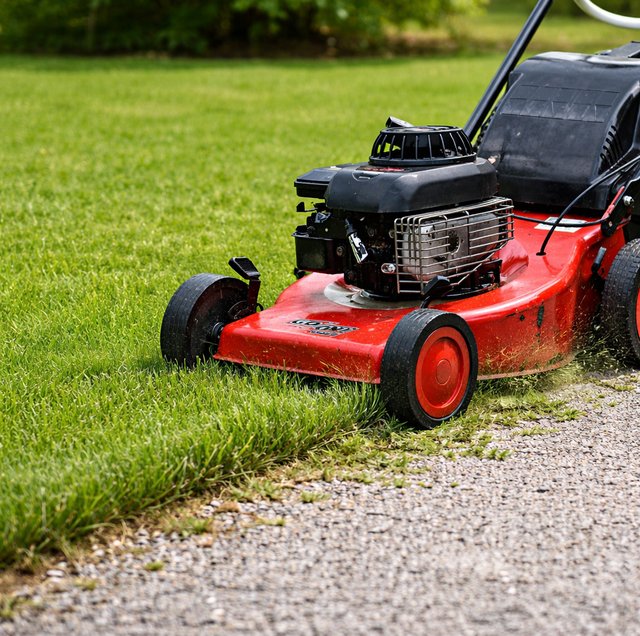
You've raked stray gravel out of the grass along your driveway for the third time this month, and the driveway itself hasn't lost any noticeable depth. The stone is getting into your yard some other way. A rotary blade running near an unedged or thinly covered driveway line doesn't just brush past loose stone; it picks it up and throws it, sometimes ten or twenty feet into the yard, and on a lot of properties that's a source most people never suspect: the mower that cuts the lawn right next to it. Material choice plays a role in how much stone sits around to be caught in the first place, but the throwing mechanism itself is a separate problem, tied to how the mower moves along that edge and what the blade encounters when it gets there.
How a Spinning Mower Blade Turns Loose Stone Into a Projectile
A rotary mower deck works by spinning a blade fast enough to cut grass cleanly on contact, and that same speed makes it dangerous to anything solid in its path. Blade tip speeds on a typical residential mower run well over 100 miles per hour. When the blade edge or the airflow beneath the deck catches a pebble rather than a grass blade, the impact accelerates the stone and launches it through the discharge opening or from beneath the deck's edge.
Part of what makes this worse than it sounds is the deck itself. A mower deck is shaped to create a slight vacuum under the housing, lifting grass upright so the blade cuts it evenly instead of just laying it flat. That same lift effect pulls loose debris, including small stones sitting on top of the turf, up off the ground and into the blade's path before the operator ever notices anything is there. Airflow reaches past the deck's own footprint, so a stone sitting just outside the housing can still get pulled in and caught.
Mowing Direction and Discharge Position Near the Edge
Where the thrown stone ends up depends heavily on the direction the mower faces as it passes the driveway line. Most walk-behind and riding mowers discharge clippings, and anything else the blade catches, out one side of the deck. If that discharge side is pointed toward the lawn on the pass closest to the gravel, stone gets thrown deeper into the yard, toward flower beds, windows, parked cars, or wherever someone happens to be standing. If the discharge side faces the driveway instead, most of what the blade catches gets thrown back onto the gravel it came from rather than into open grass.
The angle of approach matters too. A mower that runs parallel to the driveway edge exposes the blade to that strip of ground for the full length of the pass, giving it more opportunities to catch a loose stone than a mower that only crosses the line briefly at an angle. Slowing down for that specific pass, rather than holding a steady cutting speed the whole way around the yard, gives you more reaction time and fewer stones passing under the deck per second, since a faster pass covers the same loose stone with less warning before the blade reaches it.
The Safety and Turf Cost of Mower-Flung Stone
A stone thrown by a mower blade travels fast enough to crack a window, dent a car panel, or cause a real injury if it strikes a bystander, a pet, or you, which is why mower manufacturers build discharge guards and warn against mowing with the chute pointed toward people or structures. That risk is the main reason this particular scatter source deserves more attention than tire kickout or rain runoff, both of which move stone more slowly and over shorter distances.
A stone caught by a spinning mower blade can travel fast enough to shatter a window, dent a vehicle, or seriously injure a bystander or pet. Never mow toward people, cars, or windows near a gravel edge, and keep the discharge chute pointed away from anyone standing nearby.
The mower itself pays a price too. Repeated contact with hard stone dulls and nicks the blade's edge faster than grass alone ever would, and a blade that keeps striking gravel near the same edge often needs sharpening more often than the rest of the deck's wear would otherwise call for. A harder strike against a larger stone can also bend the blade or jar the spindle it's mounted on, which shows up later as a vibration or an uneven cut across the whole lawn, not just near the driveway.
Why Some Stone Sits Loose Enough to Get Hit
Not every stone near a driveway edge is equally likely to end up under a mower blade. A driveway with a defined edge and a compacted, interlocked surface doesn't leave much loose material sitting proud of the grass line for a blade to catch. The trouble spots are usually where individual stones sit exposed on thin turf or bare soil at the transition, unattached to anything below, free to be picked up rather than driven over.
Shape and gradation affect how often that happens, without changing why it happens in the first place. Rounded, single-size material tends to roll toward the edge and settle loose in the grass rather than locking into a compacted mat, which puts more individual stones in the mower's path over time. Angular material with a mixed range of particle sizes compacts tighter and holds its position better, so less of it ends up sitting loose at the boundary where a blade can reach it. Either way, once a stone is loose enough to sit on the grass rather than interlocked with the driveway surface, its shape stops mattering much. A rotary blade will catch a small angular chip about as easily as a small rounded pebble if both are sitting in the same spot.
Mower Scatter vs Tire Kickout vs Rain Runoff
Stone ends up in the lawn through more than one mechanism, and they don't behave the same way. Tires push stone sideways and forward during turns and pull-ins, so tire-scattered gravel tends to cluster near the driveway edge, heaviest near the turning radii and entry points, and rarely travels more than a few feet. Rain runoff carries fine material and small stone downhill along whatever grade the property has, following the same drainage path a puddle would, so it tends to collect at low points rather than spreading evenly along the whole edge.
Mower-thrown stone is different from both. Because it's launched by a spinning blade or pulled by deck vacuum, it can travel much farther in one motion than a tire ever kicks it, and it lands in a pattern that follows the discharge direction and the mowing route rather than the slope of the ground. A scattered arc of stone sitting well out into an otherwise clean lawn, especially in a rough line that matches how the mower was run, points to the blade rather than tires or rain.
Cutting Down on Mower-Caused Scatter
Reducing the amount of stone your mower can reach and throw comes down to a handful of habits and small changes you can make at the edge itself.
Aim the discharge chute toward the driveway: on the pass closest to the gravel, position your mower so that anything the blade catches is thrown back onto the stone rather than into your yard.
Trim the last few inches by hand: running a string trimmer along the immediate edge, rather than taking the mower deck all the way to the line, keeps your blade away from the loosest, most exposed stone.
Walk the edge before mowing: picking up visible loose stones from the grass line before you mow is a standard mower safety practice, and it directly removes the material most likely to get thrown.
Raise the deck slightly on the edge pass: a small increase in cutting height keeps the blade a bit farther from stones at grass level, reducing contact without leaving that strip noticeably taller than the rest of the lawn.
Keep a defined transition at the edge: a driveway with a clear, well-maintained boundary between stone and turf, rather than a ragged strip where the two blend together, gives a mower far less loose material to catch in the first place.
Frequently Asked Questions
Yes, and the damage isn't always where you'd expect it. A stone strike that chips one edge of the blade throws it out of balance, and an unbalanced blade transmits vibration straight into the spindle bearings rather than just cutting unevenly, which wears those bearings out well ahead of schedule. On some push mowers, a hard enough strike can also shear the small flywheel key that keeps the blade timed to the engine, which shows up as sudden hard starting or a kickback feel when you pull the cord rather than as a cutting problem at all.
Generally yes. Riding and zero-turn mowers tend to run larger decks and higher-volume discharge airflow than a typical push mower, both of which can propel a caught stone farther and with more force. Their wider decks also cover more of the edge strip in a single pass, which increases how often the blade encounters loose material along that line.
Not by much where stone is concerned. Mulching decks are built to recirculate grass clippings for finer chopping, which reduces how much vegetative debris exits the discharge port, but a stone caught by the blade doesn't get mulched the way grass does. It still gets struck and can still exit through the discharge opening or the deck's edge, so mulching mainly changes what happens to clippings, not what happens to gravel.
Look at the stone itself before you look at the pattern. Stone thrown by a mower blade often carries a fresh, light-colored chip or scar on one face where the blade struck it, since the same impact that launches it also marks it. Tire-pushed stone rarely shows that kind of damage; it just rolled or got kicked sideways. If you want a second check, the landing pattern backs it up: an arc or line that follows your mowing route points to the blade, while stone bunched tightly at the edge or near a turning radius points to tires instead.
It can, and the effect works two ways, not one. A lower cutting height puts the blade closer to ground level everywhere, including near the driveway, which increases the odds of direct contact with stones at grass height. A lower deck also sits closer to the turf, which strengthens the vacuum effect underneath it, so a low-set deck both reaches more stones and pulls harder on the ones nearby. Raising the cutting height a notch, especially on the pass nearest the gravel, weakens that pull as well as the direct contact.
Yes, temporarily. Freshly delivered material hasn't had time to settle or compact into place, so more individual stones sit loose on the surface and near the edge in the weeks right after a top-off than once the load has been driven on and rained on for a while. Extra caution near the edge during that settling period cuts down on how much fresh stone ends up in the lawn.
Stop gravel from spreading into your lawn — talk to Polk Services about edge repair and regrading options for your driveway. Polk Services LLC serves Lakeland, Highland City, and Mulberry. Call (863) 344-5806.
