

Add a Gravel Parking Pad or Turnaround: 4 Things to Get Right
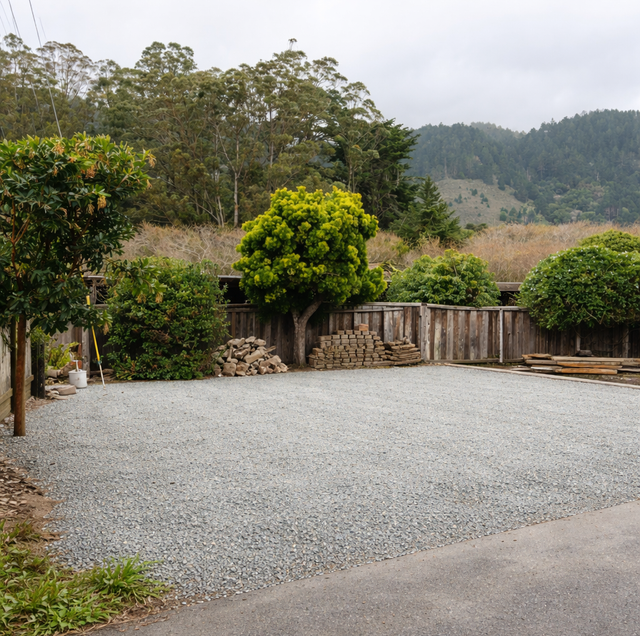
A property doesn't need a second driveway to solve a parking problem. A dedicated gravel turnaround or parking pad, tied into the existing drive, does the job faster and offers much more flexibility in shape than tearing out concrete and repouring a larger slab. Getting the size, grade, and material right the first time determines whether that new area holds up.
When One Driveway Isn't Enough Space Anymore
A driveway that worked fine when it was built often stops working once life adds a second vehicle, a work truck, a boat, or visiting family who all show up at once. The usual result is cars parked in the grass, tire ruts along the edge of the asphalt or gravel, or a driver backing all the way out to the road because there's nowhere on the property to turn around. The original driveway simply outgrew its parking footprint.
Adding a dedicated gravel parking area or turnaround solves this without tearing out and repouring anything. It's a smaller, faster project than a full driveway replacement, and because it's gravel, you're not locked into a fixed shape the way you would be with a concrete slab. The area can follow the natural line of the yard, wrap around a tree, or angle to match how vehicles actually move on the lot. Before any stone gets spread, though, the layout has to be worked out on paper (or at least walked and flagged) first, because a poorly sized turnaround creates its own problems: tight three-point turns, mower ruts, or a low spot that collects water every time it rains.
Backing Out Onto the Road Is a Real Risk, Not Just an Inconvenience
If the only way out of a driveway is to reverse the full length of it onto a public road, that's a blind maneuver every single time, and it's worse with a longer vehicle, a trailer, or reduced visibility from hedges or a curve in the road. A turnaround removes that step entirely: pull in, use the extra pad to point the vehicle back toward the road, and pull out facing forward. It sounds like a small convenience until you've done it once with a loaded trailer or in the dark, and then it's obviously the safer way to use the property.
How Much Room a Turnaround Really Needs
This is where most DIY layouts go wrong: people size the new area by eye, based on how big it "looks like it should be," rather than by the actual turning path of the vehicles that will use it. A vehicle doesn't turn in a straight-line box; it turns in an arc, and the arc is different for every vehicle type. Sizing too small means the driver still has to make a three-point turn, which defeats the purpose and chews up the gravel edges faster than through traffic would. Sizing too large wastes stone and yard space you didn't need to give up.
A simple hammerhead or T-shaped turnaround works for most passenger vehicles and pickups. The stem of the T should be at least as wide as your existing driveway, and the crossbar should be long enough on each side for the vehicle to pull in, stop, and swing out without touching the edges.
A full loop, or circular drive, avoids backing up entirely but requires the largest total area of any layout, since the vehicle never reverses; it just keeps moving forward through the loop.
A simple wide spot or bulb at the end of the drive is the smallest-footprint option and works fine for a car or short truck, but it gets tight fast with anything longer.
Sizing for a Car vs a Truck or Trailer
The single biggest sizing mistake is designing a turnaround around the vehicle you own today, rather than the largest vehicle that will realistically use it. A sedan or crossover can turn in a noticeably tighter radius than a full-size pickup, and a pickup towing a trailer needs more room again, because the trailer doesn't follow the same arc as the tow vehicle; it tracks a wider path on the inside of any turn.
If the turnaround only ever needs to serve everyday cars, a compact hammerhead is usually plenty. If a work truck, RV, or trailer will use it even occasionally, size it for that vehicle, not the daily driver, because retrofitting a too-small pad later means tearing into gravel that's already compacted and settled. It's worth walking the actual vehicle through the intended path, or having whoever does the grading work stake it out and drive it, before any stone goes down, rather than relying purely on a measured drawing. A turning path that looks fine on paper can still clip a fence post or a low tree limb in real life.
One more distinction matters here: a turnaround that only sees rolling traffic, and a pad where a trailer or RV parks and sits for weeks at a time, are different builds. Anything stationary needs a deeper, compacted base under the tires and any jack or leveling points, since a parked load concentrates weight on a few fixed spots rather than spreading it across a moving tire path.
Tying the New Grade Into What's Already There
A new parking area or turnaround doesn't exist in isolation. It connects to your existing driveway, and if the two don't share a consistent grade at that connection point, you end up with a step, a rut, or a new low spot exactly where the old surface meets the new one. Water follows the path of least resistance, and a mismatched seam is often exactly where it collects and stays soggy underfoot for days after a normal rain.
The fix is to survey the existing driveway's slope before laying out the new area, not after. The new pad should pick up roughly the same fall direction as the driveway it's attached to, so runoff keeps moving the same way it always has instead of pooling at the junction. If the new area sits lower than the surrounding yard even slightly, that low point needs somewhere to drain to, whether that's a swale along the edge, a slight crown carried through from the existing drive, or a tie-in to whatever drainage path the property already relies on. Getting this step wrong is the most common reason a brand-new gravel area starts looking rough within the first season, long before the stone itself has done anything wrong.
Where Property Lines and Setbacks Come In
Because a parking pad or turnaround is often placed at the side or the far end of an existing driveway, it's easy to end up closer to a property line, easement, or the road right-of-way than the original driveway ever was. Some jurisdictions also regulate how close impervious or semi-impervious surfaces can sit to a boundary, or require a permit for any surface addition over a certain size, even a gravel one. Rules vary by county and even by lot, so before staking out the new area, check with your local jurisdiction, whether that's planning, zoning, or public works, to confirm setback distances and whether the project needs a permit. This is a five-minute phone call that's a lot easier than moving a finished pad later.
It's also worth calling for a free utility locate (811 in most areas) before excavation starts, since a new gravel area often disturbs more ground than people expect once base material and grading are involved.
Never start digging or grading for a new parking area without calling 811 first. Striking a buried gas, electric, water, or fiber line can cause a serious injury, a costly outage, or worse, and in most states skipping that call is against the law.
Matching Material Between Old and New Gravel
A new gravel area that looks and drives differently from the existing driveway reads as an afterthought, and it can also create a functional seam where loose stone migrates, or the two sections wear unevenly. Where possible, match the stone size and color to what's already down, especially in the finish layer that you actually see and drive on. If the original driveway used a specific regional stone that's no longer readily available, the next best option is a close match in size and color rather than something visibly different, so the transition reads as a single connected surface rather than two patched-together projects.
Where the new area ties directly into the old, a clean, gradual transition between the sections, rather than an abrupt seam, keeps stone from migrating between the two and helps the whole thing hold its shape under regular turning traffic, which stresses the surface differently than straight-line driving does.
The Area Stays Useful Once It's Tied In Right
A turnaround or parking pad gets more turning, pivoting, and start-stop traffic than a straight driveway, and that kind of movement is harder on loose stone than vehicles simply rolling forward. Pivoting tires work surface stone loose in any month of the year; what changes through the year is how fast standing water moves that loosened stone once it's already displaced, which is exactly why the tie-in grade covered above matters more on a turnaround than it does on a straight run. A well-tied-in, properly graded area keeps that loosened stone from migrating far even after it's worked free. Plan on an occasional top-up of stone in the areas that see the most turning, since that's where surface material naturally displaces first.
Frequently Asked Questions
As a starting point, the crossbar should extend at least one full vehicle length beyond each edge of the driveway stem for a passenger vehicle, and more if a full-size truck or a trailer will use it. The stem itself should match or slightly exceed the width of the existing driveway so a vehicle doesn't have to hug one edge to line up straight.
Yes, in most cases the new area is tied in at the edge rather than cut into the existing surface. The one exception is when the existing driveway's own edge restraint, like steel or wood edging, runs along the spot where the new area needs to connect; that section of restraint usually has to come out and get reset a few feet back so the two areas can share one continuous compacted base instead of butting against a buried edge.
Depending on the jurisdiction, you could be asked to remove or relocate the encroaching section, which means excavating and moving already-placed stone. Some areas also treat a gravel surface addition over a certain square footage as requiring the same setback compliance as a paved one, so being gravel isn't always an automatic exemption.
Not usually a separate system, but it's worth checking that the existing drainage path, a swale, a ditch, or wherever the water has always gone, has enough capacity left for the extra square footage now feeding into it. A drainage path that barely kept up with the original driveway can start backing up once a second gravel area is added upstream, even if the new area's grading is done correctly.
That depends heavily on traffic and how well the grading and tie-in were done at installation, but the sections that see the most pivoting, the inside of the turn mainly, are typically the first to need a top-up, sometimes within the first year or two of regular use, while straighter sections can go much longer.
Yes. The new gravel area still needs a clean, graded transition where it meets the asphalt edge. A slight lip or edge treatment there helps keep loose stone from migrating onto the paved surface. Mixed-material driveways with a gravel turnaround or parking extension are a common and workable combination.
Get a turnaround or parking pad laid out right — call to have the area sized, graded, and tied into your existing drive. Polk Services LLC serves Lakeland, Highland City, and Mulberry. Call (863) 344-5806.
