

Best Gravel for a Driveway: 6 Materials, Ranked by Durability
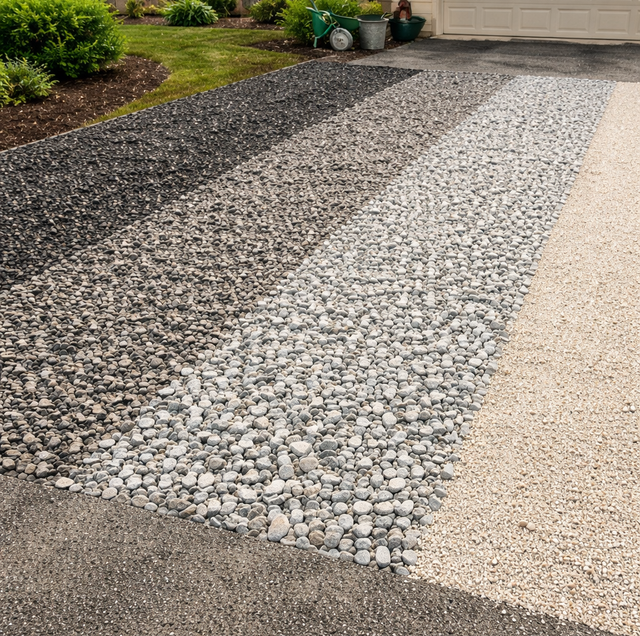
Not every gravel driveway holds up the same way, and the choice of material is the single biggest reason why. Some driveways stay firm and flat for a decade; others rut, migrate, and need topping off every season, even under the same traffic and the same weather. Before picking a load of stone, it helps to know how the common options actually behave once a vehicle starts driving on them.
What Makes One Driveway Material Outlast Another
Not all "gravel" behaves the same way once a truck rolls over it. Some materials lock together as they compact, forming a semi-rigid surface that sheds water and holds its shape for years. Others stay loose no matter how much you drive on them, drifting toward the edges and leaving ruts down the middle within a season. The difference usually comes down to particle shape and fines content: angular, broken particles with a range of sizes interlock and compact into a dense mat, while smooth, rounded, single-sized particles just roll past each other under load.
That single fact explains almost every complaint homeowners have about a driveway that "never firms up." Below are six materials commonly used or considered for a driveway, what each one actually does under tires and weather, and where each one earns or loses its keep.
Six Materials, Side by Side
| Material | Compaction /Durability | Drainage | Look |
|---|---|---|---|
| Crushed asphalt millings | Best, binds into a firm, semi-solid surface | Good, sheds water off a crowned grade | Dark charcoal-gray, blacktop-like |
| Crushed concrete | Very good, compacts hard and resists rutting | Good | Light gray, mixed particle sizes |
| Limerock / limestone screenings | Good, fines lock the surface tight | Good once compacted | Off-white to tan |
| Angular crushed stone (clean stone) | Good for the top layer, better as a wear course over a compacted base | Excellent, very open | Gray, sharp-edged, uniform |
| Pea gravel | Poor, stays loose indefinitely | Excellent, almost too open | Rounded, tan/brown, decorative |
| River rock | Poor, same rolling problem as pea gravel | Excellent | Rounded, mixed earth tones |
Crushed Asphalt Millings
Millings are reclaimed, ground-up asphalt pavement, and they're the material we install most often on residential driveways. Fresh millings are dark, angular, and full of fine dust from the milling process. Once spread and compacted with a plate compactor or roller, the residual asphalt binder in the millings softens slightly under the sun and pressure, helping the particles knit together at the surface. Over a few weeks of traffic and heat, that top layer firms into something closer to a semi-rigid mat than loose stone. It holds tire ruts better than any round-stone option, and because it's a repurposed material rather than freshly quarried stone, it's a common choice where sustainability and reuse matter to the homeowner.
Crushed Concrete
Crushed and screened concrete (often labeled recycled concrete aggregate) is angular rubble from demolished slabs, sidewalks, and foundations, graded down to a driveway-appropriate size. Like millings, it has a wide range of particle sizes in the mix, from coarse chunks to fine concrete dust, and that gradation is what allows it to compact into a dense, load-bearing surface. It doesn't bind the way millings do since there's no asphalt cement to soften, but the interlock between angular pieces is strong enough that a well-compacted crushed concrete driveway resists rutting nearly as well. It also holds up better than asphalt millings to occasional exposure to fuel or oil drips, since there's no asphalt content to soften from petroleum products.
Limerock/Limestone Screenings
Limerock is quarried limestone crushed down to a fine, mixed gradation, commonly used as a base course in driveway and hardscape construction as much as a standalone driveway surface. The fine limestone dust in the mix (the "screenings") is the working part. When compacted with moisture, those fines fill the voids between larger particles and lock the whole layer together. A properly compacted limerock driveway sheds water well and holds a firm, pale surface, though it can wash and rut faster than millings or crushed concrete on a grade with poor drainage, since the fines that hold it together are also the part most easily carried off by running water.
Angular Crushed Stone (Clean Stone)
This is generic crushed limestone or similar hard-rock aggregate, screened to a fairly uniform size with sharp, broken edges (the trade often calls it "clean stone" because it's washed free of fines). The angular shape gives individual stones some grip against each other, more than a rounded stone ever will, but because it's screened to one size range rather than a full gradation, it never packs down into a solid mat the way millings, crushed concrete, or limerock do. It works well as a top dressing over a properly compacted base, or in a drainage-critical spot where water needs to move through fast, but used alone as the whole driveway depth, it stays looser underfoot than the three materials above.
Pea Gravel
Pea gravel is small, rounded, naturally worn stone, and it's a common choice for walkways, fire pits, and drainage beds. On a driveway, the same roundness that makes it comfortable to walk on works against it: round stones have almost no surface friction against each other, so they roll and redistribute under every tire pass instead of locking into place. A pea gravel driveway needs regular raking and topping-off, develops ruts in the tire paths quickly, and tends to migrate onto the lawn or into the street with every rain. It's a legitimate material for plenty of jobs; a primary driveway surface for daily vehicle traffic isn't one of them.
River Rock
River rock is the larger, smoother cousin of pea gravel, rounded by years of water tumbling rather than crushing, and it shares the same core problem. Because the stones are rounded rather than angular, they never interlock, so the surface stays loose no matter how much material you add or how often you compact it. It also tends to shift and "float" a car's tires more than pea gravel because the individual stones are bigger, which can make a driveway feel unstable in wet weather. River rock has a place as a decorative border or a drainage swale accent; as a driving surface, it's one of the weaker choices on this list.
Getting the Base Right Matters as Much as the Material
Even the best-performing material on this list will fail early if it's dumped straight onto native soil. A durable gravel driveway starts with the existing ground graded to shed water away from the house, then a compacted sub-base (often a coarser aggregate or additional millings) laid down and compacted in its own pass before the finish material goes on top. Skipping that step, or laying the finish material too thick in a single lift, is why some driveways still rut even when the material itself is good: the compaction never reaches full depth, so the top few inches shift over a soft, uncompacted layer beneath. A crowned profile, with the center slightly higher than the edges, keeps water moving off the surface instead of pooling and softening it from below.
Particle Size Matters Almost as Much as Material Type
Two driveways built from the same material can behave differently if the particle size is wrong for the job. Base-layer material is generally kept coarser, with larger chunks mixed in among the fines, since that range packs down into a stable platform under load. Finish-layer material, whatever you choose from the list above, is usually screened to a smaller, more consistent range so it lies more smoothly underfoot and doesn't leave large stones loose on the surface where tires can kick them up. A finish layer poured too coarse feels rough and stays looser than it should; poured too fine without enough larger particles mixed in, it can wash and rut faster in heavy rain. Getting the size range right for each layer is as much a part of a durable driveway as the choice of material itself.
Frequently Asked Questions
Most residential gravel driveways are built in two compacted lifts: a 4- to 6-inch sub-base layer of coarser material, then a 2- to 3-inch finish layer of the surface material, for a total compacted depth of around 6 to 9 inches. Heavier vehicle traffic, such as a boat trailer or an RV, generally calls for a deeper sub-base to prevent the load from punching through to the soil below.
Yes, a limerock or crushed concrete sub-base under a millings or clean-stone finish layer is a common combination. What matters is compacting each lift on its own before adding the next: if both materials get dumped and spread together in one pass instead, the mix never reaches full compacted density, since the fines from one layer and the coarse particles from the other interfere with each other rather than locking together, and that under-compacted zone ruts and pumps under tire weight far sooner than a properly layered build.
Weeds root in the fine organic material and windblown soil that settles into gaps between stones over time, not in the gravel itself. A layer of geotextile fabric between the prepared sub-grade and the base course isn't sold as a weed barrier; its main job is keeping the stone and soil separated, but it limits weed growth from below as a side effect, and periodically topping off low or thin spots keeps the surface dense enough that airborne seeds have less bare soil to take hold in.
A well-compacted millings or crushed concrete driveway typically needs a light top-off every 2 to 4 years in normal residential use, mostly at entry points and turning radii where tires scrub the surface hardest. Pea gravel and river rock driveways need it far more often, sometimes multiple times a year, because the material never stops migrating.
Millings tend to grey and fade somewhat over time rather than holding a deep charcoal color, since UV exposure and oxidative aging break down the asphalt binder at the surface, much like they grey an asphalt road over the years. Limerock and crushed concrete can lighten slightly and show more dust-gray tone as fine particles wash to the surface with rain, which is normal and doesn't indicate the base is failing.
Standing water almost always points to a flat or reverse-graded area rather than a bad material choice, since even angular, well-compacted gravel needs a slope to shed water. Low spots that develop over time, often near a drainage swale or where a driveway meets the street apron, usually need regrading rather than just more material dumped on top.
Which Material We Recommend Most Often
For a standalone daily-use driveway, we install crushed asphalt millings most often, mainly because the residual binder gives them a firmness that other loose materials can't match without extra maintenance. Crushed concrete is a close second where a lighter-colored surface is wanted, and limerock earns its place as a base course or a finish layer on driveways where the pale, compact look matters more than dark asphalt tone. Angular crushed stone works best paired with one of those three rather than carrying the whole driveway alone, and pea gravel or river rock are better reserved for the walkway, border, or drainage bed they were made for than asked to hold up a car every day.
Get a gravel driveway that actually holds up — talk to Polk Services about material and grading options for your property, from gravel driveways in Plant City to Winter Haven. Polk Services LLC serves Lakeland, Highland City, and Mulberry. Call (863) 344-5806.
