

Power Recliner Removal vs. a Standard Chair: What Changes
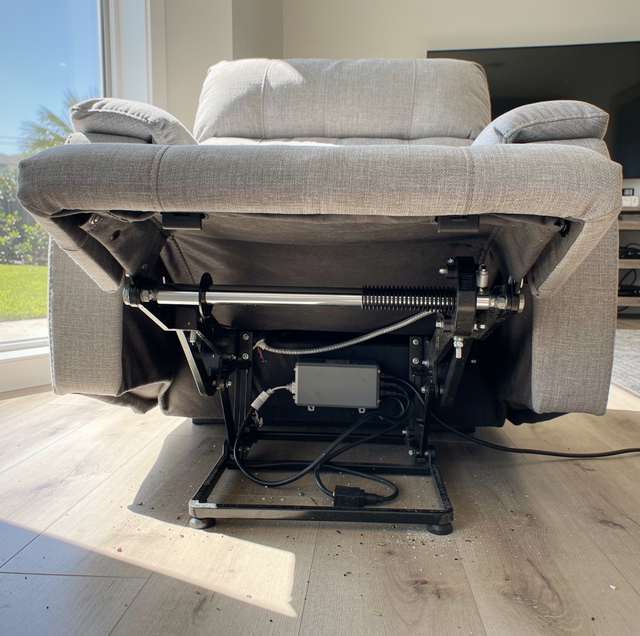
The armchair that used to sit in that corner could be walked out of the room by two people without much thought about it. The power recliner that replaced it doesn't behave the same way. You notice it the first time you try to shift the chair a foot to vacuum behind it: it drags instead of sliding, one end presses harder into the floor than the other, and a cord runs out of the back toward the wall. From the outside it's still just a chair with fabric on it. Everything that makes it a harder piece to move is bolted to the underside of the seat, where you've never looked.
What Sits Inside the Base of a Power Recliner
A manual recliner is a wood or steel frame, padding, upholstery, and a steel linkage that folds the footrest out. That's the whole inventory. A power recliner keeps all of that and adds a set of components the older chair never carried, and they all live in the same place: the base, below seat height.
The first is the motor, a linear actuator that drives a threaded shaft out of a housing and bolts to a steel plate fastened to the seat frame. The second is the power supply box that feeds it, which is why the cord carries a brick instead of a plain plug, and which rides strapped to a frame rail under the seat on some chairs and sits loose on the floor behind others.
Then there's the wiring, and on a chair, it goes places it doesn't on other powered furniture. One lead runs from the box to the motor and stays in the base. A second leaves the base, climbs the inside of a side seam, and ends at the control wand that hangs off the arm. On a chair with a powered headrest or powered lumbar support, a third lead crosses the joint where the back section meets the seat frame, which is the one seam on the piece that is also a place the chair comes apart.
None of these parts is heavy on its own. Together, and mounted where they are, they change what the chair is.
The Scissor Mechanism Carries More Mass Than a Spring and Cam
The linkage in a manual recliner doesn't have to generate any force. You do that. Push back against the chair's back, and your own body weight drives the steel arms open; a cam and a catch hold the position you stopped in, and springs pull the footrest back when you shift forward. The steel only has to hold what you put there. It can run lighter gauge because the only load it carries is the load you put in the seat.
A power mechanism works in the opposite direction. The actuator extends its shaft against the scissor arms and drives the footrest out under whatever load happens to be sitting in the seat, so all of that force enters the linkage at one anchor point instead of spreading across the frame the way a person's weight does. The linkage is built for a load it generates rather than one it only has to hold. Add the actuator, its mounting plate, and the bracket work that anchors it, and you have the weight difference between the two chairs, sitting in one assembly.
There's a second consequence, and it matters more on pickup day than it does in the living room. A threaded shaft holds its position by the pitch of its own thread, not by a latch you can trip. Cut the power to a chair stopped halfway and the mechanism stays halfway. The footrest doesn't drop or retract. It waits exactly where the motor left it, which is how a chair can arrive measuring longer at the door than its owner remembers it being.
A powered scissor mechanism closes with motor force behind it, not spring tension a hand can hold back. Keep fingers, feet, and cords clear of the linkage under the seat any time the chair is plugged in.
Why the Weight Sits Low and Rearward
A standard chair spreads its mass fairly evenly. Frame, arms, padding, and cushions all contribute, and the center of that weight sits somewhere near the middle of the piece at roughly seat height. Two people picking it up feel about the same load in each set of hands.
A power recliner places its added components below the seat and toward the back of the base, where the actuator anchors and the power supply box are located. The chair's center of mass drops and moves rearward simultaneously. That's not a size problem. It's a balance problem, and it shows up in three places.
Carrying is the obvious one. Two people lifting the chair, one at the front and one at the back, are not sharing the load evenly, and the person at the back is holding the end with the motor. The split doesn't hold steady either. Tip the chair to clear a doorway and the load slides toward whoever has the low end at that moment, so the heavier share changes hands partway through a turn rather than staying where it started. Tilting is the second. Lean the chair backward to clear a threshold or a low header, and the heavy end rotates downward past the pivot instead of staying put, so the piece wants to keep going. Setting it down on its back or on an arm is the third. A chair balanced this way doesn't rest stably on a face it wasn't built to sit on, which is why nobody should be parking one on end in a hallway while they figure out the next move.
The same imbalance is why the chair fights you before it ever leaves the floor. A recliner base rides on glides, fixed plastic or steel pads meant to spread weight across a floor rather than roll across it, and the rear pair carries more of the chair than the front pair does. Push on one corner and the loaded rear glide acts as the pivot, so the chair swings instead of sliding. Those rear glides are also the ones that score a wood floor or snag the edge of a rug on the way out of the room.
The Cord and the Control Wand Travel With the Chair
Every other piece of furniture in the room leaves the house as one object. A power recliner leaves as an object with two or three flexible things trailing off it: the wall cord, the lead from the power supply box to the motor, and the control wand on its own cable.
A loose cord is the single most avoidable problem during a recliner pickup. A cord hanging from the underside runs right at ankle height for whoever's walking backward, and it hooks things: the nose of a stair tread, the corner of a door casing, the chair's own glide as the piece pivots, the baluster at the bottom of a run. When a cord catches mid-carry, the load stops before the people carrying it do, and on a stair that's the worst possible moment for a chair to stop moving. The control wand adds its own version of the same problem. It sits in a pocket sewn into a side seam, its cable is short because it was only ever meant to reach a seated hand, and it swings free every time the chair is tipped.
Unplug the chair at the wall, then coil the wall cord and the wand cable and tuck them into the seat before pickup day. Cords hanging loose off a chair are what catch on a stair nose.
Wall-Hugger Designs and the Clearance They Were Bought For
If the recliner sits inches from the wall and still reclines, it's a wall-hugger, sometimes sold as a zero-wall or wall-saver design. A conventional recliner tips its back into the space behind the chair, so it needs open floor back there. A wall-hugger instead rides the seat forward on a track as the back goes down, keeping the back panel roughly where it started.
People buy these for a specific reason: the room couldn't spare the space behind the chair. That usually means the chair is tight to a wall, wedged into a corner, or hemmed in by a side table it was measured against. Getting it out onto open floor comes first.
The design adds hardware too. That forward-riding track is a carriage and rail assembly under the seat, on top of the recline mechanism rather than in place of it, and it's more steel in the same low, rearward zone that was already carrying the motor. It also means the chair's closed and open footprints are two different shapes. Whether the opening at the door will take it is its own question, and it gets measured the same way it would for any bulky piece.
Why a Power Recliner's Back May Come Off at a Bracket
Recliners are often built with the back as a separate section that seats onto metal brackets on the seat frame. Not all of them are. Plenty of manual chairs are upholstered as a single unit, with the back permanently fixed to the frame, and there's no bracket to be found on those.
Where there is one, the joint is usually a pair of steel channels on the back's uprights that drop over matching tongues welded to the seat frame, held by the weight of the section itself and sometimes by a lever or a screw at the outer edge. On a chair with nothing crossing that joint, the back lifts straight up off the tongues, and that's the end of it.
Where a power recliner differs is what crosses that joint. A powered headrest or powered lumbar support in the back section has its own small actuator, and that actuator is fed by wiring running down into the base to the same power supply. Releasing the bracket on a chair like that doesn't leave you holding a free section. It leaves a section that's mechanically loose and still connected, which is a different situation entirely and not one to discover with the piece half-lifted off the frame.
That's worth knowing about rather than acting on. What the bracket holds, whether anything is wired across it, and whether the joint is worth opening at all are things the crew works out on-site, with the chair still sitting on the floor.
What a Chair That Won't Power Up Changes About Donation
Expectations need setting here. The walk-through flags donation-eligible pieces on four conditions: frame damage, staining, odor, and pest history. Hardware completeness isn't one of them, and neither is whether a chair runs when you press the button. That check happens with the chair standing still, and it is not a motor test.
Resale intake is a different counter with a different habit. A real intake process operates anything with a moving part rather than judging it by eye, because a recliner can look correct sitting still and only show the fault when somebody tries to use it. A recliner is a piece of furniture bought for its mechanism, and a power recliner is one bought specifically for a powered mechanism. A chair that won't recline generally fails there on its own, regardless of how sound the frame and fabric are.
The failure could sit in several places, too. A dead outlet, a power supply box that's stopped feeding the motor, a wand cable broken inside its insulation where it flexes, an actuator that's given out. Sorting out which one takes a bench and time, and it isn't a diagnosis anyone makes with a truck at the curb. What carries over is the material: the steel in that mechanism and the motor bolted to it are metal, and they stay separate from foam and fabric rather than going out with them.
Frequently Asked Questions
Not quite. A lift chair adds a second motor and a scissor frame under the whole seat that tilts the chair forward to help someone stand, so it carries a lifting assembly on top of the recline mechanism. That's more steel again, mounted even lower in the base.
One per reclining seat, as a rule. A three-seat piece with two reclining ends carries two actuators, two mechanisms, and their wiring. Some run every seat from a shared power supply, and some give each seat its own, which is why one piece has a single cord to the wall, and another has two.
They do. A massage function runs on small vibration motors set into the seat and back, and a heat function uses a pad wired into the same low-voltage supply. Neither adds much weight, but both add wiring crossing between the back section and the base.
The chair usually can't be run at all. Most power recliners put every control on the wand rather than on the chair body, so with the wand gone there's no button to press and no way to show that the mechanism still works. Wands are matched to a specific chair by connector and voltage, so a spare from another recliner rarely substitutes.
Yes. A swivel base sits on a bearing plate between the chair and the floor, and a glider rides on arms or a track that lets the seat rock. Either adds a moving joint below the mechanism, so the chair body can rotate or swing while it's being lifted instead of staying square.
It takes up different floor. The carriage has already carried the seat forward along its track, so the chair occupies space ahead of where it normally sits, while the back panel remains near the wall behind it. The measurement that matters is from the back panel to the leading edge of the footrest, not the size of the chair closed.
Recliner that stopped moving and won't fit the room anymore — book the pickup and let the crew deal with the cord, the weight, and the carry. Polk Services LLC serves Lakeland, Highland City, and Mulberry. Call (863) 344-5806.
