

Questions to Ask a Grading Contractor: The 4 That Matter
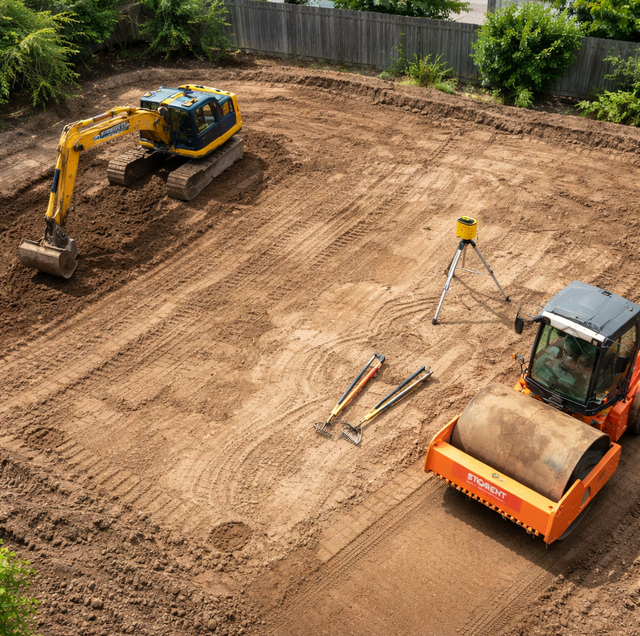
Quick Answer: Four questions expose whether a contractor knows the job: how they compact fill, where their fill comes from, where water goes once it leaves your yard, and how they verify the finished grade. A specific answer names a method, place, or number.
A grading estimate usually takes twenty minutes: someone walks the yard, nods at the low spot, and has a number back to you within a day or two. That pace makes it easy to hire on gut feel and a fast turnaround, and skip finding out how the person is actually going to do the work. Grading failures don't show up at the walkthrough. They show up months later, in a puddle that came back, a fresh crack across a patio, or a fence post leaning a little more than it used to. By then the crew is long gone, and the same yard has to be dug up and reworked a second time. Four questions, asked before you sign anything, tend to surface whether a contractor actually thinks through the work or is running the same pitch on every yard.
Why the Answer Matters More Than the Question
These four questions aren't hard to find or unusual to ask. Any contractor worth hiring has heard versions of all of them before, which is why the question itself isn't the test. The test is what comes back. A real answer to "how do you compact the fill" names a method and maybe a piece of equipment. A vague answer is a single reassuring line with nothing underneath it: "we'll pack it in good," "don't worry, we've done this a hundred times," "it'll drain fine." Reassurance is easy to say and doesn't tell you anything about the actual plan for your yard.
There's a simple physical version of this same test that has nothing to do with dirt: knock on a kitchen cabinet door you're looking at. Solid wood gives back a dull, dense thud. Thin veneer over particleboard sounds hollow and thin, even though both doors look identical with the paint on. You can't see the difference by looking at either one, but tapping it tells you immediately which is which. A contractor's answer works the same way. Two people can say "yes, we compact it properly" in the exact same tone of voice, and one of them has a real process behind the sentence while the other is hoping you don't ask a follow-up.
A contractor who mentions calling 811 before digging, without being asked, is showing the same habit these questions are trying to draw out. A utility locate is standard before any dig and typically takes a day or two.
Question 1: How Are You Compacting the Fill?
Ask this one plainly: "How are you building up the fill, and what are you compacting it with?" You're not trying to become an expert in soil mechanics on the phone. You're listening for whether the answer names an actual process or just asserts an outcome.
A specific answer describes the fill going down in layers, with a compactor run over each layer before the next goes on top, and it usually mentions which piece of equipment they'll use and why (a plate compactor for a tight side yard, a heavier roller for an open stretch). It might also mention checking the soil's moisture before compacting, since fill that's too dry or too wet won't pack down right no matter how many passes it gets.
A vague answer stops at "we'll compact it" or "we run the machine over it a few times" with no mention of layering, no mention of equipment, and no acknowledgment that a thick pile compacted only once behaves differently than the same fill built up gradually. That gap matters because a fill area that isn't compacted correctly can look identical to one that is, right up until it settles.
Question 2: Where Does Your Fill Actually Come From?
Ask directly: "Where is the fill coming from, and can you tell me where it was sourced?" Then listen for whether the answer is a place or a shrug.
A specific answer names something concrete: a supplier, a pit, a quarry, or a specific land-clearing job the material came off of. It's the kind of answer that could be verified if you wanted to, and it often comes with an offer to include the source in the written estimate.
A vague answer is "it's just clean fill" or "don't worry about it, it's good dirt" with nothing behind it. That phrase alone tells you almost nothing, since two loads can both get called "clean fill" while one came from a known supplier and the other came off an unmarked pile nobody can vouch for. If a contractor can't or won't say where a load is coming from before it's delivered, it's harder to get an honest answer after the truck has already dumped it in your yard.
Question 3: Where Does the Water Go Once It Leaves My Yard?
This is the question people skip most often, because "it'll drain" sounds like a complete answer. It isn't. Ask specifically: "Once water leaves the regraded area, where does it actually go?"
What a real answer sounds like: It points to a place, a swale that carries it to a low corner of the lot, a spot where it discharges into an existing drainage path, or a note that the new slope keeps it moving toward a street or storm drain instead of pooling against a fence line or running onto a neighboring property. A contractor who's actually thought about this can usually walk the yard with you and point to the exact route the water will take.
Where it goes thin: An answer that waves toward the general downhill direction and stops there. "It'll drain away from the house" is true of almost any slope in almost any direction, and it doesn't tell you whether that water ends up somewhere reasonable or just becomes a new wet spot at the property line, or worse, on someone else's lot. A contractor who can't name the endpoint hasn't planned the whole path, just the part closest to your foundation.
Question 4: How Do You Check the Finished Grade Before You Call It Done?
The last question separates a crew that measures from one that estimates by eye: "How do you verify the grade is right once the work is finished?"
A real answer describes an actual check: shooting elevations with a level and comparing them against the planned slope, running a string line with a line level across the area, or walking it with a rod to confirm the fall is consistent rather than just visually "downhill enough." It treats the finished grade as something you can measure and compare against a target, not something you can tell just by standing on it.
A thin one is "you'll be able to see it slopes the right way" or "we'll eyeball it to make sure it looks good." A finished grade can look flat and even to the eye and still be off by enough to leave a shallow dish that fills with water after the first heavy rain, since a slope that shallow reads as flat to most people standing on it. That's the gap this question checks for: does the contractor have a way to confirm the number, or only the look?
What a Pattern of Vague Answers Actually Tells You
One vague answer out of four isn't automatically disqualifying. Someone might not naturally think in those terms on the phone and still do solid work, especially if they warm up once you ask a follow-up. What matters more is the pattern across all four. A contractor who gives one specific, detailed answer and three reassuring one-liners is a different signal than one who gives four specific answers, and a contractor who gives zero specific answers across all four questions, no matter how confident or friendly the delivery, is telling you they either haven't thought through the process on this kind of job or aren't used to being asked to explain it.
Ask a follow-up before you decide: If an answer feels thin, a single follow-up question, "what's an example of a job where that mattered," usually separates someone who has a real process from someone who's guessing at what you want to hear. A contractor with firsthand experience in that specific situation can usually describe the actual yard, even without naming the client. Someone repeating a script tends to circle back to the same vague phrase instead of ever landing on a concrete example.
What This Means Before You Sign
These four questions take less than five minutes in a walkthrough that's already happening, and none of them require you to know the trade. You're not evaluating the technical correctness of the answer yourself. You're listening for whether the answer has a shape to it, a method, a place, a route, a number, or whether it's just a confident sentence with no real content behind it. Getting the specifics into the written estimate, not just spoken during the visit, is worth doing too, since a detail that only exists in a conversation is hard to point back to later if the work doesn't match what was described.
Asking the right question and getting a real answer is a different thing from watching the work get done right. But a contractor who can answer specifically, before a shovel ever moves, is a much better bet to also execute specifically once the equipment shows up.
Frequently Asked Questions
Ask during the estimate visit, before you've committed to anyone, and ask the same four questions of every contractor you're comparing so you're judging the answers against each other rather than in isolation. Once you've signed, it's much harder to walk away over a vague answer.
Experience is a reasonable thing to mention, but it isn't a substitute for the specifics. Worth listening for: whether the "recent job" they describe actually resembles your yard, similar soil, similar drainage problem, similar scope, or whether it's a vague reference to "hundreds of yards" with no detail that would let you compare it to your own situation. A contractor whose examples keep drifting toward unrelated jobs is often filling time rather than answering the question.
Yes. The more useful version of that ask is a reference at least 6 to 12 months old, rather than a job finished last week, since settling and drainage problems typically don't show up until well after the crew leaves. A yard that's held up through a full year of weather, including a stretch of heavy rain, is a much stronger reference than one that hasn't been tested yet.
No. A specific answer tells you the contractor understands the job, but it doesn't replace confirming licensing and insurance, or getting the specifics (fill source, compaction method, drainage endpoint) written into the estimate so both sides are working from the same description of the job, rather than leaving it as something only said out loud.
Different specific answers aren't automatically a problem, since soil conditions, lot shape, and the scope of the job can reasonably call for different approaches. What matters more than whether the answers match is whether each contractor can explain why they'd handle your particular yard that way, rather than reciting a generic answer that doesn't reference your property at all.
It's worth asking as a separate question, not just a follow-up, because the answer tells you something the compaction question alone doesn't: whether the equipment they describe can actually fit and maneuver on your specific lot. A contractor who names a machine size relative to your gate width, fence spacing, or a tight side yard is thinking about your property specifically; one who answers only with "whatever's needed" hasn't looked closely enough yet to know.
Four questions won't turn anyone into a grading expert overnight, but they don't need to. They're built to expose whether the person standing in your yard has a real answer or a rehearsed one, and that difference tends to show up in the work whether or not you ever learn to spot it yourself.
Ask us these four questions before you decide who grades your yard — specific answers, in writing, before any dirt moves, on grading and ground leveling in Bartow and bush and lot clearing in Bartow alike. Polk Services LLC serves Lakeland, Highland City, and Mulberry. Call (863) 344-5806.
