

New Build on Raw Land? Get the Driveway Sequence Right
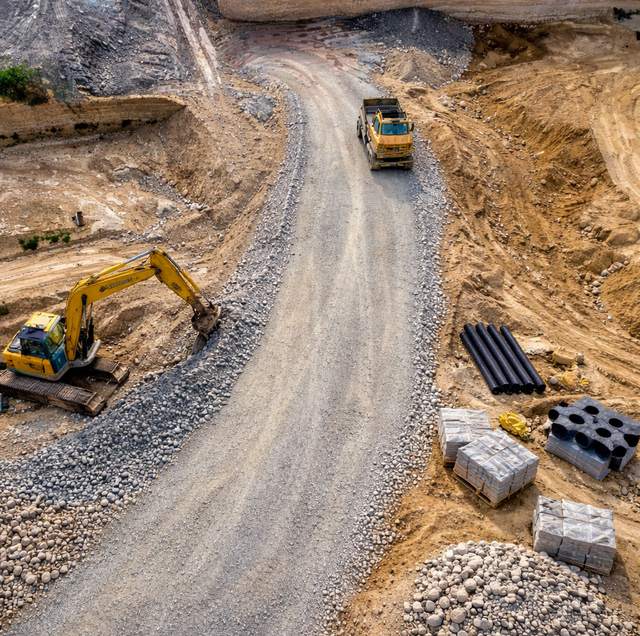
Raw land with no existing driveway, no established access point, and no prior construction on it changes the whole sequencing question. On a property that already has a driveway, the question is usually how to repair or upgrade what's there. On land that's never been built on, the question is when in the overall build timeline the driveway should even go in, because a driveway installed too early on a raw-land project gets destroyed by everything that comes after it: excavators cutting the foundation, concrete trucks delivering the slab, framing crews hauling lumber and equipment, dumpsters getting dropped and picked up. That traffic isn't gentle on a finished stone surface, and it doesn't care that the driveway looked great the week it went in.
Why the Driveway Rarely Goes in First
A finished driveway is built for the weight and frequency of a household's daily vehicles, not for a loaded concrete truck, a rented excavator, or a flatbed delivering trusses. Even a corridor that was graded correctly, with the fall, the width, the drainage tie-in, and the grading and leveling work itself done right, still gets ground down by repeated heavy loads before the house even exists to protect it from that traffic. Wheel ruts form in the finish layer; mud from the excavation gets tracked across it and works down into the stone; edge restraints get run over and pushed out of line; and the crown that was supposed to shed water gets flattened by tires passing over the same track over and over. That isn't a sign the driveway was built wrong. It's a sign it was built at the wrong point in the schedule.
The Sequence That Avoids Rebuilding a Driveway Twice
The sequence that avoids rebuilding a driveway twice generally runs as follows, though the exact pace depends on the size of the lot and how many trades are working on the site at once.
Clearing and rough grading: Trees, brush, stumps, and root systems are removed first, and the land is rough-graded to the general shape of the building pad and the driveway corridor. This is a rough pass, not the final grade, since the corridor is about to get dug into again for utilities.
Utility trenching, septic, and well work: Water, sewer or septic lines, electric, and sometimes gas all have to cross or run alongside the future driveway corridor at some point. Trenching through a driveway that already has its base and finish layers down means tearing both back up to bury the line, then rebuilding the same section from scratch. Doing that trenching before the driveway's base goes in avoids that repeat work entirely.
A temporary access route, or a driveway built to sub-base only: Once utilities are in, the site still has months of heavy equipment traffic ahead of it. Two approaches handle that. One is a separate temporary construction road, built to a lower standard in a different spot from the permanent driveway, that absorbs the abuse and gets removed or reseeded once the house is closed in. The other is building the actual driveway corridor to sub-base only, meaning the compacted base course goes down but the finish layer is deferred, so the corridor can carry construction traffic on a surface built to support the weight without scattering stone or grinding it into the mud.
Final base and finish grade, and the drainage tie-in, after heavy traffic ends: Once vertical construction is substantially finished and the steady stream of concrete trucks, lumber deliveries, and heavy equipment has tapered off, the corridor gets its final grading pass, its drainage tie-in gets connected, and the finish layer goes down last. At that point, the only traffic left is landscaping crews, final trim work, and the homeowner's own vehicles, which is what the finished surface is built to handle.
Raw Land vs a Teardown-and-Rebuild
A full teardown-and-rebuild on a lot that already had a house is a different starting point than truly raw, never-developed land. A teardown site usually already has an existing driveway pad, an established access point off the road, and utilities that are already stubbed to the property, even if some of that gets replaced during the rebuild. That head start compresses the early clearing and access steps considerably.
It doesn't remove the traffic problem, though. A rebuild still runs excavators, concrete trucks, and framing crews across the same lot, and if the new driveway sits in the same footprint as the old one, that footprint takes the same beating a raw-land corridor would. The practical difference is mainly in scope: a teardown project often reuses part of the existing driveway pad as its temporary access route during demolition and early construction, while raw land has to build that access from bare ground with nothing to work from. Either way, the same rule applies: whatever surface carries heavy equipment traffic shouldn't be the finished one.
Coordination Before Any Driveway Grading Starts
Grading a driveway corridor on raw land before certain other steps are locked in wastes the pass entirely. Surveyor stakes marking the lot lines, setbacks, and building corners need to be set before a corridor gets graded, since a driveway routed even a few feet off from where the final house placement lands can mean regrading a section that didn't need to move. Utility marking, commonly requested through 811 before any digging, matters just as much on raw land as on an established lot, and arguably more, since raw ground often has no prior utility record to work from at all until that locate happens.
Never grade or trench a raw-land driveway corridor without calling 811 first. Undeveloped ground often has no prior utility record on file, so a locate is the only way to know what's buried before an excavator or trencher hits a gas, electric, or water line.
Septic and well permitting adds another layer specific to undeveloped land. A septic system's drain field placement typically must maintain a required setback distance from driveways and other hardscape. That distance varies by jurisdiction, so it's worth checking with the local building or health department rather than assuming a number. Because that permitting process can shift where the drain field, and by extension the driveway corridor, actually sits, finalizing the septic or well design before committing to a graded driveway route avoids grading a corridor that later has to move to make room for it.
When the Driveway Finally Gets Its Last Layer
The finish layer and the final drainage tie-in are the last things that go in, not because they're difficult, but because they're the most fragile part of the build and the easiest to ruin with one more month of construction traffic. Waiting until the bulk of the heavy equipment is off the site, even if some punch-list work and landscaping crews are still coming and going, is what lets a driveway go from sub-base to finished surface once, rather than finished, ruined, and rebuilt.
Frequently Asked Questions
There's no fixed timeline, since it depends on permitting speed, how long septic or well approval takes, and how long the vertical construction phase runs, but raw-land projects commonly carry a driveway at sub-base only for several months to over a year before the finish layer goes down. The sub-base is built to handle vehicle and equipment weight on its own for that whole stretch; what it typically needs before the finish layer goes on is a regrading pass to true up the wheel ruts that traffic leaves behind, not a rebuild.
No. Where the lot has room, siting a temporary road on the side of the property with denser or rockier soil, or through an area already slated for later landscaping, does double duty: it holds up under equipment weight without extra prep, and its footprint gets reworked anyway once the house is closed in. What typically stays in the ground afterward is whatever compacted sub-base the temporary road picked up along the way, since digging that back out to bare soil isn't necessary before grading and seeding over it.
Yes, and that's the point of building the corridor to sub-base rather than leaving it ungraded until the finish layer. A season or more of construction traffic does leave the sub-base rutted and uneven in the wheel paths even though it was compacted correctly at the start, so it typically gets a regrading and recompaction pass right before the finish layer goes down rather than having the finish stone spread directly over whatever shape the base settled into.
Before, generally. A well-drilling rig is heavy equipment in its own right, and running it across a corridor that's already been finish-graded just adds another pass of heavy traffic to a surface that was supposed to be done. Drilling the well earlier in the sequence, alongside the other utility work, also means the well's final location is locked in before the corridor's grade gets finalized around it.
It happens, particularly on raw land, where plans sometimes shift once site conditions such as soil type or tree cover become clearer. The rough clearing usually still holds since it opened up more ground than the corridor strictly needs, but the grading itself, the fall and the compacted shape of the corridor, generally has to be redone to the new layout rather than patched to fit it, which is the main reason surveyor stakes and a settled site plan should come before grading starts rather than after.
The crossing itself works the same way it would on any lot, but raw land more often lacks an existing culvert to inspect or reuse, so that piece is typically planned and installed as new work during the utility and rough-grading phase rather than checked against something already in the ground.
Schedule a raw land site-work consultation — we'll map out the right order for clearing and driveway installation so heavy equipment doesn't wreck it before the house is finished. Polk Services LLC serves Lakeland, Highland City, and Mulberry. Call (863) 344-5806.
