

Remove an Outdoor Kitchen: Grill Island and Fire-Pit Pads
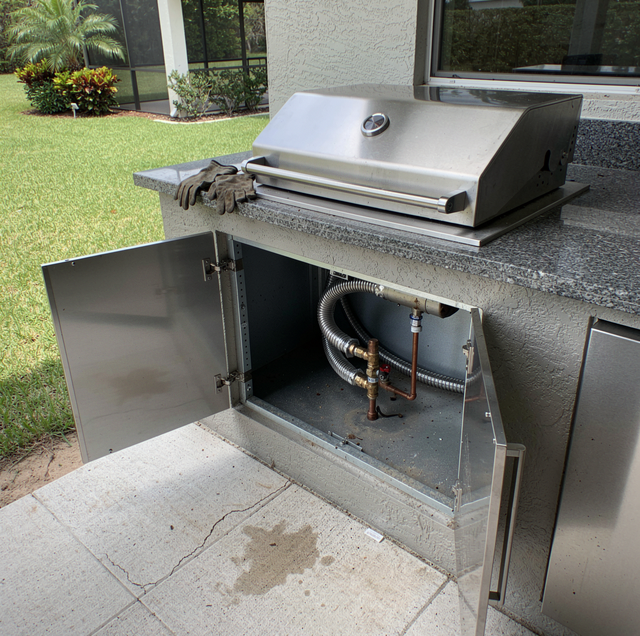
The first hands on an outdoor kitchen do not belong to a demolition crew. Before a tool touches the island, the gas supply has to be shut off at the source and disconnected by the utility or a licensed gas professional, the circuit feeding the refrigerator and the under-counter lighting has to be killed and terminated by a licensed electrician, and the water to the sink has to be shut off and drained. None of that is demolition work.
What it does is set the calendar. You cannot pick a removal date until you know when those trades can be out; until they are, the island is not safe to open. The first real step in removing an outdoor kitchen is a phone call to someone else.
That ordering is why the job looks harder than it is. The masonry box in the corner of a patio holds four separate jobs: live services, loose appliances, a heavy top, and a structural core on a slab that may or may not be leaving with it.
Gas, Power and Water Come Dead First
Open the cabinet doors, and you will see the utility side of the structure. Most grill islands carry more than one live service, each belonging to a licensed person.
Gas: A built-in grill head runs on a supply line, either natural gas piped to the island or propane from a tank in one of the bays. That supply must be shut off at the source and disconnected by the utility or a licensed gas professional before any removal work is scheduled. It is not a step a demolition crew performs, and not one to take on yourself. A propane cylinder is not part of a demolition load and leaves with the gas professional or goes back to an exchange point before the crew is booked.
Even a grill that has not been lit in years can hold a live gas supply behind its doors. Treat the island as live until the utility or a licensed gas professional has disconnected it.
Power: Plenty of islands have a dedicated circuit for an under-counter refrigerator, a rotisserie motor, or lighting under the bar overhang. That circuit gets killed at the panel and the conductors terminated safely by a licensed electrician. Pulling a plug or throwing a breaker is one thing; everything past that belongs to someone licensed.
Water and drain: A sink means a supply line and a drain, and the drain is the part homeowners usually cannot answer for. Outdoor sinks get piped into a dry well, a bed drain, or a run of pipe that daylights somewhere out in the yard. A plumber needs to trace that line and deal with it before the cabinet bay is opened up.
The Appliances Leave as Whole Units
Everything with a brand name on it comes out before anything structural moves.
Photograph the inside of every cabinet bay before anything comes out. The lines, sleeves and stub-outs hiding behind those doors are the fastest way to show your utility and your licensed trades what they are walking into.
The grill head: A built-in head drops into a cutout in the countertop and rests on its own flange. Once disconnected, it lifts straight up and out. Side burners, warming drawers, and pellet hoppers come out the same way.
The refrigerator: A built-in outdoor refrigerator slides out of a framed bay rather than sitting on the floor, and because it carries refrigerant, it does not travel with the masonry. It gets pulled as an appliance and routed to a certified recovery facility.
The sink, faucet and doors: These unhook once the water is dead. Stainless access doors, drawer stacks and trash pull-outs are fastened to the frame from inside the opening.
The Countertop Comes off Whole or in Pieces
Under the appliances is the heaviest single piece anyone will lift all day. Outdoor counters are almost always granite, tile set over a cement-board substrate, or poured concrete.
The decision that matters gets made before anyone puts a hand on it: the top comes off in one piece, or it comes off broken. Whole means enough hands and a clear path off the patio. Broken means less handling and more material to carry out. A top with a sink cutout and a grill cutout has two weak lines running through it, so a slab meant to come off whole sometimes decides otherwise on the way up.
Bar overhangs come off ahead of the main top. They ride on steel brackets, or corbels lagged into the frame, and until those are released the overhang is still tied in.
Block, Steel Studs and the Veneer Skin
Strip the finish, and you find one of two cores, and which one it is changes everything that follows.
Concrete block: A masonry island is stacked block with mortared joints, sometimes with filled cells and reinforcement running up through them. It is solid, heavy, and comes down as rubble with no salvage in it.
Steel stud framing: The other common build is a light steel frame skinned in cement board, then finished in a stone or brick veneer or a stucco coat. The frame comes apart in panels, but the skin on it is masonry, so one wall gives you two entirely different materials as it comes down.
Fire-Pit Rings and Block Surrounds
A fire-pit pad is the same structure with fewer parts. Most are a steel ring or a low block surround set on a pad, dry-stacked or mortared, sometimes capped with a stone coping and filled with lava rock or fire glass over a burner tray.
What separates one fire pit from another sits underneath the pad. A gas fire pit has a line stubbed up through the center of the pad to feed the burner, and that line stays live until the utility or a licensed gas professional shuts it off and disconnects it. A wood-burning ring has nothing under it, and from the patio the two look identical.
The surround separates fast: dry-stacked block lifts course by course, mortared block and cap come apart as masonry, and the ring, burner tray and any metal insert leave as metal.
The Pad Underneath Is Its Own Decision
The slab an island sits on is frequently a separate pour from the patio around it, placed at a different time and often thicker. So it can leave with the island or stay behind, and choosing is a real decision, because that footprint is usable space.
Leaving the pad gives you a clean, flat surface right away. Taking it out gives you back open ground, which can then be graded, topped with gravel or sodded so the corner reads as yard again.
Unsealed concrete under a grill absorbs grease and cooking oil for as long as the kitchen was in use, and that soaking goes into the slab rather than sitting on top of it. A pad that stays will show a dark shadow in the shape of the old island, and it does not wash out. A pad that is leaving gets that section flagged and looked at on its own rather than assumed into the load.
Three Debris Streams That Leave Separately
An outdoor kitchen produces material that cannot ride out together.
Masonry: Block, mortar, the countertop, and the pad if it is coming out. This is the heavy stream, and it sets how many loads the job takes.
Metal: The grill head, side burner, refrigerator, sink, doors, drawers, and, on a framed island, the steel studs themselves. Refrigerant-bearing appliances leave on their own to a certified recovery facility rather than with the scrap.
Veneer and tile: Stone, brick facing, tile and the cement board behind it are a third material entirely, coming off before or with the core depending on how well they are bonded.
Frequently Asked Questions
Often, yes. The model and serial plate is usually mounted under the firebox or on the back of the control panel behind the knobs. That plate tells a replacement island exactly what cutout the head was built for.
It can, but the stopping point is not arbitrary. Stone and brick veneer is laid in overlapping courses bonded to the cement board behind it, so a break through the middle of a run leaves a ragged bond line. Partial removals work best, stopping at an outside corner, where the veneer already turns and terminates.
Built-in grills need ventilation openings in the island sides, and those are framed cutouts rather than decoration. Access doors are held in place by tabs or a flange fastened through the cement board from inside. Pull the doors and vents, and you are left with rough framed openings.
Two different answers. A ceramic kamado sits in a cutout on a shelf or cradle and lifts out whole as an appliance, given enough hands. A masonry pizza oven is built into the structure with its own dome and hearth, so it comes down with the core.
The wall finish behind it. Whatever was there before the island went up has been shielded from sun, rain, and paint ever since, so you get a clean outline of it on the house: different color, different weathering, sometimes bare block or unfinished stucco where the wall was never carried behind the cabinet.
It turns on the location and on how much of the structure is leaving, so ask before a crew is booked. What gets asked for first, though, is usually not the permit but a sign-off on the gas disconnection from the utility or the licensed professional who performed it. That paperwork names the line and the date it was made safe. It comes from that trade rather than from a removal contractor, which is why the removal date tends to follow it. We help coordinate that step and never pull or issue a permit ourselves.
Line up the island demolition for after the services are cleared — the entire footprint becomes usable in one visit. Polk Services LLC serves Lakeland, Highland City, and Mulberry. Call (863) 344-5806.
