

Gravel Driveway Timeline: What Happens in 1-2 Days
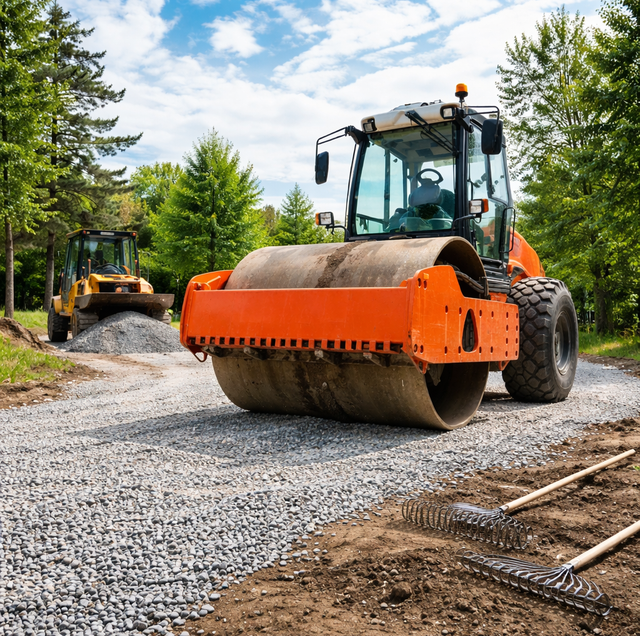
Two driveways can measure out to the same square footage and still land a full day apart in how long the job takes, because what happens on install day depends on more than the tape measure. Homeowners who've already committed to a full-service install, rather than a delivery-only drop, usually have one practical question left: what does the visit itself involve, hour by hour, and is this a one-day job or two? Here's the order the work happens in, from the morning the crew arrives to the walk-through that closes it out.
What Decides Whether Your Job Takes One Day or Two
Four things push a job from a single day into a second: length and total area, whether an old surface has to come out first, how much grading and drainage work the corridor needs, and weather. A short, straight driveway on ground that's already reasonably flat and firm can often go from bare corridor to finished, compacted surface in one visit. Add fifty or a hundred feet of length, or a wide parking pad at the end, and the base delivery, spreading, and compaction alone can eat a full day before finish stone ever goes down.
Removing an old surface changes the math more than almost anything else. Pulling out a failing asphalt or concrete driveway, or stripping a gravel surface down to bare ground because the base underneath never held, adds a demolition and haul-off phase before any new material can be delivered. That phase has its own equipment and timeline, and it usually pushes a job that would otherwise take one day into two. A driveway needing a full asphalt or concrete tear-out can run past two days once hauling, extra compaction time, and a deeper base are all factored in, so a demo-included job is worth scoping as its own timeline rather than assuming it fits the standard window.
Grading and drainage work does the same thing on a smaller scale. A corridor that's already close to the right shape needs a light pass before base goes down, which fits inside the same day. A corridor with a real high spot, a low spot, or a culvert crossing that needs attention takes longer to get right, and that extra grading work is often what pushes a job past a single day, sometimes as its own scheduled visit ahead of the base and finish work rather than eating into the same day's schedule. Weather works against fresh construction at any time of year, not just during a rainy stretch: a downpour on freshly delivered, uncompacted base can turn loose stone into a rutted mess under equipment tires, so a crew mid-storm will often stop spreading and either compact what's already down or wait it out rather than push material into wet ground.
The Site Walk That Starts the Day
The visit starts with a short walk of the corridor, not equipment unloading. The crew confirms the driveway's planned path and width against what was scoped when the job was booked, checks for anything that's changed since the last visit- a fence, a parked trailer, new landscaping- and flags anything that needs to move before trucks can get in. Utility locate flags, called in days ahead of the visit rather than that morning, get a final look here too, since equipment won't cut into the corridor until those marks are confirmed on the ground.
This is also when the crew and homeowner walk the endpoints together: where the driveway ties into the road, and where it ends at the garage, parking pad, or turnaround. Getting that agreement locked in before equipment starts moving avoids the kind of correction nobody wants: redoing work that's already been compacted.
Clearing and Site Prep: Getting the Corridor Ready to Build
With the walk done, the crew clears the corridor down to workable ground: grass, brush, loose debris, and on a bare-ground job, any stumps or heavy roots that would otherwise throw off the grade. A mini skid steer usually handles this stage on anything beyond a small strip. If an old surface is coming out, this is where that demolition happens, with the broken material loaded out and staged for either haul-off or on-site crushing and reuse, depending on its condition, rather than left in a pile on-site.
Grading gets its rough pass here too, shaping the corridor's fall and width so the base has a stable, correctly sloped surface to sit on. A corridor that only needs a light touch-up gets that pass the same day as prep, right before base delivery. A corridor with a real cut or fill to make is more often scheduled as its own visit ahead of time, since freshly moved fill needs time to settle and be checked for soft spots before the base material goes on top of it. Where fabric is part of the plan, it rolls out at the end of the prep phase, directly over the prepped ground, before any stone touches down.
Base Delivery and Compaction: The Bulk of the Work
Base stone arrives by truck and gets spread across the corridor, then compacted before the finish layer ever shows up. This step is where most of a one-day job's time goes, and it's the phase most likely to stretch a job to two days if the driveway is long or the base needs to run deeper than standard.
The base isn't spread to full depth in one pass. It goes down and gets compacted in lifts, with thinner layers built up one at a time, using a plate compactor or roller that runs multiple overlapping passes over each lift before the next one goes on top. Skipping straight to a thick, single pass leaves the bottom of that layer loose no matter how long the machine runs over the surface. On a driveway that will see regular boat trailer, RV, or other heavy-axle traffic, the base runs deeper and takes correspondingly longer to build in lifts. Angular, sharp-faced crushed stone, whether that's a limerock base, recycled concrete aggregate reclaimed from a removed slab, or another locally available material, locks together and compacts tighter than a rounded stone would, which is part of why base material and finish material are rarely the same product.
A running plate compactor or roller has a limited operator sightline and can crush a foot or catch loose clothing in the vibrating plate. Keep kids, pets, and bystanders well back from the corridor at all times this equipment is moving, not just while it's actively compacting.
Finish Stone, Crowning, and Edge Work
Once the base has been checked for soft spots and passed, finish stone goes on top: a finer, more even material spread thinner than the base and compacted to its final grade. This is also when the driveway gets its crown or cross-slope, the shape that sheds water off both edges on a straight run, or from the inner edge outward on a circular or loop driveway. Edge work, tying the finished surface cleanly into the road at one end and into the garage, pad, or turnaround at the other, happens in this same stage, since the transitions are easier to get right while equipment and material are already staged on-site.
What a Two-Day Property Looks Like Overnight
On a job that splits across two days, the property doesn't look finished at the end of day one, and it isn't meant to. The typical stopping point is a compacted base with no finish stone on top yet: firm underfoot, correctly graded, but not the surface a homeowner would want to park a car on overnight. Vehicles usually need to stay off the corridor until finish stone is down and compacted, which means planning for alternate parking that night rather than assuming the driveway is drivable the moment trucks leave for the day. If rain is in the forecast overnight, a crew may cover the compacted base with tarps to keep it from washing out before finish stone locks it in the next morning.
Day two typically opens with a quick recheck of the base, since an overnight rain or a sharp temperature swing can occasionally reveal a soft spot that wasn't obvious the afternoon before. From there, the job picks up where it left off: finish stone delivery, spreading, crowning, and edge tie-in, followed by cleanup.
Cleanup and the Final Walk-Through
Once the finish layer is compacted, the crew clears equipment tracks and stray stone from the lawn, walkways, and any areas outside the corridor that experienced truck or skid-steer traffic. Excess material either gets hauled off or, with the homeowner's agreement, left staged for a small future top-off rather than piled loosely on the new surface.
The job closes with a walk-through along the full length of the driveway, checking for any spot that feels soft or springs back underfoot instead of holding firm, since that's the kind of gap that's far easier to fix with one more compactor pass on install day than after it's been driven on for a season. Any touch-up compaction or a light drag to even out a low spot happens on the spot, before the crew leaves, rather than as a callback.
Frequently Asked Questions
There's a simple field check: a handful of the base material squeezed in a fist should hold together loosely and break apart cleanly when tapped; that's workable moisture. Material that stays wet and shiny in your palm, or squeezes out water, is still too wet to compact right. A compactor also leaves a visible tell: a test pass that pumps water up to the surface behind the machine means the lift underneath isn't ready yet. If rain hits mid-afternoon on a one-day job, that check is often what turns it into a two-day job, since the base may need to sit overnight and get rechecked the next morning rather than being pushed to compact while it's still too wet.
There's no fixed number written into the process, but a plate compactor typically requires several overlapping passes, commonly three to four, before a given lift is dense enough to build the next layer on top of it. The crew checks by feel as much as by pass count: a spot that still rocks or feels loose underfoot gets additional passes before the next lift goes down, regardless of how many passes the rest of the run needed.
No electrical hookup is needed; the equipment used for grading, spreading, and compaction runs on its own fuel. Water plays a real role in the base itself, though, not just dust control: fines compact tighter and lock into the void spaces between larger stones when they're worked in with a bit of moisture, so a light water pass ahead of a compactor run on a dry lift can noticeably improve how well that lift sets up. Either use is a spot-use tool the crew brings with them, not something that requires a hose bib or an on-site outlet.
Whether removed material gets reused in the new base or hauled off entirely depends on its condition once it's broken up: how large the pieces are, how much rebar or wire mesh is tangled through them, and how contaminated it is with organics or degraded fines. Concrete broken down to roughly a foot across or smaller, with the steel pulled clean, can often be crushed and reused on-site as recycled concrete aggregate (RCA) in the new base. Material that's too large to process on-site, too heavily reinforced, or mixed with enough soil and root debris to compromise compaction is typically hauled off and replaced with clean material. That call gets made once removal is underway, since condition usually isn't obvious until the old surface is broken apart.
The utility locate called in ahead of the visit covers underground utilities like electric, gas, and water main lines, but it does not cover private irrigation piping or low-voltage outdoor lighting wiring, since those aren't part of the public locate system. A homeowner with sprinkler heads, drip lines, or lighting wiring anywhere near the planned corridor needs to flag those locations before grading or excavation starts, since the crew has no independent way to know they're there.
Often, yes. In a longer corridor, a crew will sometimes stage the work in sections, finishing the base and even the finish stone on the portion nearest the garage while a farther section toward the road is still being cleared or graded. That's not guaranteed on every layout, and a full overnight closure while the base compacts is still the more common outcome, but it's worth asking about during scheduling if partial access matters during the job.
Get your driveway install scheduled — see the full timeline for your property before crews and materials are booked, including gravel driveway installs in Plant City and Winter Haven. Polk Services LLC serves Lakeland, Highland City, and Mulberry. Call (863) 344-5806.
