

Pool Deck Removal — Keep It, Cut It, or Take It All
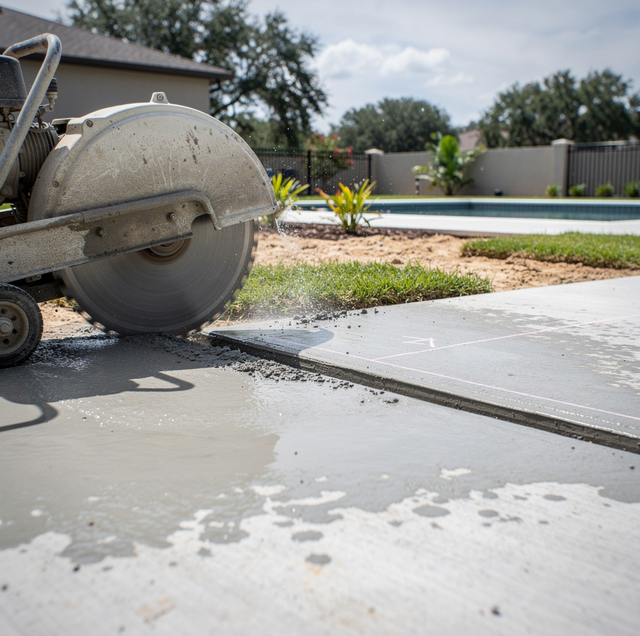
Quick Answer: A pool removal has three deck outcomes: all of it out, part of it saw cut back to a new edge, or none of it out. Machine access to the shell, and the ground left under the kept slab, decide which.
When a pool is being removed, the deck around it does not automatically come out with it. What decides the deck's fate is how much of it the crew needs clear to reach and break the shell, and how much of the remaining slab still has solid ground to sit on once the cavity is filled and graded. Those two questions, rather than preference alone, are what separate the three outcomes you actually end up choosing between.
Why the Deck and the Pool Are Decided Together
Everything below assumes a poured concrete deck. A paver field comes apart on entirely different terms, covered in pool deck pavers, which ones can actually be saved. On most residential lots, the deck is the only solid, level surface within reach of the pool, which is why deck scope and pool scope cannot be settled as two separate questions. A machine generally has to stand somewhere close to the shell to open the floor and break the walls out, and that somewhere is almost always the existing deck. A deck slated to stay in place still has to survive equipment working from it or immediately beside it, before anyone gets to deciding which portion of it gets cut away. Where a cage is staying, its footers set the cut line before the joints get a vote, and the joint search happens inside whatever that leaves. Once the shell's floor has been opened, whether the deck comes out whole, gets cut back to a smaller footprint, or stays intact depends on how much of it the crew actually used to get there, and on how much solid ground is left to build a finished edge against once the cavity is filled.
The Three Outcomes at a Glance
Every pool-removal job where the deck is in question lands in one of three places.
| Outcome | What happens to the deck | What is left at the edge afterward |
|---|---|---|
| Whole deck out | The deck is broken out along with the shell and handled the same way as the shell material | No slab remains where the pool used to be; the yard runs from house or fence straight to graded, filled ground |
| Partial deck, cut back | The deck is saw cut at a chosen line; everything beyond the cut comes out; the kept section stays anchored on its original subgrade | A defined new edge along the cut line, with fill and grading beginning right at that edge |
| Deck left in place, pool only removed | The deck stays intact; only the shell inside its footprint is opened, broken and filled | The outer perimeter is unchanged; the change happens underneath it and at the coping band right at the old water's edge |
The third outcome carries a trade the other two do not. A slab kept in place has its inner edge sitting over ground that was opened to take the shell wall out and has only just been filled back. Cracking that follows the old shell line is the specific thing that outcome gives away in exchange for leaving the perimeter alone.
Which one applies to your deck usually comes down to the two things covered below: where a cut line can actually be placed, and what kind of edge the leftover slab becomes.
Where the Saw-Cut Line Actually Gets Marked
Where a cage is staying, its footer line is the outer boundary, and everything below happens inside it. Beyond that, the line that decides what portion of the deck survives is not drawn ahead of time. It gets marked on the ground, with the machine and the remaining slab both in view, because a drawing cannot show exactly where a joint falls on the actual pour or where a panel has already hairline cracked on its own. Walking the deck first lets the operator find a line that works with the concrete instead of against it. The cut itself is run wet, water over the blade as it works, which is what keeps concrete dust out of the air on a deck people are standing beside.
That distinction matters more than it sounds like it should. A poured deck already has control joints or expansion joints built into it, tooled or saw cut at the time it was placed, specifically so the slab has somewhere planned to crack or separate. A cut placed at one of those joints is working along a line the slab already wants to open on. A cut placed across the middle of an uninterrupted panel is different: it creates a brand-new edge with no relief on either side, nothing built in to absorb movement the way a real joint does. That is why an operator will shift a cut line off a preferred spot to land on an existing joint, rather than cut clean through the middle of a panel that was never meant to end there.
A cut line gets shifted away from a joint that has already visibly failed or been heavily patched, since a repaired joint will not hold a clean edge the way one that is still tight and intact does.
What a Kept Section of Deck Borders Afterward
Once the far side of a deck comes out, whatever stays behind is a different piece of concrete than it was before, even though nobody touched it directly. Before the cut, that slab was tied into a wider deck on all sides, with movement and load spread across a single connected surface. After the cut, it borders two different things at once: the original undisturbed ground it was always sitting on toward the house or fence, and freshly graded fill on the side where the rest of the deck and the pool used to be. Those two are not the same underfoot even once the fill is compacted, because one has been settled for years and the other has not. The cut edge itself is a free edge, a border with nothing beyond it holding the slab the way a neighboring panel used to. That is a normal, expected part of a partial removal rather than a defect, but it is why the edge on a partial job looks and behaves differently from an interior joint on the same deck.
Reinforcement Changes How the Cut Behaves
Plain concrete breaks along a cut line the way you would expect: the saw scores it, the machine breaks it, and the two sides separate. A deck poured with wire mesh or rebar embedded in it does not behave the same way, because the steel inside does not break when the surrounding concrete does. Whatever reinforcement runs across the cut line has to be cut through on its own, as a separate step from breaking the concrete, or the slab on the kept side stays physically tied to the piece being hauled off by strands of steel that never let go. That is a distinct operation from plain concrete demolition, and it is part of why a reinforced deck requires more attention at the cut line than an older unreinforced pour. Whether a given deck has mesh, rebar, or neither is not something you can tell from the surface; it becomes obvious once the saw is into the slab.
Cut rebar or mesh ends left exposed at a kept edge are sharp enough to cause a puncture or a deep laceration. Stay clear of a freshly cut deck edge until the crew has bent back or capped the exposed steel.
The Coping Band at the Water's Edge
The strip of concrete right at the pool's edge, the coping band, is not the same as the rest of the deck even when the rest of the deck is staying put. That band was formed and finished against the shell itself, often shaped differently right where it met the water, and it is the part of the deck most directly connected to what is being demolished. When the deck stays, and only the shell comes out, the coping band is what has to be dealt with at the boundary between the two. It either gets cut off the shell as its own piece before the shell is broken, or it comes out with the first shell material broken below it, because saving it in place would mean working right beside material about to be demolished. Either way it leaves. The rest of the deck beyond the coping band is unaffected structurally. The coping band itself is the one strip that never survives a pool removal intact, no matter which of the three outcomes applies to everything around it.
Frequently Asked Questions
A single deep pass through a slab with reinforcement inside risks binding the blade and cracking the concrete beyond the marked line, so the saw typically scores the line first and deepens it over a couple of passes rather than going through in one cut. That extra pass is also when a hidden layer of resurfacing over the original joint pattern is picked up, before the full cut commits to a line that doesn't match what is underneath.
The cut still gets made, and where it gets made changes. A fresh line is placed to run parallel to the existing joint pattern rather than diagonally across it, because a cut crossing joints at an angle leaves wedge-shaped panels along the new edge, and a narrow wedge of concrete is the first piece on a slab to lift or rock once the ground under it moves. Running parallel keeps the remaining panels close to the rectangles the slab was poured as, which is the shape they hold best.
Not immediately. The ground on the fill side of a new free edge needs time and compaction before anything heavy sits on it, and the slope that used to carry water away from that edge is gone until the fill beside it is graded to replace it. A kept section functions the same as before once the fill around it is finished, but treating it as finished the moment the cut is made skips the step that makes the edge behave correctly afterward.
A formed lip or rolled edge along the deck's perimeter usually has reinforcement tied specifically to that shape, which means any cut near it has to clear the form itself before it clears the mesh or bar running through it. Cutting through a formed edge without accounting for that tends to chip the decorative lip even when the flat part of the cut is clean, so that section gets extra attention regardless of which outcome applies.
A section of deck that is staying often serves as a staging surface for broken material before it is moved to the cavity or loaded out, since it is usually the most solid flat surface on the property during the work. When that is the plan, the crew lays down plywood or a similar surface first so stacked material does not gouge or crack a slab that is supposed to still be there when the job is finished.
Cracking that runs diagonally out from a corner, or a slab that already rocks slightly underfoot before any equipment has touched it, usually means the ground under that section failed on its own, separate from anything related to the pool. Keeping a section like that in the plan just carries an existing problem forward, so the crew will flag it and talk through cutting back further than where the owner first asked for the line.
Whatever is decided about the deck gets decided once. A slab is a single pour with its own joint pattern, and every cut made in it is permanent in a way that fill and grading are not: fill can be topped up and a grade can be reworked, but a cut line stays exactly where it was put for as long as that concrete is in the ground. That is why this question gets settled on the deck, with the tape and the machine both there, instead of on a phone call the week before.
Get a clear read on your pool deck options — the crew looks at the deck alongside the pool and says which of the three outcomes fits your yard. Polk Services LLC serves Lakeland, Highland City, and Mulberry. Call (863) 344-5806.
