

Removing Carpet Yourself or Booking a Crew: What Decides It
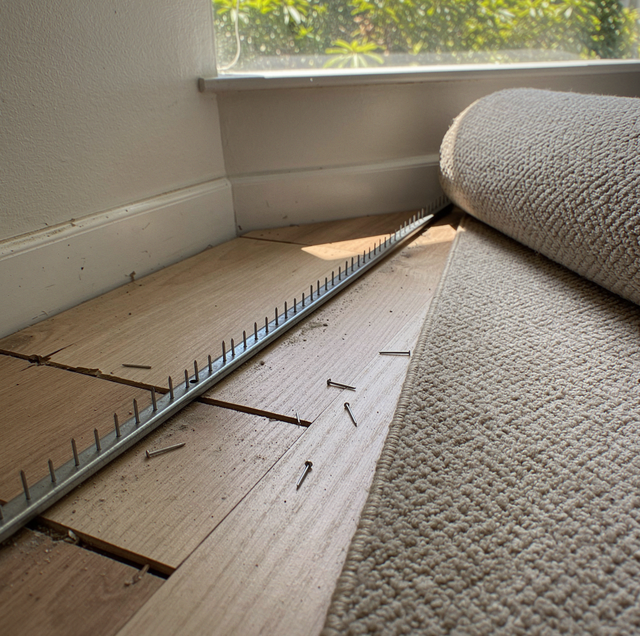
If you are pulling carpet out of one bedroom or a home office, and it's simply stretched over tack strip with nothing unusual underneath, you can do it yourself in an afternoon. Cutting it apart, pulling the padding, and getting the tack strip up is physical work, not skilled work, and plenty of homeowners handle exactly that scope of work without any trouble. The decision only gets harder once a few specific conditions change, and those are worth naming before you start.
Room Count Sets the Real Scope of the Job
One room is one afternoon. A standard single-room removal, done by a crew who does it daily, typically runs a few hours on-site once you count the pulling, the padding, the tack strip, and hauling everything out. Doing it yourself on one room takes longer because you're learning the job as you go, but the total effort stays contained.
The math changes once you're not doing one room. A whole-house job covering four to six rooms typically fills one to two full workdays for a crew moving efficiently between rooms with the right equipment already staged. Multiply that by the slower pace of doing it solo, spread across evenings and weekends, and a project that felt like a single Saturday task turns into weeks of a house half-torn up.
It flips once you're looking at more than a room or two back-to-back, or the whole house at once. At that scale, the hours stack up fast enough that the time alone starts to decide it.
Set aside a specific bucket or bag for pulled staples and nails as you go, room by room. Sweeping loose fasteners off a bare sub-floor later is slower, and it's easy to miss a few in the corners.
How the Carpet Is Held Down Changes the Job Entirely
Most residential carpet is stretched in: it's tensioned across the room and hooked onto tack strip running along the edges, with padding stapled underneath. Pulling stretched-in carpet is the version most people picture, and it behaves the way you'd expect: grab a corner, and it comes free.
Glue-down carpet is a different job entirely. Instead of being tensioned and hooked at the edges, it's bonded directly to the sub-floor across its full surface. It doesn't lift away in one motion, and it doesn't come up in workable sheets the way stretched-in carpet does. It comes up in stubborn, uneven sections, and what's left behind on the sub-floor afterward is its own separate problem to deal with.
Glue-down generally tips the job toward a crew, but scale still matters here too. A single glued-down closet or a small hallway is still a manageable DIY afternoon, even with the extra scraping involved. A glued-down bedroom or living room is a different story: the surface area multiplies the stubborn-section problem across the whole floor, and that's where hiring starts to pay off.
What's Underneath Decides How Nervous You Should Be
Most of the time, what's under the carpet is exactly what you'd expect: a plain sub-floor that needs nothing more than a sweep once the carpet, padding, and tack strip are gone. That's the easy outcome, and it's the common one.
Sometimes it isn't. Staining, soft or spongy spots, a smell that gets stronger as the padding comes up, or a transition that doesn't line up with what you know about the house's history are all signs that something happened under that carpet before you ever moved in. You won't know for certain until the carpet is up, which is exactly the problem: by the time you find out, you're already committed to the room being torn apart.
There's also the condition you create, not just the one you find. A sub-floor you intend to leave exposed or refinish later can pick up gouges and scratches from an inexperienced removal, even when nothing was wrong with it to begin with.
Even so, a known and sound sub-floor changes the calculation. If you've already seen that sub-floor before, through a prior renovation or a previous flooring pull, and it checked out fine, staying DIY still makes sense even across two rooms. What tips this one toward a crew isn't room count; it's the not-knowing: an unknown you discover mid-project, with no next step lined up, is a different problem than an unknown you can walk into with a plan already in place.
Disposal Is the Piece Most People Forget to Plan
The pulling gets all the attention, but getting rid of what you pulled is usually the part that trips people up. Carpet doesn't compress. A rolled strip of carpet is heavy and bulky, out of proportion to how small it looked lying flat on the floor, and many standard trash pickups and rented containers simply won't take it, or will only take a limited amount.
Draining an above-ground pool and pulling the liner free is the same kind of trap. Unclipping the liner from the top rail and hauling it off the frame takes minutes, and the job looks finished right there. What's actually left is a heavy, waterlogged sheet of vinyl that many curbside services won't take on a regular pickup, and it sits rolled up in the yard until that part is resolved. Carpet works the same way: the visible task is the pulling, and the part that actually holds up the project is figuring out where the material goes once it's off the floor.
It flips once the volume from more than a room or two is more than your vehicle, your trash service, or the disposal options open to you can reasonably absorb. At that point, the constraint isn't your ability to pull carpet; it's your ability to move it once it's pulled.
Sharp Debris Turns a Simple Pull into a Hazard
Tack strip is nailed into the sub-floor with points facing up, and it stays sharp the entire time it's exposed. Working around it carefully, on your own timeline, in an empty room, is manageable for most people.
Staples from the padding scatter loose across the sub-floor, not just along the tack strip perimeter. Keep shoes on until the floor has been swept twice, and keep pets and bare feet out of the room.
The deciding factor here isn't skill; it's whether kids, pets, or bare feet are coming back into that room soon, or whether a deadline is pushing you to rush through exposed tack strip and loose staples. A hurried pass is where a careful job turns into an injury, and at that point, slowing down or handing it to someone working without that time pressure is worth more than finishing it yourself today.
Where the Decision Lands, at a Glance
None of these factors decide anything on their own. Stack two or three of them against a project and the answer tends to get obvious fast.
| Factor | Leans toward doing it yourself | Leans toward booking a crew |
|---|---|---|
| Room count | One room, maybe two | A whole house or several rooms back to back |
| How it's attached | Stretched over tack strip | Glued directly to the sub-floor |
| What's underneath | A sub-floor you already know | Unknown condition, staining, or a suspected issue |
| Disposal | You have a way to move and drop off bulky material | No clear way to move material that won't compress |
| Debris on the floor | You can work carefully with no one else around | Kids, pets, or a deadline are pushing the pace |
Frequently Asked Questions
Not exactly. Along a doorway or a closet threshold, installers commonly run tack strip in two overlapping rows rather than the single strip used along a plain wall, since a doorway edge gets more foot traffic and needs a firmer hold. That doubled section has twice the nail points, so removal there takes noticeably longer than a straight wall run.
Yes, more easily than most people expect. A knee kicker or a carpet cutter, used without much practice, can bite into a wood subfloor when the blade angle is off or too much pressure is applied at once, and that damage often doesn't show until a future flooring layer goes down over it. Working slowly with the blade depth set shallow reduces that risk considerably.
It's driven by weight, not the room's shape. A strip cut to fit a corner or an odd angle would often be too heavy to carry in one piece, so crews size each cut to a width that keeps a rolled section liftable by one or two people, even if that means more strips than the room's layout would otherwise suggest.
Not as much as you'd think. A photo shows the carpet type, room size, and visible damage well enough for a rough estimate, but it can't reveal whether the carpet is glued to the subfloor or simply stretched over tack strip, and it won't show whether the tack strip has rusted or has nails underneath that have lifted. Those details usually only surface once someone pulls back a corner in person.
It varies by decade. Many houses built before wall-to-wall carpet became standard have sheet vinyl over a plywood underlayment underneath, installed when that room served a different purpose, and some have full hardwood that was simply carpeted over rather than removed. Finding either one changes the removal plan, since both need different handling than a bare sub-floor does.
Along the wall, the carpet is hooked onto a tack strip and releases with one firm pull once the hook lets go. At a seam, two edges are joined with heat tape or glue underneath, so that section tends to separate in a slower, stickier peel rather than a clean release, and it can leave adhesive residue behind that the rest of the room doesn't have.
If the disposal end is the part you had not planned for — a call can get the rolled carpet, padding, and tack strip gone in one trip. Polk Services LLC serves Lakeland, Highland City, and Mulberry. Call (863) 344-5806. Mulberry. Call (863) 344-5806.
