

Tree Roots Lifting a Driveway: What Are Your Real Options?
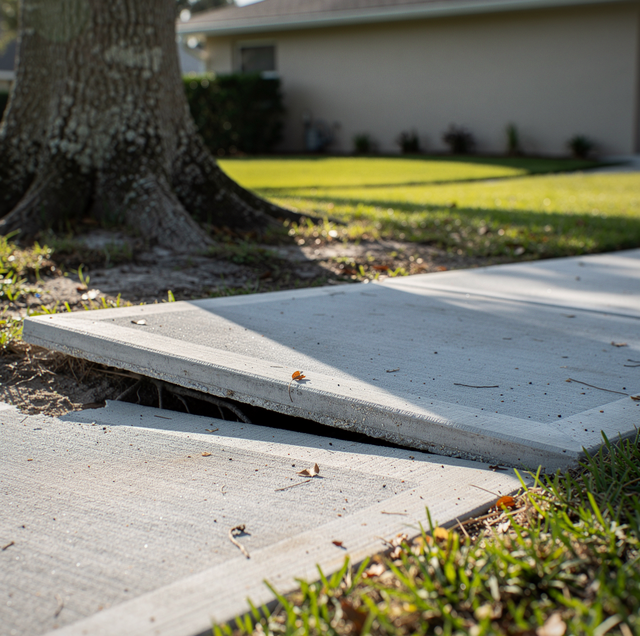
The tree is very likely part of why the property looked right to you in the first place. It shades the side of the house that gets the afternoon sun, keeps the front from looking bare, and is now pushing your driveway up along one edge. You want the tree. You also want a drive you can roll a trash can across without catching a wheel. Those two wants pull against each other, and the useful part of this decision is being honest about which combinations are on the table and which are not.
Start with What You Want to Keep
A fix for tree roots lifting driveway concrete only makes sense once you have said which side you are protecting, because each of the four options below answers a different constraint.
The tree stays no matter what: You are choosing between working around it forever and giving that stretch of drive a surface that can live with movement.
The drive has to be right: You are looking at cutting roots, a real risk to the tree, or at taking the tree out.
Both are open: The question becomes which one you will miss less in ten years, worth sitting with before anyone brings a machine onto the property.
What the Roots Are Doing under the Slab
A root running under an edge of the drive does not shove upward so much as thicken where it already lies, and concrete resting on it has nowhere to go. One detail drives everything that follows: the root is alive and still adding girth every season, so whatever you put back over it meets the same pressure again.
Pruning Roots to Relieve the Lift
Cutting the root under the panel is the option people ask about first because, on paper, it keeps both things you want. Sometimes it does. The catch is that roots big enough to lift concrete are usually the ones the tree relies on: they anchor it against wind and carry water back to the trunk. Cut the wrong one, and you can leave a mature tree unsteady, or start a slow decline you will not notice for a season or two.
Which roots can be cut, how far from the trunk, and how many at once is an arborist's judgment, made against the tree's anchoring roots rather than against the panel. A crew that removes concrete can take the slab off and clear soil above a root; root pruning and any call about what a mature tree will survive belong to a certified arborist rather than to that crew or to the owner with a shovel, and any honest contractor tells you to get that opinion first.
A lifted panel on the path you walk to the door is a trip edge, and it needs attention sooner than the tree question does. Cutting the root that raised it is an arborist's call.
Removing the Tree Altogether
Removing the tree ends the root pressure permanently and changes the property permanently. The shade goes with it, and shade over a west-facing wall or a parked vehicle is worth counting before you decide. The root system stays in the ground after the tree is gone, and ground over a decayed root run is its own problem before anything rigid goes back over it.
Size matters here too. A big, mature shade tree standing over a driveway, with a house or power service on one side, is specialist removal work requiring rigging and sits well beyond light-duty tree removal. If yours is that tree, treat the removal as its own trade and its own crew.
Removing Only the Lifted Panel
This is the narrowest fix, and where the damage is contained, it is often the right one. The lifted section comes out and gets hauled off, the trip edge is gone, the rest of the drive is untouched, and the tree keeps everything except what sat directly under that slab.
It works when two things are true. The lift has to be limited to one or two panels rather than running the length of the drive, and clearing under them has to be possible without cutting roots the tree depends on, which puts you back in front of an arborist. Be clear about the split, too: breaking the section out and hauling it away is demolition work, while whatever goes back is a separate scope and trade.
Replacing the Section with a Surface That Moves
Where the tree is staying, and the root is still growing, putting the same rigid slab back over it invites a repeat. The alternative is to stop fighting the movement and change what covers that stretch. A flexible surface, gravel or crushed millings over a graded base, rides up and settles with the root instead of cracking and standing an edge up at you. When it shifts, it gets raked and re-leveled rather than broken out.
The trade-offs are real. That stretch will look different from the rest of the drive, and it needs topping up now and then. What you get is a tree and a usable drive together, the one combination that survives twenty more seasons of growth.
The Four Options Side by Side
| Option | What happens to the tree | What happens to the concrete |
|---|---|---|
| Prune the roots under the edge | Real risk to stability and health; an arborist decides what can be cut | Pressure eases, though a panel that already lifted may not settle back flat |
| Remove the tree | Gone, shade included; the old root run stays in the ground | Lifting stops; what goes back over the old root run is a separate question |
| Remove the lifted panel only | Stays, if what is under that panel can be cleared without cutting structural roots | One or two panels out and hauled off; the rest of the drive left alone |
| Change the surface over that stretch | Stays, with room to keep growing | No rigid slab to crack; the surface moves with the root and gets re-leveled |
What Decides Between Them
How close the trunk is: The nearer the lift sits to the base of the tree, the larger and more structural the root under it, and the faster pruning drops off the list.
One panel or a run: A single raised panel is contained. A drive gone wavy in several places along the tree side is telling you the root system runs parallel to the concrete, and panel-by-panel repair turns into chasing it.
Whether this is a tree you intend to keep: One you love and plan to keep for decades justifies changing the driveway around it. One you were lukewarm about, or already in poor shape, changes the math entirely.
Whether it will happen again: If the real answer is yes within a few seasons, the option that puts the same rigid surface back is the one that fails first, no matter how good it looks the week it goes in. This is also the moment to ask an arborist about a root barrier, a rigid panel set upright in a trench along the drive's edge to steer new growth down and away rather than under the concrete. It only goes in while the ground beside that stretch is open, so raise it during planning.
Before you decide, stand at the trunk and look down the whole drive rather than at the one panel that moved. If the lift shows up in two places, a single panel swap is a short answer.
Frequently Asked Questions
Rarely. A palm sends out many thin, fibrous roots that stay close to the same diameter for life instead of thickening into a few heavy structural ones, so they seldom build the girth it takes to raise a slab. Hardwoods with shallow surface roots, oaks in particular, are the usual cause.
Tree first, when both are happening. With the trunk down, the crew can follow the root run while the ground is open and handle it in one pass, and no one works a machine around a standing trunk twice. Doing the concrete first leaves the tree work happening over freshly disturbed ground.
Stump grinding here covers stumps up to 24 inches. Anything bigger, or a stump pressed tight against the remaining concrete, gets looked at on its own before it is scheduled, and that scheduling is separate from getting the tree down.
Usually it gets graded level and sodded so the soil over the remaining roots is covered. Bare ground over a shallow root run washes out in heavy rain, and once roots sit exposed they take damage from mower decks and foot traffic.
Usually. The constraint on this job is not the yard; it is the root plate. Machine traffic and material staging are both kept off the ground inside the drip line because compacting that soil does the tree the same kind of harm that cutting a root does. The drip line, not the yard's edge, is what the parking and staging plan gets drawn against.
It has a milder version, and it fails differently. Asphalt over a live root gives way as a spreading network of fine cracks radiating out from the hump rather than at one lifted joint, so the damage reads as an area instead of a line. Because asphalt is laid hot and follows whatever is under it, a re-top over a root run must have the hump cut down first, or the new surface will simply take the shape of what it covers.
Ask about breaking out the lifted section — you get the trip edge gone and a clear look at what is under it before you decide the tree's future. Polk Services LLC serves Lakeland, Highland City, and Mulberry. Call (863) 344-5806.
