

Voids Under a Concrete Slab: How to Spot Hollow Areas
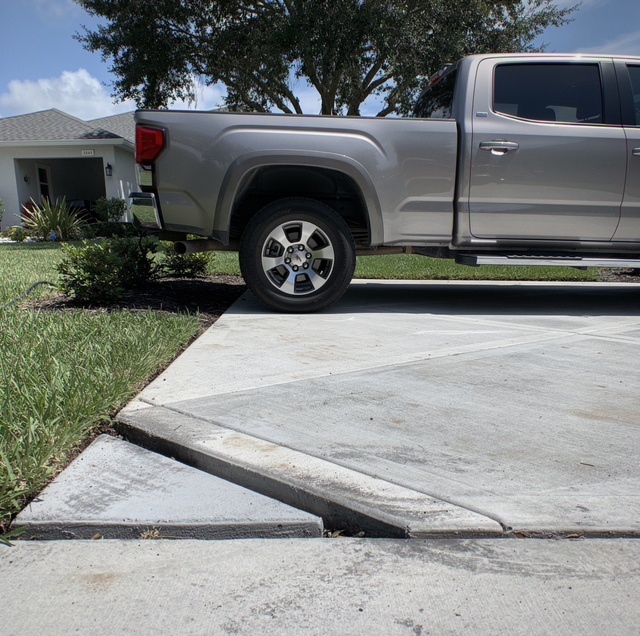
You back the truck in the way you always do, one wheel rolls onto a spot near the middle of the driveway, and the panel gives under it. The truck takes a small step down that happens nowhere else on the drive, and the concrete knocks back up as the tire leaves it. Nothing looks wrong. The surface is flat, that panel sits level with the ones beside it, and the joints look normal. What changed is underneath.
A driveway is cast straight onto the ground and carries weight by pressing into it. Take part of that ground away, and the slab holds its shape for a good while, resting on the soil still there and reaching across the part that has gone. That open space is a void, and it can sit under concrete for seasons before the surface admits to it.
The Signs That Something Is Missing Underneath
Movement under load: A panel that dips as a wheel crosses it and lifts back when the wheel leaves is bearing on nothing across part of its area. You get the same answer underfoot at a corner that gives slightly and feels solid a stride away. Weight is what finds a void.
A crack that opened without either side dropping: Concrete over a growing space bends before it breaks. A crack that has opened up but still runs level, both sides flush with no lip to catch your shoe, says the slab flexed across something rather than settled into it, which is the slab telling you it is spanning.
Soil and fines leaving at an edge or a joint: After heavy rain, walk the free edges and check the joints between panels for fine sand or silt lying on the surface, spread in a fan away from the opening it came through. Material sitting on top of the concrete left from underneath it.
A gap you can see at an exposed edge: Wherever the side of the slab is open to view, at a lawn edge or where the drive meets a garage apron, crouch down and look at the line where concrete meets ground. If you can see back under the edge, the underside is no longer touching what it was cast against.
Animals working the perimeter: Rodents and burrowing animals take the easy route into an existing space, then widen it and push the spoil out at the edge. They both point to a void and enlarge it.
How Far the Empty Space Extends
One soft spot does not tell you the size of what lies beneath it, and size determines everything else. Step along the panel in a grid, putting real weight on each foot, and note where the give starts and stops. Roll a loaded vehicle across slowly while someone watches the joints from the side, since the eye catches a joint edge shifting that a foot never feels.
Then walk the perimeter, because every exposed edge is a window and a void that reaches one shows itself there first. A narrow band of give along a free edge is a different situation from a soft patch reaching toward the center, and both differ from a whole panel that moves as a unit. Where the extent is still unclear, a contractor can drill a small port through the slab and look underneath with a borescope, which reads the space directly rather than inferring it.
Walk the entire driveway before making any decisions, including the panels that feel solid. Mark each soft spot with painter's tape and look at the pattern afterward, because one void often shows itself in more than one place.
Why a Void Keeps Growing
These spaces begin in a few familiar ways: fill dumped rather than compacted in lifts, backfill over an old utility trench that never reached the density of the ground beside it, buried organic material that rotted down, a root system that kept dying back, or ground that never held any load. What matters now is that the space rarely stays the size it started at.
Water is the reason. Once moving water finds a path under the slab, it keeps using that path and carries fine material out with each run. The space enlarges along the line the water takes rather than spreading evenly, which is why so many voids turn out long and narrow, in a shape nobody would guess from the one spot that moves.
Roots belong in the story from the other direction. Roots that died and rotted away leave behind the space they used to occupy, the reverse of a live root pushing concrete upward, and that empty channel becomes a ready-made route for water.
What a Spanning Slab Is Being Asked to Do
A slab on grade is built to spread weight down into soil across its whole footprint. Over a void, it stops doing that and carries its own weight, plus whatever you park on it, across an unsupported distance to sound ground on either side. Concrete is strong in compression and weak in tension, and spanning puts the underside into tension, the condition it handles worst.
A short reach across a small space near an edge may sit well inside what the concrete can take. A long reach is another matter, and a slab already cracked over the void has lost most of what let it span at all, since the section is now two pieces, each leaning on less soil than before.
A slab spanning a void can fail all at once under a vehicle rather than sagging first. If a panel moves when a wheel rolls onto it, stop parking there and keep heavy loads off it until someone has looked underneath.
When the Concrete above Can Stay
Not every void means losing the driveway. A small space near a free edge, with no crack over it, no movement under load and no fines showing up after rain, is a slab still doing its job on ground mostly still there. Voids of that kind are worth watching over time and rechecking rather than acting on right away.
Injection remains a candidate as long as the void is still bounded and the concrete over it is uncracked. Where fines are still washing out after every storm, the water that emptied the space is still running through it, and that is the condition that takes injection off the table.
When the Slab Has to Come Out
Removal is the right recommendation once the concrete has ceased to be an asset. A panel already cracked over the void, a soft area covering most of a panel or running across several, movement you can feel from more than one direction, or fines still washing out after every storm all point the same way. So does a void that has visibly grown between one look and the next.
In those cases, the concrete comes off first, and the ground underneath gets put right. What goes back on top afterward need not be concrete.
Who Handles Which Part of the Work
Different parts of this work sit with different trades. Slab lifting and void filling by injection are a specialty of their own. Pouring, resurfacing, sealing and patching belong to concrete contractors. Demolition, haul-off, excavation of the failed ground, and regrading make up the other half of the list, and it starts with the concrete being removed. Where a permit is required, a removal contractor helps coordinate it rather than pulling it.
Frequently Asked Questions
The two causes leave different shapes. A void following an old utility trench runs across the drive in a straight line and stops where the trench ends, since it traces the backfill that was placed and ends where the pipe run ends. A water-carved one follows the line the water takes off the drive instead, widening toward wherever the drive drains.
Yes, and it behaves differently from a storm-fed one. A weeping supply line or a cracked sewer lateral moves soil continuously rather than only when it rains, so the giveaway is a space that keeps getting worse during a dry stretch. That calls for a plumber with a locator before concrete work is scheduled.
Soil loosened at the crown of a space tends to bridge itself, the grains locking against each other into a shallow arch that stands on its own over the open ground below. That arch holds fine through ordinary use, which is why the panel above reads as solid every day you walk and park on it. It lets go the first time a delivery truck or a loaded trailer sits over it, because that is the load the arch was never carrying.
Pouring material in from the top rarely works. It runs down the same channel the water made, packs to nowhere near the density of the surrounding ground, and leaves the far reaches untouched. It also plugs the opening you were using as a tell, so the next time material leaves, you cannot see it happening.
It often does. Saturated soil loses strength, so a panel that felt firm during a dry week can move noticeably after days of rain. Check the same panel in both conditions, and treat the worst behavior you saw as the true reading.
Past the edge of the tape. The loosened material feathers out beyond where the slab was actually giving way, so the digging gets chased past the mapped edge of the void until it reaches ground that is bearing weight. The hole that opens up is always larger than the taped soft spots predicted, which is worth expecting before the work starts.
A panel that moves under a wheel is sitting over ground that keeps leaving — have the failed concrete taken out, the loose ground dug out beneath it, and the base rebuilt to a solid grade. Polk Services LLC serves Lakeland, Highland City, and Mulberry. Call (863) 344-5806.
