

Why Is Water Pooling on My Concrete Driveway After Rain?
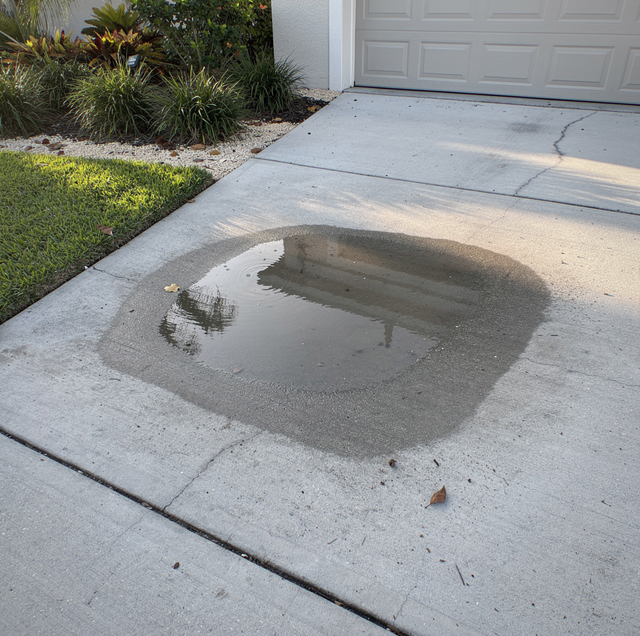
The rain stopped a good while ago. The grass has quit glistening, the street has gone pale in patches. And there on your driveway, one flat sheet of water sits exactly where it was when the sky cleared.
That gap in timing is most of the diagnosis. Everything around the puddle finished draining. The puddle did not, because nothing is carrying that water anywhere. It waits to evaporate, then returns after the next storm in close to the same outline.
Driveway water pooling repays a close reading. Where the water sits, what its edge does, whether it touches anything built, and whether it returns to the same footprint all point to different causes, and only some of those causes mean the panel has to come out.
Read the Water Before You Read the Slab
Standing water records what the surface did with the last storm, and it will do the same with the next. Three observations carry most of the information.
Where it sits: Out in the middle of a panel, along one edge only, tight against a building or a step, or straddling a joint with concrete on both sides.
What its edge does: Whether the outline feathers into damp concrete with no clear boundary, or stops in a hard line you could trace with a finger.
Whether the outline repeats: Whether the same footprint comes back every rain, or the wet area turns up somewhere different each time.
Those three answers narrow the cause considerably.
A Puddle with a Hard Edge That Follows a Joint
The water stops in a straight line, and that line sits over a control joint or a crack running across the driveway. Concrete on one side, water on the other, clean boundary between them.
A straight edge means the two sides are no longer at the same height. Slabs are cast in panels so they can move independently, and independently is what they have done. One panel dropped or tilted, the joint now carries a lip, and water arriving from the high side stacks up behind it. Run a bare foot across the joint, and you will feel the step before you see it.
The rest of the driveway may be fine. One panel has moved out of line with its neighbor.
Two things put a panel out of line: the panel broke up, or the ground holding part of it stopped holding. The second leaves a tell of its own: a corner that dips under weight while sitting level with its neighbors. A panel that dropped as one sound piece can sometimes be lifted back into line, which is a specialty trade and not work this company takes on.
A Broad Shallow Sheet in the Middle of a Panel
A different pattern altogether. The water spreads across the interior of one panel, nowhere near a joint, and its edge feathers into damp gray concrete with no boundary you could point at.
That says the panel lost its pitch, or never had much to lose. Both look identical when full of water, so you separate them by what surrounds the wet area. If the panel sits lower than its neighbors, with misaligned edges along its perimeter and cracks running through the middle, it has settled. If it sits flush all around and the concrete looks undisturbed, it came out of the finishing process short on fall.
History settles the rest. A pitch problem built in at the pour appears the first wet season and never changes. A settlement problem appears years later and keeps growing.
Water Held against a Garage, a Step or a Threshold
This is the pattern worth acting on soonest. The puddle sits where concrete meets something built: a garage door track, the bottom of a stem wall, a side step, a carport threshold.
Water that stands at a garage threshold or against a foundation wall is the pattern to address first. Every rain drives moisture at the one place your slab was built to carry water away from, and that damage compounds quietly.
The signs show up inside as well as out. A damp band across the garage floor working inward from the door. White powdery bloom on the bottom course of block.
Sort out whether the behavior is new. If the driveway shed water away from the house for years and only recently began holding it at the door, something moved, and the fall reversed. If it has always done this, the slab was finished that way.
The Puddle That Returns to the Same Outline and Dries Last
Some puddles are a fixed feature. Same rectangle, same depth, storm after storm, still there when the rest of the driveway has gone dry and pale. A surface problem shifts slightly depending on how the water arrives. This one does not shift at all.
A puddle that repeats exactly is reporting on what is under that spot rather than on the concrete face. What is under a slab is read by load and by what leaves at the edges rather than by the puddle on top, and that is a different investigation from this one. A panel that has been lifted instead of dished, with its high side toward the nearest trunk, is a separate reading again.
When the Ground beside the Slab Has Grown Taller
Water backs up along one edge of the driveway only, in a long narrow strip running parallel to the concrete. Shallow, stretching most of that side, stopping in a straight line at the grass.
The slab is where it always was. The ground beside it climbed. Mulch beds get topped up every spring and never taken down. Soil washes off the yard and is caught by the grass line, until the open edge where water used to run off is a low wall of earth.
The signs are plain once you know them. The grass line sits visibly above the concrete. Turf has knitted over the lip of the slab, hiding it. Water meets a bank of dirt and root, and stops.
Before you assume the slab dropped, cut the turf back along the concrete with a spade and feel for the buried lip. Check whether the grass line has climbed above the slab surface, since that is what usually changed.
The concrete here may be completely sound, with all its original fall intact.
What the History of the Puddle Tells You
Sort the puddles you have by history.
A puddle that has never changed its outline: The same footprint since the first wet season you can remember, the same depth, no creeping edge. This is a stable defect. The fall was set when the concrete was finished, and nothing has moved since, so correcting it means changing the surface itself. That is coating, overlay, and repour work, and it belongs to concrete finishers.
A puddle that has grown: The outline is wider than it used to be, the edge has crept outward, and the water takes longer to clear than it once did. Something is still moving, and a surface correction laid over it will be chasing it. Look hard at the panel first. A panel cracked through into pieces riding at different heights, or with joints lipped in more than one place, or with cracks wide enough that the two sides shift when a vehicle rolls across, has stopped behaving as one piece.
A puddle that has moved: Water used to gather somewhere else and now gathers here. The face of the concrete did not rearrange itself, so the change came from around it or beneath it. Check the grass line along the open edge, check whether the panel now tips toward the house.
Once a panel stops behaving as a single unit, there is nothing left to lift as a unit. That is a removal job. The panel gets broken up and hauled off, and what is left is open ground you can work with, whether that becomes fresh concrete by a finishing contractor, compacted millings, gravel or sod. Lifting a settled but intact panel is a different trade with different tools.
Frequently Asked Questions
A brushed or broom finish carries fine grooves that hold a thin film long after the rest of the slab has dried. That film reads as wetness rather than depth. Check whether the wet area follows the direction of the texture lines. A hard troweled surface shows a true pond far more plainly.
A held puddle evaporates once the weather turns dry. One that never clears is being fed rather than held, and the source is usually close by: an irrigation head throwing part of its arc onto the slab, a downspout discharging at that corner, or an air conditioner condensate line running out onto the concrete. Follow the wet trail back on a dry day, and the feed is normally obvious.
Lay a straightedge or a long level across the panel and look at the gap underneath it. Run it one way, then turn it across that first line and run it again, because a dished panel often reads clean along one direction and hollow along the other. Where the middle lifts away from the concrete while both ends stay down, you have found the dish, and you have found it on a dry day with no water involved at all.
A spot that ponds regularly grows algae and traps fine dirt, and the staining settles into a distinct outline at the old water line. That ring is a record you can read in dry weather. Compare it with an older photo; a widened ring means the low spot is still moving.
A slow soaking rain is the diagnostic condition, and a downpour is the useless one. Where the slab has fallen, a gentle rain keeps the film thinning toward nothing, so those areas go dry gray while the low spot stays filled. Where the sheet stalls on its way down maps the travel path, and a path that swings sideways means a panel has tipped. Watch as the rain eases: the outline shrinks inward and settles onto the true shape of the defect, which tells you far more than a puddle simply appearing.
Because the way that storm delivered its water is placing the patch, and the shape of the slab has little to do with it. Wind, the point where runoff enters the driveway, and a drift of leaves or clippings all steer the sheet, and each storm steers it somewhere slightly new. A wet area that never repeats its footprint is telling you about the weather. Wait for the outline that does repeat, and read that one.
Have the failed panel broken up and hauled off — you get the dead concrete gone and open, workable ground in its place. Polk Services LLC serves Lakeland, Highland City, and Mulberry. Call (863) 344-5806.
