

Gravel Over a Failed Concrete Driveway: What Happens Underneath
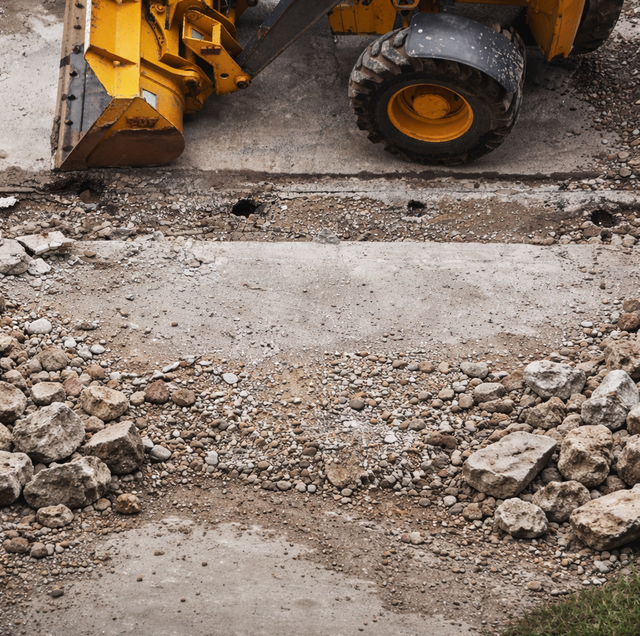
A driveway slab that's split into plates, dropped at one edge, or humped along a seam has already told you it's done. The real question at that point is what to do with the broken slab that's already sitting there, not which material wins in a general comparison. That decision shapes almost everything about the job, including how much material gets hauled, how the new surface drains, and whether the driveway settles evenly a year from now.
Why Concrete Driveways Fail in the First Place
Concrete doesn't usually fail because the concrete itself was bad. It fails because of what's happening underneath and around it. Expansive soil that swells when wet and shrinks when dry will flex a slab until it cracks along its weakest point, usually a control joint or a spot where the original base was thin. Tree and shrub roots do the same thing from below, working their way under an edge over several seasons and lifting it unevenly. A slab poured over an improperly compacted base will develop soft spots that sink under the weight of vehicles, especially near the street where trucks and trailers turn. Water that isn't directed away from the driveway edge erodes the soil beneath it, leaving voids the slab eventually drops into. Freeze-thaw cycling adds stress in colder stretches of the year, but it's one contributor among several rather than the reason most warm-climate driveways fail: heavy seasonal rain, sandy or shifting subgrade, and steady root pressure do most of the damage here year-round.
Once a slab has cracked into separate pieces, dropped more than an inch at a joint, or developed a slope that pools water rather than sheds it, patching stops being a real fix. That's the point where gravel becomes a realistic option, and where the retrofit questions start.
Deciding Whether the Old Slab Has to Come Out
Not every failed slab needs to be fully demolished and hauled away. The decision usually comes down to three things: how badly it's broken, whether it's still roughly level, and what the finished grade needs to look like.
Sections that are cracked but still flat and stable: these can sometimes stay in place and function as part of the base itself, especially in the middle of a run where vehicle weight is more evenly distributed. Sections that have heaved, dropped, or tilted: these almost always need to come out, because leaving an uneven slab underneath creates a permanent low spot or high spot that gravel can't correct on its own. The surface above will eventually mirror whatever is happening below it. Areas near the garage, street, or any spot where the finished grade has to match an existing threshold: these usually require removal too, since a slab sitting even a few inches proud of the target grade will force the new gravel surface up with it.
A driveway that failed in one localized area but is otherwise sound is a good candidate for partial removal: take out the damaged section, regrade it to match the rest, and leave the stable concrete alone. A driveway that's cracked wall to wall, or that's dropped unevenly across its whole length, is usually more predictable to just clear entirely and start the base fresh.
A separate product category worth knowing exists: permeable plastic grid or resin-bound overlay systems that get installed directly on top of an intact, if unattractive, slab without removing it. That's a different build than a traditional loose-aggregate gravel driveway and outside what's covered here, but it's worth knowing the option exists if the old slab is structurally sound and cosmetics are the only real complaint.
What Happens to the Broken Concrete
Removed concrete doesn't automatically mean a dumpster and a trip to the landfill. Crushing it on site and reusing it as part of the new base is a common, legitimate practice: broken concrete, usually sold or labeled as recycled concrete aggregate (RCA), is angular and compacts into a dense, well-draining layer that performs similarly to a crushed-stone base in many situations. It's not a universal substitute for a properly graded aggregate base, and how much can be reused depends on the size of the broken pieces, how much reinforcing steel is tangled in them, and whether the pieces can be broken down small enough to compact evenly.
Crushing broken concrete on site throws fine dust into the air that carries crystalline silica from the aggregate, and repeated exposure to it is a genuine respiratory hazard. Wet the material down before and during crushing, and wear a NIOSH-rated respirator, not just a basic dust mask, if you're working near the crusher.
Where the slab is too badly broken, too heavily reinforced, or simply too large a volume to process on site, hauling it off and bringing in clean aggregate is the more reliable route. Either way, the material doesn't just vanish. It gets crushed for reuse, hauled off for recycling or disposal, or in some cases removed and reused elsewhere on the property, which is a question worth asking before demolition starts rather than after.
Rebar, Wire Mesh, and Buried Edges
Most poured driveways from the last several decades have some form of steel reinforcement, whether that's a full grid of rebar or a lighter welded wire mesh. That steel bends and tangles instead of breaking, and it often holds broken slab pieces together even after the concrete itself has fractured, which is part of why removal is a job for someone experienced with the equipment rather than a weekend project. A competent installer knows how to identify what's tied into a slab before pulling pieces free, and how to separate the steel from the concrete cleanly enough that neither ends up buried where the new base will sit.
Buried edges and old expansion joints matter more than they look like they should. An expansion joint is a full-depth break cut into the slab itself, filled with a compressible strip, and if a chunk of slab edge or that filler strip gets left in the ground instead of pulled, it leaves a narrow band of disturbed, loosened ground running right where the joint used to be. Compact over that band without addressing it, and you get an inconsistent compaction zone under the new surface: solid on one side, softer on the other. That's exactly the kind of hidden variation that shows up later as an uneven dip.
How the Old Slab Changes the Ground Underneath
Soil that's been sitting under a concrete slab for years isn't the same as soil that's been open to the weather the whole time, and that difference matters once you're building on top of it. The area directly under a solid slab is often more densely compacted than the surrounding yard, simply from years of weight sitting on it undisturbed. The soil right at the slab's edges, on the other hand, is frequently the opposite: loosened and eroded by years of water running off the concrete surface and concentrating along that line. A site that looks uniform from above can have compacted ground in the middle and soft, washed-out ground along the perimeter, and that unevenness needs to be addressed before base material goes down, not discovered after.
Removing a raised or heaved slab also changes the grade, sometimes more than people expect. A driveway that used to shed water because the slab sat a few inches above the surrounding soil can suddenly become the low point of the yard once that concrete is gone, especially if nearby landscaping or a walkway was built up around it over the years. Reworking the grade so water still moves away from the house and toward a reasonable drainage path has to be planned as part of the retrofit up front.
Building the New Base Over Reclaimed Ground
Whatever combination of leftover slab, crushed concrete, and native soil is left after removal, it all needs to be brought to a consistent, properly compacted surface before the finished gravel goes on. That generally still follows the same layered logic any gravel driveway needs: a stable sub-grade, a compacted base course, and a surface layer, but the reclaimed-ground version of that process spends more time on verification. That means checking for soft spots where old edges or voids were, confirming the compaction is even across the old slab footprint versus the surrounding soil, and correcting the grade where a removed slab has left a low spot. In tighter driveways, or spots where a full-size machine can't maneuver, a compact skid steer is often the right tool for breaking up remaining material, moving crushed concrete around, and running a compaction pass without tearing up adjacent landscaping.
What a Walk-Through Tells You Before Work Starts
A slab with one bad section and a stable grade everywhere else is usually the easiest retrofit: cut it loose from the sound concrete, clear the damaged area, regrade, and build the base without disturbing the rest of the driveway. A slab that's cracked end to end, dropped unevenly, or pooling water in more than one spot is telling you the whole base has been compromised, not just the surface, and in that case a full clear-and-rebuild almost always outperforms trying to salvage pieces of it. Either way, the goal underneath is the same: even compaction, a grade that moves water where it should go, and no buried surprises left behind from what used to be there.
Frequently Asked Questions
Requirements vary by property and jurisdiction, so it's worth checking with the local building or planning department before work starts. Converting a hard, impervious surface like concrete to a more permeable one like gravel can change how a property's stormwater runoff is calculated, which is a detail some homeowners don't think to ask about until it comes up later.
Solid concrete sheds almost all the rain that hits it, while a gravel surface lets some water soak in rather than running straight off. Because of that difference, the new driveway sometimes needs a slightly different crown or a shallow drainage swale along one edge to keep water moving as it did with the old slab, rather than assuming the same runoff pattern will hold.
Yes, and when that's the plan, the boundary is usually cut rather than broken. Running a concrete saw along a straight control line creates a clean, stable edge for the remaining slab rather than a jagged break, making it far easier to tie the new gravel section into the old one without a visible seam or a weak transition point.
It can, but not every piece qualifies. Slab fragments larger than roughly a foot across usually need to be broken down further before they're useful as fill or base material, and pieces still tangled with wire mesh or rebar are generally set aside until the steel is pulled first. Clean, appropriately sized pieces are what typically get reused as fill under a shed pad or as rough erosion-control fill along a slope; anything left over goes out with the rest of the demolition debris.
A magnet or a handheld metal detector run over broken pieces before hauling will usually locate embedded rebar or wire mesh that isn't visible at a glance. Any exposed rebar ends found during removal should be cut back or capped rather than left protruding, since a buried sharp end left near the surface is a real puncture hazard for tires and feet alike.
It can, particularly along old expansion joint lines, since those are full-depth cuts through the slab where the ground below was disturbed when the joint was formed and later when it was pulled out. A quick way to check before the new base goes down: run a probe or a length of rebar into the ground along the suspected joint lines and compare how easily it sinks in there versus a few feet away in undisturbed soil. A noticeably softer spot along the joint line warrants an extra compaction pass before the base course covers it up for good.
Schedule a driveway assessment — a technician will walk the old slab with you and lay out what can be reused before any work starts. Polk Services LLC serves Lakeland, Highland City, and Mulberry. Call (863) 344-5806.
