

What Bare Ground Needs After Lot Clearing (3 Hidden Risks)
Quick Answer: Cleared ground isn't ready to grade or build on until stump holes and pulled roots are filled and compacted in layers, root channels are checked for hidden voids, and disturbed soil from traffic is re-compacted. Skip this and the ground settles later.
Once the brush, saplings, and stumps are off a lot, the ground underneath looks finished. It's open, it's brown, and from a distance it reads as a blank slate ready for a mower, a slab, or a load of sod. That first impression is the thing to be suspicious of. Clearing removes what was growing on the ground; it does almost nothing to fix what that growth left behind beneath it, and most of what's wrong is invisible until a tire, a footing, or heavy rain finds it.
Why Cleared Ground Isn't Automatically Ready
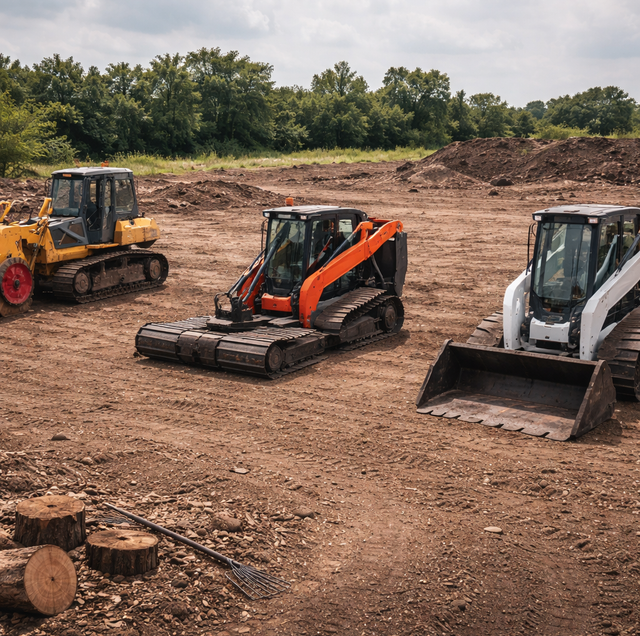
A lot-clearing crew's job is to remove vegetation and get the debris off site: brush chipped or hauled, small trees cut and stumps pulled or ground down, the visible mess gone. That's a different job from preparing a stable base for grading, sod, gravel, or a structure. The equipment that does the clearing (a skid steer with a brush cutter or grapple, a stump grinder, sometimes a small dozer for pushing debris into a pile) disturbs the ground as a side effect of doing its actual job, not as a step toward making that ground load-bearing.
Undisturbed soil has structure that took years to build: In an untouched section of the lot, the soil under the old canopy was consolidated by years of settling and rain, and knit together by root growth threading through it. The moment a stump comes out, or a root mat gets torn loose, that structure is gone in that spot, and gone doesn't mean flat; it means hollow.
What a Pulled or Ground Stump Leaves Behind
There are two common ways a stump is dealt with, and each leaves different problems.
Pulled or excavated stumps leave an actual hole, often 2 to 4 feet across and 1 to 2 feet deep for a mid-size tree, sometimes deeper for anything with a taproot. The root ball comes out with a chunk of the surrounding soil clinging to it, so the hole is bigger than the stump itself. If that hole gets pushed over with loose dirt from the pile next to it and never compacted, it's a soft spot sitting right under whatever gets built or grown on top of it later.
Ground stumps look cleaner on the surface (the stump is chewed down to grade or below it), but the roots are still down there, unless the whole root plate was pulled as well. Wood breaks down over years. As buried roots decay, the space they occupied becomes a void, and the soil above it settles into that space slowly, which is exactly why a spot that graded flat can show a shallow depression eight or ten months later with no obvious cause.
Either way, the fix is the same: excavate the hole out to solid, undisturbed soil at the edges, backfill with soil that matches what's around it (not construction debris, not stump grindings, not a mix heavy in wood chips that will keep decomposing), and compact it in lifts, meaning 4 to 6 inches of fill, tamped or plate-compacted, then the next 4 to 6 inches, rather than dumping the whole hole full at once and calling it done. A single deep pour of loose fill compacts unevenly no matter how much you run a plate over the top of it, because the bottom of the fill never gets real pressure on it.
For any stump hole deeper than about 18 inches, compact in lifts no thicker than 6 inches. A single deep dump of loose fill looks solid on top but stays soft at the bottom, which is exactly where it will settle first.
Root Channels: The Damage You Can't See From the Surface
This is the part that gets skipped most often, because there's nothing to look at. A large tree's root system doesn't stop at the trunk; lateral roots can run 15 to 30 feet or more from where the tree stood, tapering as they go, some at the surface and some a foot or more down. When that tree comes out, the small and medium roots that don't get pulled with the main root ball are left in place, and they decay in the ground over the following months and years.
A decaying root doesn't collapse into solid ground behind it. It leaves a channel roughly the shape and path of the root itself, an open or loosely soil-filled tunnel running through the ground where a living, structural root used to be. On flat, undisturbed ground, that channel is a curiosity. On graded ground, especially ground that's supposed to shed water away from a structure, it's a path of least resistance. Water finds the loose backfill and root channels before it finds the compacted native soil around them, and it moves through that path preferentially, which can hollow the channel out further over time or resurface as an unexplained soft or wet spot well away from where the original tree stood.
There's no way to visually confirm a root channel from the surface after the tree and stump are gone. The most reliable check is physical: probe suspect areas (near where large trees stood, along the path large roots likely ran) with a soil probe or a length of rebar. Solid, undisturbed ground resists steady pressure. A channel or a pocket of loose backfill gives with noticeably less resistance, sometimes with an inch or two of sudden give where the probe met firm resistance a few inches away. That's the same principle as knocking on a wall to find a stud versus a hollow section between them; the resistance itself is the information, not what you can see.
Call 811 before any digging deeper than a hand probe, even on ground you cleared yourself. Buried gas, power, water, and communication lines run through cleared lots too, and locates take a couple of business days.
Disturbed Soil From Equipment Traffic
Root holes and root channels are two specific problems. The third is broader: wherever the clearing equipment actually drove, turned, or set down its bucket, the soil beneath was either compacted unevenly or loosened, depending on what happened there. A skid steer track repeatedly pivoting in one spot can over-compact a patch of soil into something dense and nearly impermeable, which creates its own drainage problem later, even though it may sound like a good thing. Meanwhile, the staging area where debris got piled and picked back up, or a spot where a grapple dragged brush across the same path repeatedly, tends to end up loose and mixed, with organic material worked into the top few inches that wasn't there naturally.
Neither condition is "ready." Over-compacted soil sheds water rather than letting it soak in evenly, which can contribute to standing water in that specific patch even after the rest of the lot grades and drains well. Loose, organic-mixed soil compresses unevenly under new fill or a structure because it's not consistent from one square foot to the next, so it settles in an inconsistent pattern instead of settling as a whole.
This is why a competent regrade after clearing isn't just "push the high spots into the low spots and call it level." It starts with identifying which areas were disturbed by equipment traffic and which were left alone, then treating the disturbed areas (rip and re-compact the over-compacted patches, and remove loose organic material and replace it with matching soil in the loosened patches) before the whole lot is brought to final grade together.
Getting From Cleared to Actually Ready
In order, before a cleared lot should be treated as ready to grade, seed, gravel, or build on:
- Locate and address every stump hole and pulled root ball area: excavate to solid soil, backfill with matching material, compact in 4-to-6-inch lifts.
- Probe for root channels near former large-tree locations and along likely root paths, especially anywhere close to a planned structure, drain line, or driveway.
- Identify equipment-disturbed zones (staging piles, turning areas, drag paths) and correct them separately, rather than grading over them as-is.
- Only then bring the lot to final grade, so the finish grading is shaping ground that's already structurally sound underneath, not smoothing a surface over hidden problems.
Doing it in that order matters more than doing each step perfectly. Grading first and fixing voids after means redoing the grading; fixing voids and disturbed soil first means the finish grade is the last thing touched and stays that way.
One more thing worth saying plainly: none of this is a knock on the clearing work itself if the crew did what they were hired to do (get the vegetation and debris off the lot). It's simply a different scope of work, and treating it as automatically finished is what gets cleared lots into trouble down the road.
Frequently Asked Questions
There's no fixed number of days, because it depends on what was cleared and how it was removed, not on time passing. A lot cleared by hand or with light equipment and minimal stump removal can often be checked and corrected within a week or two. A lot where several large stumps were pulled needs each hole backfilled and compacted before grading starts, which is a labor step, not a waiting period; grading before that compaction is finished just buries the problem instead of fixing it.
Driving over loose fill compacts only the top few inches and leaves the bottom of a deep hole soft, which is the opposite of what you want. A wheel or track spreads its weight over a small contact patch that passes over each spot in an instant, while a plate compactor or roller concentrates repeated, sustained pressure into the same footprint through several passes. That difference is what actually reaches the bottom of a hole; driving across the surface, even with something heavy, mostly seals a firm crust over the looser material still sitting underneath.
No, and trying to is usually more disruptive than helpful. Small feeder roots, about an inch in diameter or less, break down quickly and rarely leave a channel large enough to matter. The roots worth tracking down are the structural laterals from large trees, generally a few inches or more in diameter near the trunk, since those are the ones that leave a channel wide enough to carry water or collapse under a footing.
Typically no. Stump grinding chews the visible stump down below grade and leaves a mound of wood grindings mixed with soil in and around the hole; grinding out the stump isn't the same service as excavating, backfilling with matching soil, and compacting the area, which is a separate grading step usually done by whoever handles the ground-prep work.
Grass will often grow over a stump hole or a root channel just fine at first, because roots and settling voids are below where turf roots reach. The problem shows up later as a depression that reappears no matter how many times it gets topdressed, or as a wet or spongy spot that tracks back to a void that was never actually filled, just covered.
A true root channel tends to run in a rough line rather than sit as a round patch, since it follows the path the root took. Probing every few feet along a suspected line will usually show a pattern of resistance that drops and returns as you cross in and out of the channel, whereas naturally loose or sandy soil tends to feel consistently soft across a broader, less linear area.
Every cleared lot carries some version of this underneath it; the difference between one that settles evenly for years and one that develops mystery low spots is almost always whether someone checked what was left behind before building on top of it.
Schedule a post-clearing grading assessment — find and fix stump holes, root channels, and disturbed soil before they become a settling problem. Polk Services LLC serves Lakeland, Highland City, and Mulberry. Call (863) 344-5806.
