

The Space After a Deck Removal: What's Still Buried
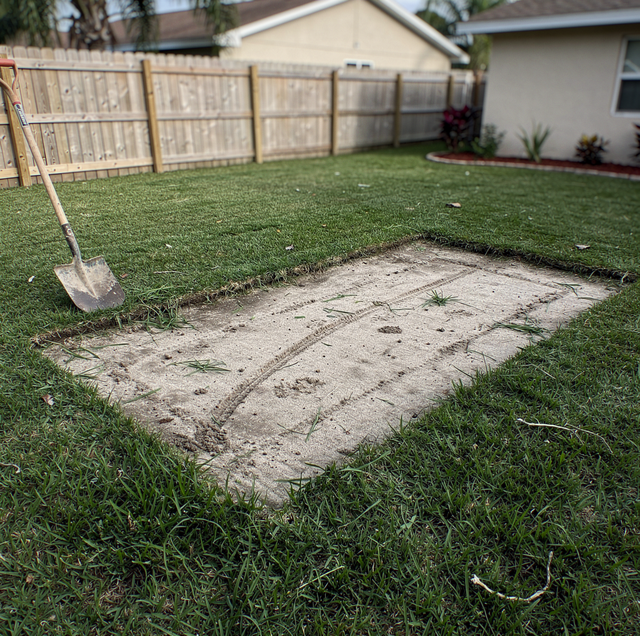
The rake-clean at the end of a deck removal leaves a rectangle of bare ground where a structure sat for years, sometimes decades. Most homeowners expect that rectangle to be a blank slate, dirt like the rest of the yard, just missing grass. It isn't. Soil under a deck spends its whole life in shade and in the rain shadow the decking casts, cut off from the three things that keep ordinary lawn soil open: water moving down through it, roots growing and dying back in it, and the soil life that follows both. What the crew's rake-clean uncovers is closer to a preserved patch of ground from years ago than a fresh start: pale, hard-packed, often bare to the dirt, with none of the organic layer a working lawn builds up on its own.
Quick Answer: A cleared deck footprint isn't blank dirt ready for grass. It's shade-starved, compacted soil that may still hide footings, sits on a grade the deck was managing, and needs real prep before sod or seed has a chance.
The Ground the Deck Leaves Behind
Walk the footprint the same day the decking comes up, and the ground tells a clear story. The soil is usually pale and hard-packed rather than the darker, looser brown of ground that's been rained on, walked over, and left to build up an organic layer for years. Whatever thin grass survived at the very edges, in reach of some indirect light, is usually sparse, pale, and shade-adapted, not ready for the sudden full sun it's about to get once the structure above it is gone.
None of this shows up as damage the way a homeowner expects it to. It's just years of a different set of conditions than the rest of the yard has had, sitting quietly under a structure that hid it the entire time.
What's Left in the Soil
Land-deck posts don't sit on bare dirt. They sit on footings, poured concrete piers, or sonotube cylinders set below grade before the deck ever went up, and those footings are the part of a deck that a removal doesn't automatically take with it. Pulling them out is a separate, quoted line item from taking down the structure above. A customer chooses to have them pulled for a clean site, or leaves them in place when the ground use afterward isn't sensitive to what's a few inches under the surface, or when a new structure going in the same footprint can reuse the same footing positions.
For a lawn, that decision carries more weight than it might seem to. Grass doesn't care what's under a driveway or a shed pad. It cares what's under it, and a footing left behind doesn't decompose, settle away, or soften over time. It just sits there, permanently, under whatever gets planted directly on top of it.
A footing left in the ground doesn't decompose or settle away. Buried a few inches under new sod or seed, it can deflect roots, dull a mower blade, or leave a hard spot underfoot indefinitely.
The Grade the Deck Was Hiding
A deck doesn't just sit on top of the ground; it sits on a grade that was shaped for it. Water falling on the decking surface drains straight through the gaps between the boards, and the slope underneath was cut or built up around the footings to carry that water to a specific location, usually away from the house. While the deck stood, the boards hid whatever that slope was doing. Nobody watched the water move, because there was nothing to see it move across.
Once the decking is gone, that hidden grade is suddenly doing its job in the open, on bare ground instead of under cover, and it either sheds water as it was meant to, or it doesn't. A slope cut correctly for a covered structure can still leave water sitting somewhere unexpected on open lawn, especially if the ground settled unevenly over the years the deck stood on it. This is worth checking before anything gets planted, since correcting a grade after grass is established is a bigger job than correcting it on bare dirt. A patio replacing the same footprint would need that grade question answered differently, since a hard surface manages water on top rather than letting it soak in.
Getting the Surface Ready to Grow Anything
A deck leaves a particular kind of ground behind, not just a hard one. The density isn't uniform across the rectangle: the strips directly under the joist lines are packed more tightly than the bays between them, so loosening the surface has to reach the whole footprint rather than just the spots that look worst from standing height.
No organic layer to work with: In an open lawn, clippings, leaves, and roots die back into the soil year after year and rebuild it. Under a deck, none of that ever landed. The footprint arrives at planting day with all of that deposit missing, which is a separate problem from density and isn't solved by loosening alone.
A footprint sitting high or low: A deck built up over a dip, or dug into a rise, leaves the ground under it at a level the rest of the yard never had. Fill dirt brought in to true up that difference does more for how the finished lawn reads than anything planted on top of it.
Backfill that isn't the same dirt: Where footings came out, the holes hold whatever went back into them, and that material rarely matches the ground around it in texture or density. A deck's footing holes are small, deep, and spread well apart rather than one large cavity, so what shows later is a scatter of soft spots rather than a single depression. Sandy fill settles quickly once disturbed, so each hole needs to be compacted in place rather than left as a shovel of loose dirt, and where the water table sits close to the surface, the bottom of an old hole can stay damp longer than the ground around it.
Sod or Seed: Let the Site Decide
The footprint is a hard-edged rectangle butting up against lawn that has been established for years on every side. That edge decides more than any general preference does: whatever goes into the rectangle has to match what is already growing around it in blade, texture, and height, or the patch reads as a patch long after it is fully green.
Sod arrives in a fixed variety and density, so matching means knowing what the surrounding lawn is rather than taking whatever is on the pallet. Seed can be matched as closely, but it comes in thin and takes its time reaching the density of the lawn beside it, and the line between old and new stays legible for the whole of that stretch. Sod also holds a disturbed surface together the day it goes down, which counts for something on ground that was graded and filled that same week.
Sod follows the grade underneath it closely, so a footing hole that wasn't compacted correctly, or a low spot left from the grading work, shows through a sod mat sooner than it would through a lawn grown from seed. The prep done beforehand determines which option makes more sense than any preference for one over the other.
When It Stops Looking like a Former Deck
Coverage is the fast part. Grass, whether sodded or seeded, fills in over a matter of weeks once it's rooting into properly prepped soil. Matching the rest of the yard is the slow part, because the soil underneath is still catching up. It's thinner, less structured, and slower to hold moisture evenly than ground that's been open and growing for years, and that difference doesn't disappear the moment the grass looks green.
What closes that gap is roots working into the soil and organic matter rebuilding, gradually, the same slow process that made the ground different in the first place, running in reverse. Until that happens, a footprint that's technically grown in, full coverage, no bare patches, can still read as its own patch from a slightly different shade or texture, most noticeable right after mowing when grass of different ages sits side by side.
Frequently Asked Questions
It can, faintly, longer than most people expect. The soil directly under the joists is often denser and drier than the soil between them, since the joists themselves blocked even the limited rain and light from reaching the ground beneath them. That banded pattern usually shows more clearly in raking light or from an upstairs window than at eye level standing in the yard.
It can help. Laying new sod strips crosswise to the direction the old joists ran, rather than parallel to them, breaks up that banded compaction pattern faster, since roots growing across the bands knit them together instead of following the same lines the joists left behind.
Not always. Capping it with a modest amount of additional fill is often enough, which avoids reopening a hole in an otherwise finished lawn. What tends to give the spot away later is moisture rather than depth: the shallow soil sitting over a buried footing holds less water than the deeper ground on either side of it, so during a dry stretch that patch browns off before the rest of the lawn does.
Often, yes. The perimeter, where rainwater has dripped off the board gaps for years, tends to be more eroded or unevenly packed than the center of the footprint, so it may need a touch more grading attention than the middle of the rectangle.
Not at first. Ground that has been packed and dry for years sheds water before it absorbs it, so early rain tends to run to the edges and leave the footprint looking watered while the layer underneath stays about as dry as it was under the boards. Breaking the surface open is what changes that, and until it happens, what lands on the rectangle mostly leaves it.
Often a small one. A deck built over part of a sprinkler zone sometimes leaves that section without a working head, or with one capped off during construction. Extending coverage to the reclaimed footprint is usually a matter of adjusting the existing zone rather than adding a new one.
Take the deck out and get the ground back — book a free footprint walk-through. Polk Services LLC serves Lakeland, Highland City, and Mulberry. Call (863) 344-5806.
