

Converting a Dirt or Grass Driveway to Gravel: What Changes First
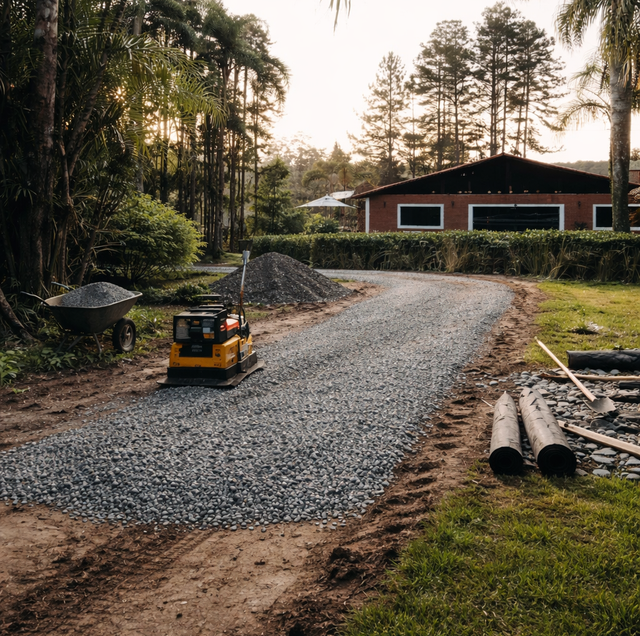
A property that already has a driveway, even a rough one worn in by years of parking, backing a trailer, or just walking the same line to the mailbox, isn't starting from bare ground the way a new-construction lot is. The path already exists in the yard: where it curves around a tree, how wide it needs to be for two vehicles to pass, where it meets the garage or the road. Converting that existing dirt or grass path into a gravel driveway is a different job than building one on land that's never carried a vehicle before, and it comes with its own set of questions that don't apply to a from-scratch install.
Why Living Grass Has to Be Stripped, Not Covered
Where a driveway has grown in with grass, whether it's a two-track worn by tires with a strip of grass surviving down the center, or a full lawn area being converted into a driveway corridor, the grass itself is a problem gravel can't just sit on top of. Living grass and the root mat beneath it aren't a stable surface for building. Roots keep growing after the stone goes down, and turf is stubborn enough to send new blades up between gravel pieces from below, especially along any strip that never got driven on regularly and never compacted the way a tire path does.
Root mat left in place: it also holds water like a sponge sitting under whatever gets built on top of it, keeping that section soft and slow to firm up long after the ground around it has drained.
Grass that's only mowed or scalped: it looks removed from a few feet away, but the crown of the plant and the root system are both still alive underneath, which means the pushing-back-up problem shows up within a season rather than being solved.
The fix is to strip the sod and root mat down to firmer soil before anything else happens, not to mow it short or lay stone over it. For the layer-by-layer build that goes on top of that stripped ground, fabric, base course, and finish stone, that's covered in full elsewhere; here the question is what's unique to converting ground that's already grown in versus starting on cleared dirt.
Does an Existing Dirt Track Help or Hurt the New Driveway?
A dirt track that's been driven for years already has one thing going for it that raw land doesn't: the soil under the tire paths has been compacted by repeated vehicle weight over a long stretch of time, which is a real head start on the compaction work a new driveway's subgrade needs anyway. That's real, and it can shorten the prep work in those specific bands.
It doesn't mean the whole track is ready to build on, though. An established track often holds water differently than the yard around it, sometimes because the compacted soil sheds rain faster than the looser ground beside it, sometimes because years of the same wheels finding the same low spot have turned that spot into a collection point that never existed before the track did. A driveway corridor with its own drainage pattern baked in from years of use needs that pattern read and addressed, not assumed to be fine just because the ground feels firm underfoot.
When the Track's Ruts Need Correcting Before Building on It
Ruts that have formed gradually over years of driving the same two lines are shaped by whatever the ground did under repeated load, not by any grading plan, and that shape usually isn't the one a new gravel surface should sit on. Two low bands running the length of the corridor with a higher, ungraded strip between them will keep directing water into those same two bands once gravel is on top, unless the track gets regraded to a proper crown before the base goes down.
Correcting that shape means cutting the high center down or filling and compacting the low bands so the corridor has one consistent grade across its width, with a crown or cross-slope that sheds water off both edges instead of channeling it down the old wheel paths. Skipping that regrading pass and building straight over an established rut pattern tends to reproduce the same low spots in the new surface within the first season of use, since gravel and a thin base layer don't erase years of settled ground shape on their own.
How a Conversion Compares to a Raw-Land Install
The biggest practical difference between converting an existing path and building on raw land is how much of the project even happens before gravel gets involved. A raw-land driveway has to go through clearing, rough grading, and a utility-trenching phase before the corridor is even ready for a base course, since water, sewer, electric, and other lines often have to cross or run alongside a driveway that doesn't exist yet. A conversion on a property that's already lived-on generally skips the clearing and rough-grading phases, since there's no brush or tree removal and the corridor's rough location is already set by years of use. Utility installation is typically already done, not still pending, though existing lines often run under or alongside a driveway that's been there for years. That is exactly why a locate request still comes before any stripping or regrading starts on a conversion, just as it would on raw land.
Even a driveway that's been there for years can have power, water, sewer, or irrigation lines running under or beside it. Call 811 to have lines located and marked before any stripping or regrading starts —not just on raw land; an established track gives no visual clue about what's buried beneath it.
That's what makes a conversion a shorter, less disruptive project overall: strip the turf and root mat, correct the grade where the old track's shape works against it, and build the base and finish layers on ground that's already functioning as a driveway in every sense except the surface material. The work that remains is real, but it's a fraction of what a raw, undeveloped lot requires before the same base course can go down.
Where the New Gravel Meets the Remaining Lawn
Every converted driveway has an edge where the new gravel corridor meets the lawn that's staying lawn on either side, and that seam gets more wear than it looks like it should. A crown built into the driveway sheds water off both edges by design, which means the strip of grass right along the gravel takes more runoff than the rest of the yard does, not less. Left unaddressed, that edge tends to erode into a shallow channel, and loose stone from the corridor migrates a few inches into the grass with every mower pass and every rainstorm.
A defined transition strip, a graded buffer along each edge rather than gravel simply stopping where grass starts, gives that runoff somewhere to go without cutting a channel and gives the mower a clean line to follow instead of chewing into loose stone. Some form of edge restraint at that seam holds the gravel in its lane and keeps the two materials from slowly trading places over a few seasons of mowing, rain, and tire overhang from vehicles pulling slightly wide.
Frequently Asked Questions
No, and this is one of the bigger differences in labor and time between conversion projects. A two-track path that's already bare in the wheel lines usually only needs that center strip stripped of grass and roots, since the tire paths on either side are typically already compacted dirt with no turf to remove. A full lawn area being converted into a driveway corridor requires stripping the entire width, which is considerably more material to clear and haul off.
It still needs both. Compacted subgrade is one input into a stable driveway, but fabric's job is keeping fines from that subgrade separated from the stone above it so they don't work up into the base over time, and compaction alone doesn't stop that mixing. A well-compacted old track shortens the subgrade prep step; it doesn't replace the fabric or base layers that go on top of it.
Yes, mainly for what's under the surface at each spot. A shaded stretch near mature trees often has larger roots running closer to the surface than an open, sunny section does, which can mean more careful digging or a shallower cut to avoid damaging tree roots during the strip and grade phase. It's worth walking the planned corridor and flagging any spot where a root larger than a few inches crosses the path before grading equipment gets there.
It can be widened, and a conversion is often the easiest time to do it, since the ground on either side of an old track is usually already at a similar grade to the track itself, unlike a raw-land corridor where the new width has to be cut and graded from scratch on both sides. Widening still means stripping turf and roots across the added width the same way the original strip needed it, just extended a few feet further into what was lawn before.
A standing-water spot on the existing track usually points to a low point that needs more than a simple regrade, sometimes a shallow swale cut alongside the corridor to carry water past that point, or a tie-in to wherever the yard's drainage already runs. Building gravel directly over a known pooling spot without addressing where that water is supposed to go tends to reproduce the same soft spot under the new surface within the first heavy rain.
There's no single number since lot size and the condition of the existing track both matter, but a conversion on an already-accessible property commonly wraps in a matter of days rather than the several months to over a year a raw-land driveway can span once clearing, utility work, and staged construction-traffic phases are factored in. The turf-stripping and regrading steps are usually what set the pace, not the base and finish layers themselves.
Get an existing dirt or grass driveway ready for gravel — we'll check the turf, the track, and the transition edges before any stone is ordered, whether that is a gravel driveway in Plant City or one in Winter Haven. Polk Services LLC serves Lakeland, Highland City, and Mulberry. Call (863) 344-5806.
