

Where Deck Boards Rot First: 6 Spots That Reveal Trouble
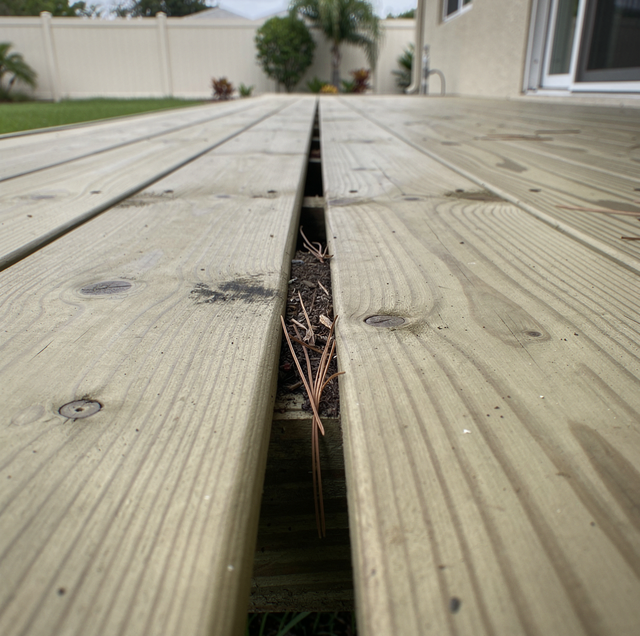
At the exact spot where a single deck board crosses a joist and its cut end hangs just past the edge, the wood is doing something different from the rest of the board. A saw cut across the grain exposes the ends of thousands of long fibers that normally run the length of the board, carrying moisture along the length of the tree they came from. Once those fiber ends are cut and left exposed to weather, they draw water in along their length far faster than the flat face of the board ever absorbs it. That difference, more than anything else about a deck, decides where rot shows up first.
Cut Ends and Exposed End Grain
Every deck board has at least two cut ends, and most have more anywhere a board was trimmed to fit a corner, a stair opening, or a post. Pressure-treated lumber arrives from the mill with preservative forced into the board's outer shell under pressure, but that treatment does not extend evenly to the core, and it does not travel with the board once a saw opens a new face. A field cut is a fresh, unprotected surface: the moment an installer trims a board to length, the cut end exposes bare core wood that never received the same protection as the factory-milled faces around it.
Because end grain pulls water in along the length of those exposed fibers rather than across them, a cut end still holds water the flat face of the same board has already lost to the sun. That is why the first soft, dark, or crumbling wood on most decks appears at the perimeter: the outer ends of the boards, the returns around a stair opening, the trim edge where a border board was mitered. Cedar and redwood, which carry no forced-in preservative at all, show the same pattern even sooner, since their natural resistance sits mostly in the heartwood rather than at a cut surface.
The Top of the Joist Underneath
The top edge of the joist under a board tells a different story than the board's surface does. The two pieces of wood sit face to face across their full length, and that contact line blocks sun and air from ever reaching the wood between them. Rain that soaks the top of the deck sheds off the board's exposed surface and dries in sun and wind; the strip of joist directly under the board stays damp long after.
Fungal decay needs sustained moisture and a moderate temperature to take hold, and a shaded, still, damp joist top under a deck board supplies both, especially in hot, humid climates where the air itself rarely dries the wood out between rains. The joist can be losing strength for years before anyone sees it: the top of the board keeps looking solid because it is the one surface still getting sun and airflow, while the framing member holding it up is quietly softening just below the surface.
The contact line between a board and the joist beneath it is the one surface on a deck that never sees sun or wind, which is why decay there is usually older than on the visible face.
Where Two Boards Meet over a Joist
A butt joint is where two deck boards end over the same joist, so two cut ends from two different boards sit within a fraction of an inch of each other directly above one strip of framing. Every board on a deck has cut ends; a butt joint puts two of them, from two different boards, on top of the same few inches of joist.
Rain that lands on the deck's surface finds that seam and funnels through it repeatedly, run after run, storm after storm, while the boards on either side shed most of their water off to the sides. The joint combines the two weaknesses already described: end grain that draws water in quickly, and sitting directly on a joist top with no sun or air to dry it out. That combination is why a butt joint often shows visible softness or dark staining before a plain, uninterrupted stretch of board does.
Post Bases at Grade
Where a deck's support posts meet the ground, the wood is exposed to a kind of moisture that the boards on top never see: constant contact rather than intermittent rain. A deck surface dries between storms because sun and wind reach it. A post base surrounded by soil, mulch, or turf that has crept up around it may never fully dry, especially where grading holds water against the base after every rain instead of carrying it away.
The concrete under a post base is rarely the problem: It is the wood immediately above where the post meets that footing, and the grade around it, that shows decay first, since that is the zone where moisture, soil contact, and lack of airflow overlap for the longest stretch of any wood on the structure.
Stair Stringers and the Bottom Tread
Stair stringers run at a steep diagonal from the deck frame down to the ground, and that angle changes how they take on water compared to a flat deck board. Rain that lands on every tread up the full run of stairs sheds downward along the stringer, so the bottom few feet of stringer and the lowest tread absorb runoff from the entire staircase above them, not just their own share of a storm.
The bottom tread also sits closest to grade, in the same standing-moisture zone as a post base, and it is usually cut from the same dimensional lumber as the deck boards above it, without the wider surface area that helps a flat board shed water quickly. That combination is why stair rot often shows up at the bottom step before it shows up anywhere on the deck surface itself.
Soft, dark wood at any of these points means it has lost structural strength. Do not step onto stairs or boards showing this decay or add weight to test how solid they feel; compromised wood can fail without warning.
The Underside No One Looks At
Every other location on this list is visible from above, at least once you know where to look. The underside of a deck is not. It is the one surface an owner standing on the deck never sees, and it is also the shadiest, stillest, least ventilated surface on the entire structure, especially on a low deck close to grade or one with the space beneath it closed off.
Water that gets through the gaps between boards during a storm lands on the tops of the joists and any beams below from underneath, adding a second wetting from below to the wetting the same wood already gets from above where the boards sit on it. Because nobody looks up into that space, decay there can travel a long way, softening joist after joist, before anything changes about how the deck looks from on top.
What These Six Spots Add Up To
None of these locations rot because of bad luck. Each one is a place where water either arrives faster, through cut fibers, or leaves more slowly, trapped against another surface with no sun or air to dry it, than on the flat, open face of an ordinary board. Cut ends and seams show the first kind of damage. Joist tops, post bases, and the underside show the second. Stair stringers get both at once.
That pattern is diagnostic, not decorative. Rot that starts at a handful of predictable points and stays there for years is telling a different story than rot that has already spread into the field of a board or up into a post. Reading where the decay is, rather than just noticing that it exists somewhere, is the difference between knowing you have a problem and knowing what that problem reaches.
Frequently Asked Questions
Yes, and in a different way. Every screw driven through a deck board punctures its protective outer shell and opens a fresh hole into untreated core wood, the same unprotected surface a saw cut creates. A heavily fastened board ends up with many small entry points spread across its length rather than only the two at its ends, and each one is a place water reaches wood the treatment never got to.
Usually, yes. The same contact line runs the full length of every joist, under every board that crosses it, so the condition that produced decay at one crossing is sitting at all the others on that same run. Decay found at a single board-to-joist crossing is rarely isolated to that spot; more often it is simply the first place the repeating condition along that joist became visible.
Stringers over a certain span are usually doubled or tripled: two or three pieces of lumber fastened face to face rather than a single wide board. That mated seam between the stacked pieces traps water the same way a joist top does, so a stringer can be rotting between its own layers even while its outer face still looks sound.
It can, because a post is judged from its base upward rather than from the portion at eye level. The section closest to the ground stays damp the longest, so strength is lost there first, while the length a person sees when standing beside the deck gets the most sun and airflow and has the least reason to show anything. A post can look straight and solid from shoulder height and still be failing where it meets the footing.
Not in the fungal sense, since composite has no wood fiber for decay organisms to feed on directly. But a cut or drilled edge in composite decking exposes the material's core, and if water repeatedly gets into that core, the board can swell there permanently. Unlike wood, which can dry out and partly recover, that swelling in composite does not reverse.
It shifts the pattern rather than removing it. Wind-blown rain still reaches board ends under most overhangs, and runoff shed from a roof edge above a deck concentrates along whatever line it drips onto, so a covered deck often shows earlier wear along that drip line even though the center of the deck stays comparatively dry.
Send photos of the deck — we will tell you what the removal involves. Polk Services LLC serves Lakeland, Highland City, and Mulberry. Call (863) 344-5806.
