

What Causes Deck Collapses and Why the House Connection Fails
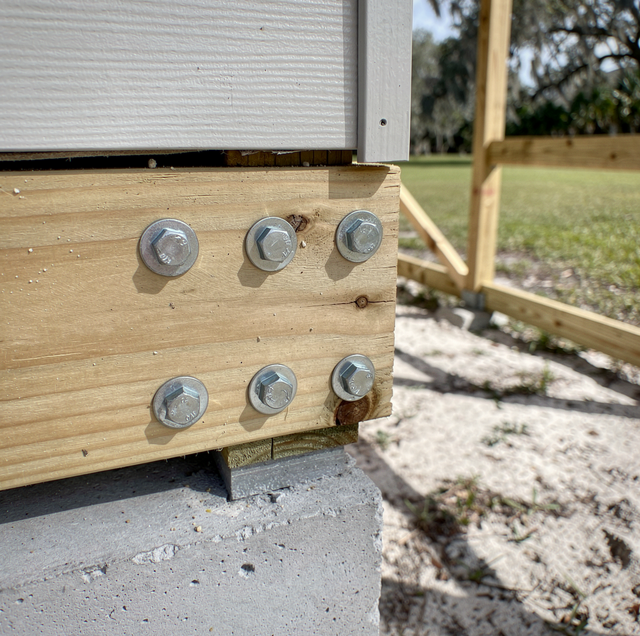
Quick Answer: Most deck collapses are connection failures, not structural ones. The joists, beams and posts stay intact while the ledger board separates from the house, dropping the inner edge and folding the deck toward the ground.
A ledger board is the flat piece of lumber bolted against the wall behind an attached deck, and it carries more responsibility than any other single member out there. Every joist running from the house toward the yard either sits on that board or hangs from a hanger nailed into it. Whatever weight lands on the inner half of the deck travels along those joists, into the ledger, through the fasteners, and finally into the framing inside the wall. The posts and footings people picture as the deck's support are only holding the outer half. The house is holding the rest.
What the Ledger Is Holding
Follow the load path rather than the deck's outline. Weight applied near the house side of the deck goes almost entirely into the ledger connection, because the joist under it is supported at the house end and at a beam somewhere out in the yard. The closer the load sits to the wall, the larger the share the ledger takes.
That means the fasteners holding the ledger are the busiest hardware on the structure and the least visible. Deck boards, railings, and posts are all in plain sight and get looked at. The ledger sits behind a rim of trim, under a lip of siding, tucked into the one place nobody looks.
The National Association of Deck and Railing Contractors publishes an estimate that roughly 90 percent of deck collapses result from failure of the ledger connection to the house rather than failure of the deck structure itself. It is worth reading that carefully. It does not say most decks fail because the wood was bad or the beams were undersized. It says the deck usually stays together and comes off the wall as a single unit.
Why the Fasteners Do the Failing
Not every fastener behaves the same way under the same load, and this is where a lot of older decks went wrong.
Nails resist shear better than withdrawal: A nail driven through a ledger and into the framing holds well against a load pushing straight down along the wall. It holds far less well against anything that pulls the board away from the house, because a smooth shank resists withdrawal only by friction between the steel and the wood fibers that close around it. Anything that softens the wood surrounding the shank loosens that grip, and a nailed connection has nothing else holding it in.
Bolts do not withdraw the same way: A through-bolt runs completely through the ledger, the sheathing and the rim joist inside, with a washer and nut clamping the far side, so the connection bears against the wood rather than depending on friction along a shank. There is nothing for it to back out of. A lag screw sits somewhere in between, threaded into the framing rather than clamped through it, and it depends entirely on how much solid wood its threads caught.
Corroded steel loses section: A fastener that has been wet on and off for years is not the fastener that was installed. Rust consumes the shank from the outside in, and the thinner the remaining steel, the less load it carries. The head can look completely normal, while the shank inside the wall has lost most of its cross-section.
Attachment practice has changed a great deal over the decades, and a deck built a long time ago may be hanging on hardware that would not be chosen for the job today. That is not a judgment about the builder. It is just what the deck has.
How Water Gets Behind the Ledger
The second half of the problem is that the ledger connection is a hole punched in the house's weather barrier.
Siding sheds water down its face. A ledger board bolted flat over that siding interrupts the path, and unless a flashing detail carries the water back out over the top of the board, some of it goes behind. Once behind, it has nowhere to drain and no airflow to dry it. It sits in the gap between the ledger and the wall, wetting the sheathing and the rim joist from the back side.
That back side is the side nobody can see, which is what makes it dangerous. The face of the ledger board can look sound and dry while the rim joist behind it has softened to the point where bolt threads no longer have anything to grip. Wood does not have to crumble to stop holding a fastener; it only has to soften enough that threads pull through.
In hot, humid conditions, this runs faster than in dry climates, because the wood stays above the moisture level that decay fungi need for more of the year. Pressure-treated lumber generally gives a 15 to 25 year deck lifespan in that kind of weather. Cedar and redwood run shorter. Composite decking outlasts both, but composite boards do not change anything about the ledger, the rim joist, or the fasteners underneath them. A deck can have a perfectly sound walking surface while sitting on a finished connection.
Why a Collapse Happens All at Once
Decks do not sag for a season and then let go. They tend to be fine and then not fine, and the reason is how the load is shared.
A ledger connection is a row of fasteners, all carrying roughly the same job. When one of them loses its grip, the load it was carrying does not disappear. It redistributes to its neighbors, which are now each carrying more than they were designed for and are usually in the same condition. The next one goes sooner than the first, then the next sooner still. The sequence compresses.
The visible part of that process is very short. Everything up to the last few fasteners looks like an ordinary deck holding an ordinary group of people, because it is. There is no gradual droop to notice, no groaning warning period, and no chance to walk off. The inner edge drops, the joists rotate off their bearing, and the whole platform folds toward the wall it was hanging on.
This is why "it was fine last summer" comes up so often afterward. It usually was fine. The connection was already near its capacity limit, and nothing about that state shows on the surface.
What a Full Deck Does to the Joint
Load on a deck is not the steady, evenly spread weight that the word suggests.
People do not distribute themselves. They cluster at the rail, at the grill, at whoever is talking. A dozen adults standing in one corner concentrate far more weight into a few feet of ledger than the same dozen spread across the platform. And they move, which means the load is not just heavier but changing direction constantly, working the fasteners in exactly the cyclic pattern that pulls nails.
Storms do a version of the same thing in a single event. Hurricane Milton in 2024 pulled attached decks off siding and dropped trees through deck sections. A storm load like that does not have to break anything on its own. It can simply take a connection that was already thin and finish it, leaving a deck that looks like it survived while the joint behind it did not.
A deck showing signs of connection distress should not be loaded, used for a gathering, or walked on for a closer look. Keep people and pets off it entirely and arrange a professional assessment before anything else happens.
What Connection Distress Looks Like from the Yard
None of what follows is a reason to climb under a deck or pull on anything. It is what is visible standing back, with both feet on the ground.
A gap that was not there: A line of daylight, shadow, or separation appearing between the deck's inner edge and the wall of the house, or a deck edge that no longer sits level with the door threshold it used to match.
Siding that has moved: Buckling, staining, a rusty streak, or a bulge in the wall material at or just below the deck line, which is what water coming back out of a wall cavity tends to leave behind.
Bounce that has grown: A deck that has become noticeably springier or that moves when nobody is on it.
Rust weeping from the connection: Brown staining running down the siding beneath the ledger line.
What these signs are not is a diagnosis. Any one of them can have a benign explanation, and a connection can be near the end of its capacity while showing none of them at all, which is the reason a clean-looking deck is not evidence of a sound connection. The signs are worth acting on when they appear, and their absence is not worth relying on.
What lies behind the ledger can only be seen by someone qualified to open the assembly, which is why a closer look from the homeowner's side settles nothing. Whether the outcome is repair or removal is a separate decision, and taking an attached deck off the house is its own job with its own sequence, including sealing the mounting holes with construction-grade sealant once the ledger comes off.
A damaged deck does not come apart the way a sound one does, and the safe order for taking it down is worked out on site before anything is touched.
Frequently Asked Questions
Not on this point. The share of load a ledger carries is set by how the joists span between the wall and the outer beam, not by the deck's overall footprint, so a compact attached deck sends the same proportion of whatever stands on it into the house connection as a wide one does. Size affects how many people can gather on the platform; it does not change the geometry that determines where their weight goes.
That is a known bad condition. Brick and stone on a wood-framed house are usually a veneer, meaning a cladding layer tied back to the structure rather than part of it. Bolts landing in veneer are anchored to something that was never intended to carry structural load, and the veneer itself can be pulled loose by the deck.
Yes, because that weight is permanent. People are an intermittent load that comes and goes; a hot tub, large planters, built-in seating, or an outdoor kitchen is a dead load that sits on the same square footage every hour of every year. Anything added after the deck was built was not part of what the connection was sized for.
A general home inspection is visual and non-invasive, so the inspector does not remove siding, trim, or decking to see the ledger connection. A report with no deck finding means nothing concerning was visible, not that the connection was examined. It is not a structural clearance.
They can. Wood preservative chemistry changed, and the copper-based treatments used on modern pressure-treated lumber are more corrosive to unrated steel than the formulation they replaced. A deck built around that changeover can have hardware not rated for the lumber it is sitting on, which accelerates the loss of section described above.
It is a hardware category designed to resist a deck pulling away from a house, typically a tension device that ties deck framing back to the floor framing inside, working alongside the bolts rather than replacing them. Older decks generally predate it, which is part of why attachment practice looks so different now than it did decades ago.
Take the deck out of the equation — book a free removal walk-through. Polk Services LLC serves Lakeland, Highland City, and Mulberry. Call (863) 344-5806.
