

A 36-Inch Refrigerator in a 30-Inch Doorway: The Number That Decides
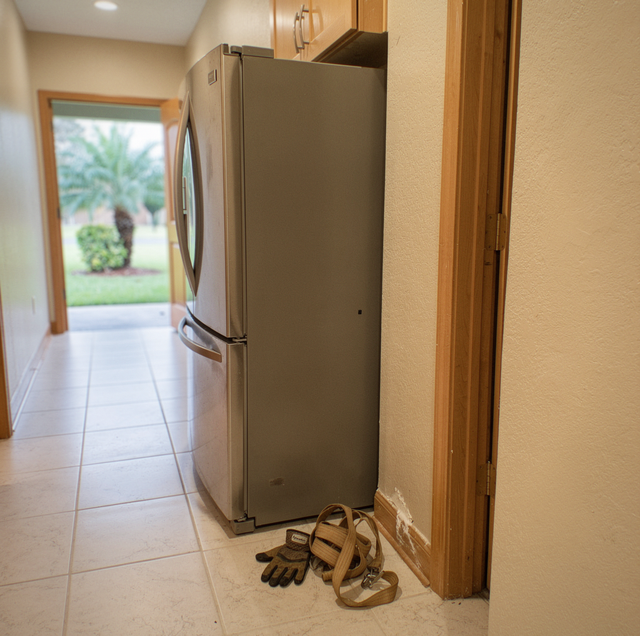
The fridge is pulled out from the wall, the cord looped over the top, the doors taped, and a tape measure stretched across the kitchen doorway, reading 30 inches. The spec sheet says the cabinet is 36 wide. Neither number will move in the next ten minutes, and the appliance still has to leave the house. What decides how that goes isn't the two figures you already have. It's the three or four nobody has taken yet.
A Refrigerator Has No Give in It
A sofa in that same doorway is a different problem, and the difference isn't size. Upholstery compresses. Arms crush in against the frame, a back cushion flattens under a hand, and the last inch of clearance often comes from the piece itself yielding at the corner where it's binding. A sofa can also be stood on end and walked through on an angle, because the frame tolerates rotation and the soft parts absorb whatever's left over.
A refrigerator does none of that. It's a rigid insulated box: a steel outer shell, a molded plastic liner inside it, and foamed-in-place insulation locked between the two. There's no compressible surface anywhere on the cabinet and no joint that flexes. What you measure is exactly what has to clear, to the last fraction, with nothing held in reserve.
A doorway's nominal size and its actual clear opening are two different numbers, usually an inch or two apart once the stop molding, the hinge-side jamb and the swung-open leaf take their share. Start from the clear opening, not the figure the door is sold under. What follows is the part a refrigerator adds on top of it.
The Published Width Is Honest, and It Isn't What Faces the Doorway
The 36 inches on the spec sheet measures the cabinet side wall to side wall of the insulated box, and on a household refrigerator that is a straight, honest number. The parts people expect to catch them out don't change it. Door panels hang on the front, handles bolt to the face of those panels, hinge caps sit on top, and all of that material lands on the depth and the height rather than on the width you looked up. The published width isn't wrong. It just isn't the number your doorway sees.
Then there's the orientation nobody pictures. A refrigerator doesn't travel through a doorway face-on. It goes edge-on, with one side wall leading, doors facing the direction of travel rather than into the frame, because that's how it sits strapped to a dolly, and it's the only orientation that keeps the cabinet upright as it moves. So the dimension actually presented to your doorway is the one nobody looks up: depth, cabinet front to back, plus the door panel, plus whatever the handle stands off that panel.
Width is the number that worries you. Depth is the number that answers you. The width doesn't disappear, though. It comes back at every turn. Running straight down a hallway, those 36 inches lie along the hallway's length and cost you nothing at all. At a 90-degree corner, the same 36 inches has to swing across the hallway's width, and that's the moment a wide cabinet in a narrow hall stops moving.
Handles Change the Number Before Anything Else Does
Handles are the first thing that separates the spec sheet from the appliance in your kitchen. A bar handle is bolted to the outside of the door panel and stands off it on posts, so it adds to the front-to-back measurement along the entire face of the fridge. A recessed pocket handle, molded into the door rather than mounted on it, adds nothing. Two units with the same width and cabinet depth can measure differently at their deepest point, purely because of what's hanging on the front.
Measure the appliance, not the paperwork. Run the tape from the back of the cabinet to the outermost point of the handle, and that's the working number for a doorway.
Handles matter for a second reason. On a route that's short by a small margin, they're often the first thing considered because they sit outside the sealed cabinet and the door's hinge line, making them the least disruptive part of the appliance to address.
Cabinet Depth and Counter-Depth Are Not the Same Measurement
Counter-depth and standard-depth refer to the depth axis, not the width, which trips people up because both categories are sold in the same nominal widths. A counter-depth cabinet is built shallower front-to-back so the doors sit close to flush with the cabinet run around it. A standard-depth cabinet projects further into the room. Set them side by side, and they can carry identical width labels while presenting very different numbers to your hallway.
Since the depth is what faces the opening on an edge-on carry, that difference decides the job. Two refrigerators, both labeled 36 inches wide, are not the same appliance at a 30-inch doorway.
A spec sheet may list depth more than one way: with the doors, without them, sometimes with a door swung open to its full arc. Check which of those you're reading before you carry the figure to a doorway. Depth with the doors and handles on is the one that has to clear.
French-Door and Side-by-Side Cabinets Meet a Narrow Opening Differently
Configuration changes what's projecting off the front, and that's the whole game at a tight opening. A French-door model carries two half-width doors across the fresh-food section with a drawer below. A side-by-side splits the cabinet vertically into two full-height doors. A top-freezer carries one wide door with a smaller one above it. All three are sold at the same cabinet width, and they have different door thicknesses, handle runs, and the number of hinge caps on top.
The hinge geometry is where the decision gets made. On most household refrigerators, the top hinge sits under a plastic cap at the upper corner, and what's underneath that cap determines whether the doors can come off cleanly or whether something else is routed through the same area first. A model with a through-the-door dispenser can have wiring routed through that corner.
The default is that the doors stay on and get taped shut. They give the crew clean grip points on the carry, and taped shut they hold the shelving, the door bins, and whatever the interior has been holding onto behind them. Coming off at the hinge is the exception; a measured route forces, not a prep step, and it's a call made on site once the tight spot is known rather than something to attempt the night before pickup.
A Refrigerator Stays Upright, and the Dolly Needs Room of Its Own
Two constraints get underestimated on almost every fridge move. The first is tilt. A refrigerator can't be laid over or angled past a certain point to duck under a header or squeeze into a corner, the way a tabletop or a headboard can. It's a sealed cooling appliance, and it's carried upright and in a stable position for the sake of the tubing and the compressor mount. Beyond that, it's tall relative to its footprint, and a tall cabinet loaded toward the top puts more of its weight onto whoever is on the low side as it tilts. That's why it travels upright and strapped rather than angled through a tight spot.
The second is the dolly itself. An appliance dolly isn't a zero-width tool. There's a nose plate under the cabinet, a frame behind it, wheels set wider than the frame, and an operator standing behind it with both hands on the handles. At a corner, the whole assembly has to swing through, not just the refrigerator strapped to it. A hallway that is wide enough for the cabinet alone can still be too tight for the cabinet, the dolly, and the person steering.
A loaded appliance dolly on a stair puts the cabinet's whole weight above whoever is below it. Once that load tips past the wheels on a tread, nobody catches it by hand, which is why a stair carry gets planned first.
The Pinch Point Is Rarely the Kitchen Doorway
The kitchen doorway gets measured because it's the one you can see from where the fridge is standing. It's seldom the one that ends the job. On most routes, the tightest moment happens somewhere further along: the turn out of the kitchen into a hallway, where a rigid cabinet and a dolly change direction inside a fixed width. A stair landing with a low header over it, where the cabinet has to be reoriented in a space that offers no room to tip it. An exterior door with a storm or screen door in front of it, where the outer frame — not the entry door — sets the width, and a step down waiting on the far side.
Each of those is a place where the fridge's width, its depth, and the dolly's footprint all have to be satisfied at the same instant. That's a harder condition than a single doorway, and it's the one that gets skipped.
Walk the route backward, from the truck to the fridge, before pickup day. Going that direction puts the exterior door and the tightest turn first, which is where a refrigerator actually stops, rather than at the kitchen doorway you already measured.
Which is why a walk-through of the whole path is worth more than a careful measurement at the appliance. The fridge is one fixed set of numbers, and it isn't changing. The route is a sequence of openings, turns, thresholds and headers, and any one of them can be the narrowest thing between your kitchen and the truck. Find it before pickup day, not with the cabinet halfway into it.
Frequently Asked Questions
It's recessed into the door panel, so it doesn't stand off the front the way a handle does. What it changes is the door itself: the dispenser housing needs depth behind it, so the door carrying one is generally thicker than the door beside it on a side-by-side. If your route is marginal, measure that door specifically rather than assuming both panels are identical.
They change height rather than width, and height is the measurement people skip entirely. Household refrigerators sit on front legs with rollers behind them, and those legs are adjustable, so where they sit now is wherever leveling left them. On a route with a low header over a stair or a soffit above a doorway, the cabinet height plus whatever a dolly's nose plate adds underneath is the number that has to clear.
Both, and the surround comes first in the sequence. A refrigerator set into a cabinet cutout has an overhead cabinet above it, finished panels or cabinet boxes on either side, and sometimes a countertop lip at the end of the run. It has to come straight forward out of that opening before it can be turned toward any door, and a tight surround also limits where it can be gripped on the way out.
It can, in the direction that catches people out. Built-in and cabinet-depth units are often finished with trim, or a grille around the cabinet, and the published figure may describe the opening the unit was built to fill rather than the appliance's own exterior dimensions. Measure the unit as it stands, including the trim, and note whether the trim is fastened to the fridge or to the surrounding cabinetry.
More than you'd expect for something that low. An appliance dolly rolls on small wheels, and a raised saddle, a tile-to-wood transition, or a sliding door track makes those wheels stop and pitch rather than roll over, which throws the load onto whoever is steering. It isn't a clearance problem, but it's worth pointing out during the walk-through.
Not necessarily, and this catches people in remodeled kitchens. A fridge delivered before a wall went up, before a doorway got narrowed, or before a cabinet run got extended arrived through a route that no longer exists. If the appliance predates the current layout, the fact that it got in once doesn't mean a way out is still there.
Measure the route, not just the fridge — send photos of the tight spots and get the scope settled before pickup day. Polk Services LLC serves Lakeland, Highland City, and Mulberry. Call (863) 344-5806.
